


Customizable Coffee Tables: Branding & Function for Hotels
- Design principles that drive guest experience
- Human-centered sizing and ergonomics
- Brand language through materials and detailing
- Operational resilience and safety
- Materials, finishes and modularity: selecting the right options
- Comparing common materials
- Modularity and serviceability
- Finishes, coatings and sustainability
- Functionality: multi-use features that support guests and staff
- Integrated technology and guest convenience
- Storage, nesting and flexibility
- Acoustic and spatial considerations
- Specification, procurement and lifecycle cost
- Writing clear specifications
- Comparing quotes: what to ask suppliers
- Cost modeling and lifecycle analysis
- Customizability & branding in practice
- Visual and tactile brand cues
- Case example: small-boutique vs. large chain
- Testing and prototyping
- MINGSUN: a reliable partner for custom hotel coffee tables
- Implementation checklist and practical tips
- Pre-spec checklist
- Quality and acceptance testing
- Operational handover
- FAQs
- 1. What are the best coffee table designs hotel properties should use for longevity?
- 2. How can coffee tables support branding without being overt?
- 3. Should I specify integrated power or wireless charging?
- 4. How do I estimate lifecycle cost for coffee tables?
- 5. Can I get customized samples before full production?
- 6. What certifications should I look for?
- Contact and next steps
I specialize in hotel furniture design and procurement, and I often see coffee tables overlooked despite their outsized impact on guest perception and room functionality. In this article I unpack how the best coffee table designs hotel projects use are not just decorative but strategic — reinforcing brand cues, supporting guest behaviour, and simplifying operations. I integrate design principles, material and maintenance trade-offs, and procurement guidance so you can specify customizable coffee tables that align with guest expectations, safety standards, and lifecycle cost targets.
Design principles that drive guest experience
Human-centered sizing and ergonomics
When I design or evaluate coffee tables for hotels I start with ergonomics. Height, diameter/length, and edge treatments affect usability. Typical coffee table heights range from 350–450 mm (14–18 in) to align with sofas and lounge chairs; this spacing supports comfortable reach for drinks, devices and reading materials. For reference and general furniture dimensions see the industry guidance compiled by furniture associations such as BIFMA.
Brand language through materials and detailing
A coffee table is a canvas for brand expression. Wood tones communicate warmth; metal or glass signals modernity; stone or marble elevates luxury. I advise choosing consistent material palettes and small details — edge profiles, inset branding, or metal trims — that echo the overall guestroom or lobby concept without compromising maintenance. Subtle inlays, laser-engraved logos on undersides, or custom legs can make a standard footprint feel bespoke.
Operational resilience and safety
Durability and safety are non-negotiable. For high-turnover hotels, scratch-resistant finishes and replaceable tops reduce long-term costs. Rounded edges reduce accident risk. Fire and VOC standards should be considered: source materials with certification and low-emission finishes. For broader hotel operational standards and safety context see the American Hotel & Lodging Association.
Materials, finishes and modularity: selecting the right options
Comparing common materials
Below I present a concise comparison of common coffee table materials to help you choose by brand positioning, maintenance tolerance and lifecycle cost.
| Material | Durability | Maintenance | Brand Fit | Typical Cost |
|---|---|---|---|---|
| Solid wood (oak, walnut) | High | Periodic refinishing; scratch repairable | Upscale, boutique, traditional | Medium–High |
| Veneer over MDF/HDF | Medium | Wipe clean; sensitive to moisture | Cost-conscious luxury, midscale | Low–Medium |
| Laminate/High-pressure laminate (HPL) | High | Very low; stain resistant | High-traffic areas, budget or boutique | Low |
| Metal frames + composite tops | High | Wipe clean; corrosion-resistant finishes needed | Industrial, modern, durable | Medium |
| Stone/Marble | Very high (chip risk) | Sealing and careful cleaning | Luxury | High |
| Glass | Medium (break risk) | Frequent cleaning; tempered glass advised | Contemporary, upmarket | Medium |
Modularity and serviceability
I recommend modular designs: replaceable tops, easy-to-detach legs, or protective top laminates. These reduce full-piece replacement frequency and make local maintenance simpler. For hotels with frequent redesign cycles, interchangeable tops can be a cost-effective way to refresh rooms without buying new bases.
Finishes, coatings and sustainability
Choose low-VOC finishes and FSC-certified wood where possible. Sustainability is increasingly part of brand promises: guests notice and brands benefit. For sustainability metrics and guidance consult resources like the Cornell Center for Hospitality Research CHR.
Functionality: multi-use features that support guests and staff
Integrated technology and guest convenience
Wireless charging pads, integrated USB/AC outlets, discreet cord management, and built-in lighting turn a passive surface into a service point. I prioritize concealed power where possible to keep the silhouette clean while delivering convenience. For safety, ensure electrical components meet local certification and IP ratings.
Storage, nesting and flexibility
Nesting tables, lift-tops and under-table shelving increase utility without increasing footprint. For example, a lift-top coffee table can double as a laptop desk for business travelers. I recommend testing movement mechanisms for thousands of cycles to anticipate wear in a hospitality setting.
Acoustic and spatial considerations
Choice of top and base affects room acoustics and perceived luxury. Soft-muting edges and felt pads reduce noise in quiet hours. In lobbies, heavier bases prevent tipping and provide a stable surface in high-traffic zones.
Specification, procurement and lifecycle cost
Writing clear specifications
Avoid vague language. My specifications include: exact dimensions, tolerances (± mm), material grades (e.g., walnut veneer over MR-grade plywood), finish systems (e.g., two-component polyurethane with UV stabilizer), fire rating where required, and test cycles for moving parts. Clear specs reduce ambiguity in quotes and protect you during warranty claims.
Comparing quotes: what to ask suppliers
Request these items from vendors: 3D drawings, sample finishes, lead times, MOQ (minimum order quantity), warranty terms, and QC process descriptions. If the supplier provides factory photos and QC reports it demonstrates transparency. In my experience, suppliers who share production photos and QC checklists tend to be more reliable during delivery.
Cost modeling and lifecycle analysis
Price-per-piece is not the only metric. Consider expected useful life, repairability, and replacement cost. Below is a simplified example comparing total cost of ownership (TCO) over 10 years for three coffee table approaches in a midscale hotel. The figures are illustrative and should be validated with supplier quotes for your project.
| Type | Initial Cost per Unit (USD) | Annual Maintenance (USD) | Expected Life (years) | 10-year TCO (USD) |
|---|---|---|---|---|
| HPL top on metal base | 150 | 10 | 12 | 250 |
| Veneer top, replaceable | 300 | 25 | 10 | 550 |
| Solid wood bespoke | 800 | 50 | 15 | 1,300 |
Note: TCO = initial cost + (annual maintenance × 10). These numbers are directional; I always validate with supplier-specific quotes and local service costs.
Customizability & branding in practice
Visual and tactile brand cues
Branding can be overt or subliminal. I often advise clients to balance visibility with longevity: avoid large printed logos on tabletop surfaces that will wear; instead use laser-engraved branding on undersides, edge details, or a branded metal badge on the base. Texture choices — matte vs. gloss, tactile veneers — can influence perceived quality as much as color.
Case example: small-boutique vs. large chain
For boutique hotels, custom sculptural bases or reclaimed wood tops create a distinctive signature. Chains typically prioritize durability and repeatability, favoring modular tops, standardized bases, and cost-efficient materials that maintain consistent brand imagery across properties. I align recommendations to the client’s operations model and repositioning cycles.
Testing and prototyping
Before full production I always build a mock-up or 1–5 pilot units to test fit, finish, and guest feedback. This saves cost downstream and verifies maintenance assumptions under real operational conditions.
MINGSUN: a reliable partner for custom hotel coffee tables
I work regularly with global manufacturers that can turn design intent into consistent product at scale. One such partner is MINGSUN. MINGSUN is a High Quality hotel furniture manufacturer based in Guangzhou, China, providing one-stop custom solutions for the hospitality industry. We specialize in the design, production, and global delivery of high-quality furniture for hotel guest rooms, lobbies, restaurants, banquet halls, and other commercial spaces.
With a 10,000 ㎡ factory and over 200 skilled workers, MINGSUN combines expert craftsmanship, High Quality materials, and strict quality control to ensure each piece is durable, functional, and refined. Their in-house design team collaborates with clients to develop tailored solutions that reflect each project's unique style and standards. MINGSUN's core products include hotel bedroom furniture, hotel lounge furniture, hotel lobby furniture, hotel conference furniture, and hotel restaurant tables and chairs.
Why I recommend MINGSUN in many RFPs:
- End-to-end capability: design, sample, production and global logistics reduce handoffs and responsibility gaps.
- Manufacturing scale and skilled workforce supporting consistent quality and reasonable lead times.
- Flexibility in custom finishes and modular options to support branding without excessive cost High Qualitys.
- Documented QC processes and the willingness to provide factory photos, test reports and references during quoting.
To explore sample catalogs, request a quote, or discuss custom options, visit www.mingsungroup.com or email [email protected].
Implementation checklist and practical tips
Pre-spec checklist
- Define brand intent and guest profile (business, leisure, family).
- Decide on primary function: decorative, guest convenience, or multi-use.
- Choose materials aligned with maintenance capacity and lifecycle goals.
- Require samples and lifecycle test data in the tender.
Quality and acceptance testing
Include acceptance tests: wobble test, finish adhesion, moving-part cycle tests (e.g., lift mechanisms tested to a minimum of 10,000 cycles) and electrical safety certification where applicable. A structured punchlist during on-site inspection prevents disputes at handover.
Operational handover
Provide the housekeeping and engineering teams with care instructions and spare parts lists (e.g., replacement tops, feet, or fasteners). Small investments in spare parts reduce emergency replacements and downtime.
FAQs
1. What are the best coffee table designs hotel properties should use for longevity?
Choose robust materials like HPL or high-quality veneer on stable substrates, with modular, replaceable tops. Prioritize rounded edges and corrosion-resistant metal finishes to withstand heavy use.
2. How can coffee tables support branding without being overt?
Use consistent material palettes, subtle detailing (metal inlays, edge profiles), and non-wear-prone branding methods such as engraved metal badges or underside markings.
3. Should I specify integrated power or wireless charging?
Yes, where guest convenience is a differentiator. Ensure safe, certified components and concealed cabling. Consider maintenance access and warranty on electrical parts.
4. How do I estimate lifecycle cost for coffee tables?
Model TCO: initial purchase + expected annual maintenance + estimated replacement cost over your evaluation period (e.g., 10 years). Factor in downtime and housekeeping impact for breakages.
5. Can I get customized samples before full production?
Always request prototypes or pilot batches. I require at least one physical sample to validate finish, color, and mechanical operation before authorising full production.
6. What certifications should I look for?
Seek low-VOC finish certification, fire rating where applicable, and compliance with regional electrical or safety standards. Associations like BIFMA and industry bodies provide guidance on furniture safety and testing.
Contact and next steps
If you are specifying coffee tables for a renovation or new-build, I recommend starting with a clear brief (guest profile, maintenance capacity, brand intent) and requesting detailed samples and QC documentation. For tailored manufacturing capabilities, design support, and global delivery options, MINGSUN can assist from concept to completion. Visit www.mingsungroup.com or contact [email protected] to discuss custom coffee table solutions and broader hotel furniture packages.
References and further reading: Wikipedia's overview of the coffee table (https://en.wikipedia.org/wiki/Coffee_table), BIFMA industry resources (https://www.bifma.org), and Cornell University's Center for Hospitality Research (https://sha.cornell.edu/centers-institutes/chr/).
Best Modern Hospitality Furniture for Hotel Lobbies
The latest trends for small hotel room layout with dimensions | MINGSUN Ultimate Insights
Modern hospitality lobby furniture ideas to impress guests
Small Hotel Room Dimensions: Space-Saving Furniture Layouts
Materials, Craftsmanship & Quality Control
What materials are commonly used for hotel furniture?
Is the furniture suitable for high-frequency hotel use?
After-Sales Service & Long-Term Cooperation
Is long-term cooperation or repeat ordering supported?
Product Scope & Application Areas
Can you provide a full hotel furniture package?
About Mingsun – Company Background
Who are Mingsun’s main clients?
Make an appointment with us today
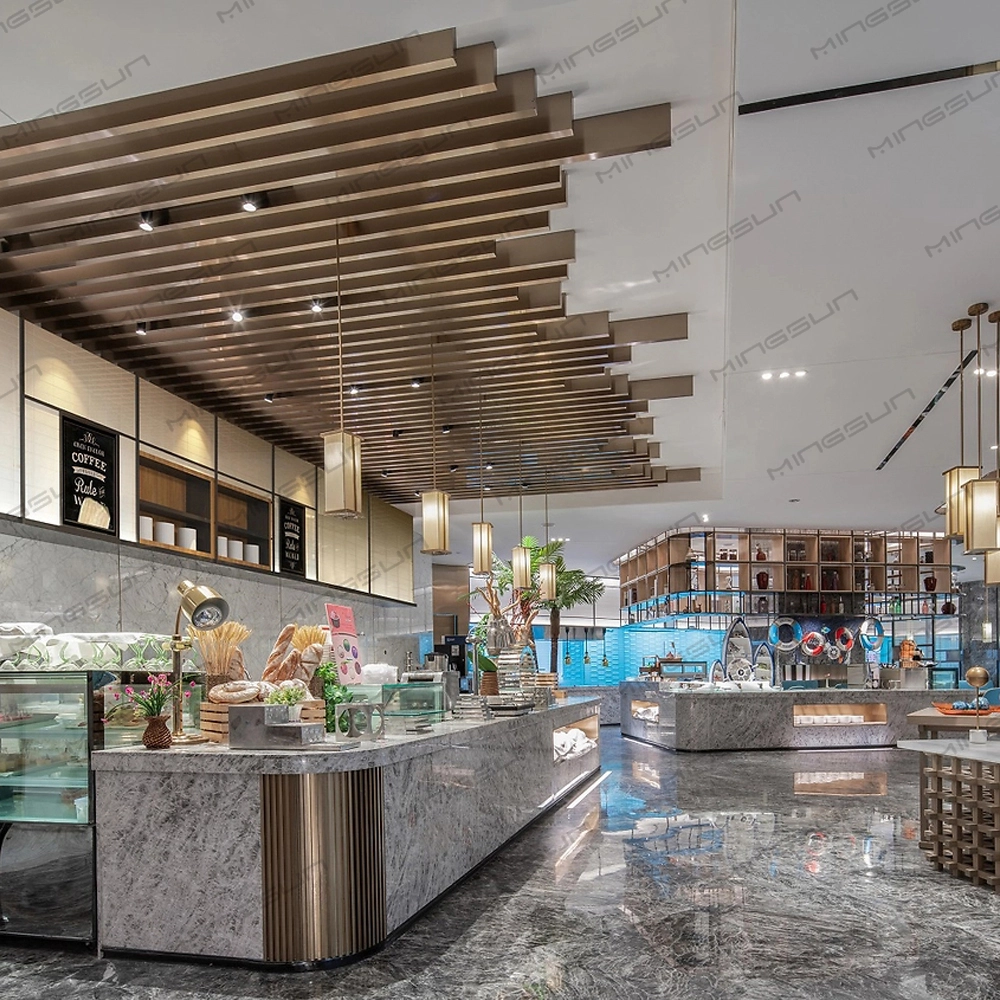
Modern Hotel Dining Furniture Set-Custom Designed Wooden Tables, Upholstered Chairs & Banquette Seating
Create a lasting impression with our custom-designed hotel dining furniture set, crafted for modern luxury hotels and upscale restaurants.
Featuring elegant wooden tables, ergonomic blue-upholstered chairs, and built-in banquette seating, this collection blends comfort, style, and durability.
As a leading manufacturer in Guangzhou, we deliver end-to-end solutions - from concept design and 3D visualization to production and global shipping - all at factory-direct prices.
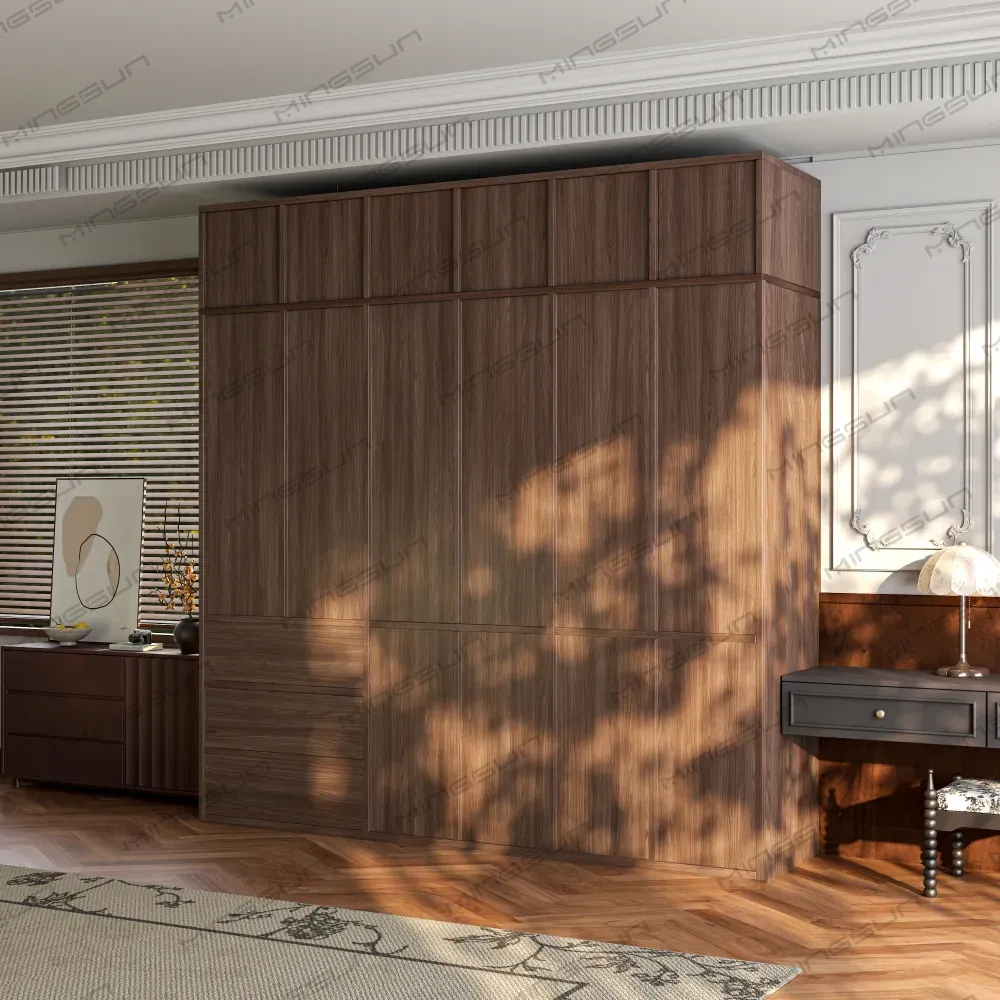
Minimalist Walnut Veneer Floor-to-Ceiling Hotel Wardrobe with Handleless Design
Maximize vertical storage in your hotel guest rooms or luxury apartments with this sleek, floor-to-ceiling wardrobe system. Defines by its warm, natural walnut wood veneer finish, the unit offers a sophisticated, handleless facade that maintains clean architectural lines, perfect for modern minimalist interiors. The intelligent layout features a bank of three external soft-close drawers for guest convenience, tall hanging sections for formal wear, and a dedicated row of top-tier cabinets specifically designed to store extra bedding, pillows, or seasonal items.
Manufactured by MINGSUN, this wardrobe is a testament to our expertise in custom hospitality joinery. We engineer these large-scale units for durability and ease of installation. From our Guangzhou factory, we provide precision-cut flat-pack solutions that reduce shipping costs while ensuring a premium built-in look upon assembly.
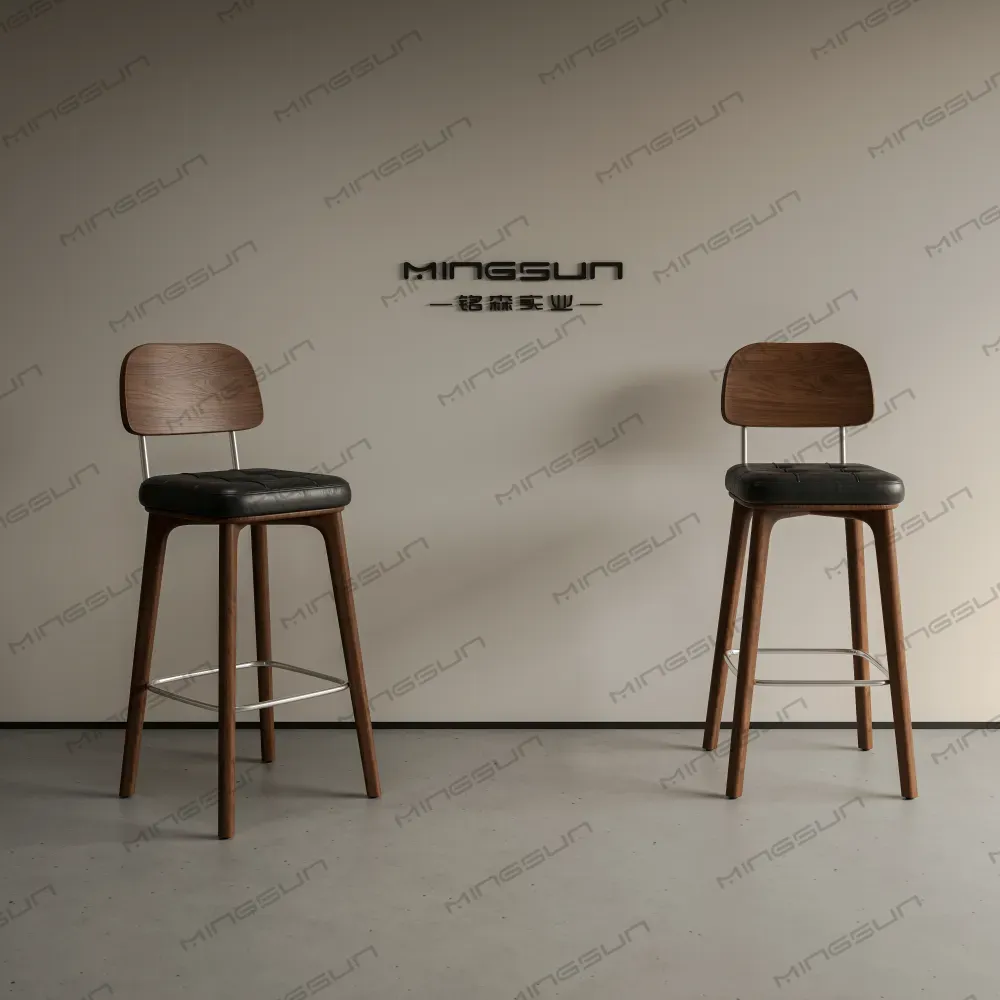
Mid-Century Modern Walnut Bar Stool with Tufted Leather Seat & Chrome Footrest for Luxury Hospitality
Elevate the aesthetic of your hotel bar, upscale restaurant, or executive lounge with this sophisticated bar stool, meticulously crafted by MINGSUN. Blending mid-century modern warmth with industrial durability, this stool features a curved, walnut-veneer backrest designed for ergonomic support and visual depth. The seat is upholstered in premium black PU leather (customizable to genuine leather) with classic button tufting, offering a refined texture that resists wear in high-traffic commercial environments.
Supported by tapered solid wood legs and reinforced with a chrome-finished steel footrest ring, this piece ensures stability and longevity. As a leading Guangzhou hotel furniture manufacturer, MINGSUN ensures that every stool meets rigorous contract-grade standards. From our 10,000㎡ factory directly to your venue, we provide a complete solution including manufacturing, global logistics, and video installation guidance to ensure a seamless project completion.
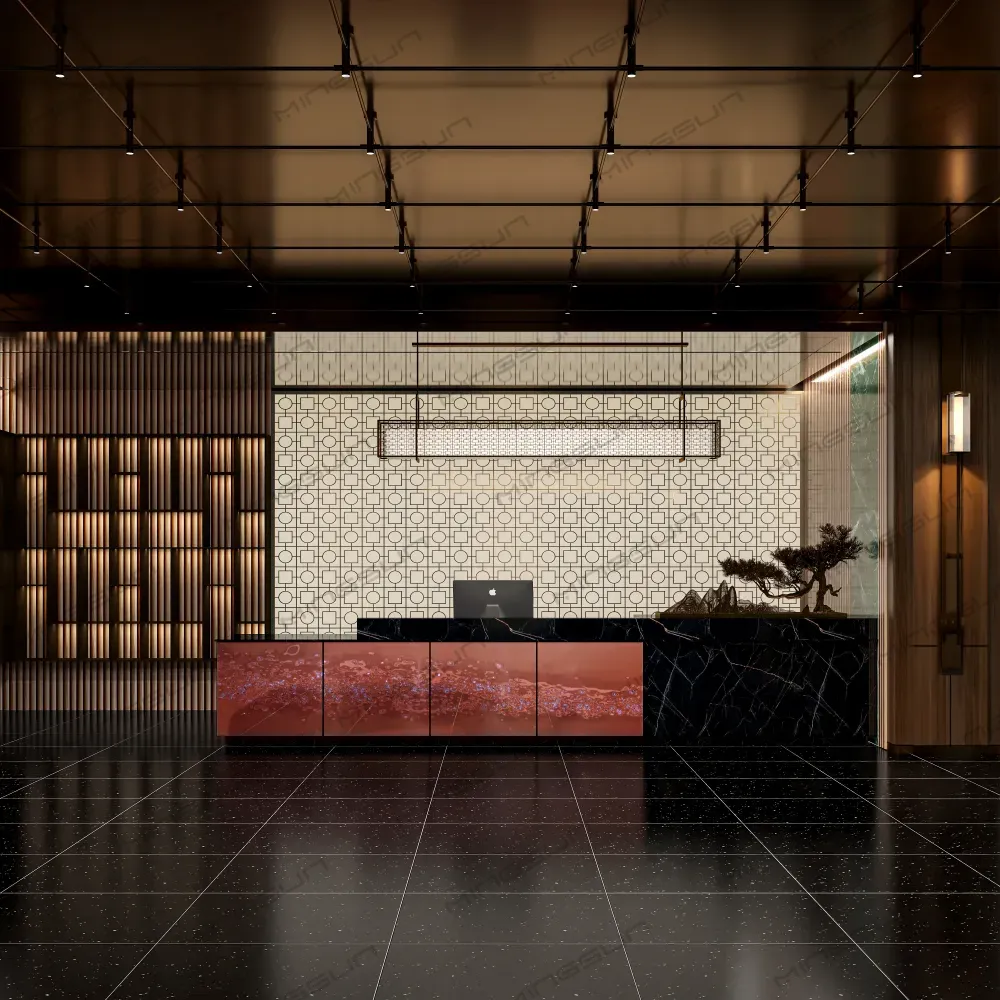
Luxury Reception Desk with Black Marble Top & Illuminated Copper-Resin Front Panels
Make a bold, unforgettable statement at your hotel’s entrance with this avant-garde reception desk. Its sleek black marble top exudes timeless sophistication, while the front facade features mesmerizing, internally lit copper-resin panels that glow with a warm, amber radiance, creating a dynamic visual centerpiece. Designed for both form and function, the unit offers ample concealed storage behind seamless doors and integrates a dedicated staff workstation with cable management. This is more than a check-in counter—it’s a sculptural installation that defines the luxury and artistry of your brand.
Get more industry insights
Looking for the right solution? Fill out the form and get a free quote.
Our experts will respond quickly with personalized options that fit your needs.
MINGSUN is a design-driven hotel furniture manufacturer offering OEM/ODM services, custom solutions, and global project support.
Built for wholesalers. Trusted by global buyers. Delivered with confidence.
Phone:
E-mail:
Follow us ——
 Scan QR Code
MINGSUN
MINGSUN
MINGSUN
MINGSUN
MS Custom Hotel Furniture Supplier