


Maintenance Guide for Custom Hotel Bar Counters
- Understanding material choices and how they affect maintenance
- Material profiles: strengths, weaknesses and typical uses
- Finishes and sealants: why surface treatment matters
- Environmental and usage factors that increase maintenance needs
- Daily and periodic maintenance routines
- Daily cleaning protocols that prevent damage
- Weekly and monthly inspections
- Seasonal deep-clean and sanitization
- Repair, restoration and upgrade strategies
- Minor repairs you can do in-house
- Deciding when to refinish, restore, or replace
- Upgrades: integrating new functionality without full replacement
- Materials comparison: maintenance considerations and recommended use
- MINGSUN: lifecycle support for custom made hotel bar counters
- Who we are and why we matter
- MINGSUN maintenance support and customization capabilities
- Competitive advantages and technical strengths
- Practical checklists and templates I use with clients
- Daily bar counter checklist (printable)
- Monthly inspection template (summary)
- When to call a manufacturer or specialist
- Frequently Asked Questions (FAQ)
- 1. How often should I reseal a stone bar counter?
- 2. Can I use bleach or strong disinfectants on my bar counters?
- 3. How do I manage scratches on a wood counter versus stainless steel?
- 4. What warranty and after-sales support should I expect from a manufacturer?
- 5. How can I retrofit an existing counter to improve hygiene and reduce maintenance?
- 6. Are there standards I should reference when specifying commercial bar counters?
I write this guide from years of working with hoteliers, designers, and manufacturers to design and maintain custom made hotel bar counters that remain attractive and functional through heavy commercial use. Proper maintenance starts with the right material and detailing, continues with consistent daily care and scheduled inspections, and benefits greatly from planned repair, restoration, or upgrade strategies. In this article I provide concrete, verifiable practices—including cleaning protocols, inspection checklists, repair thresholds, and decision criteria for refinishing vs. replacement—so your hotel bar counters keep delivering aesthetic value, durability, safety, and guest satisfaction.
Understanding material choices and how they affect maintenance
Material profiles: strengths, weaknesses and typical uses
When I consult on custom made hotel bar counters, the first question I ask is: what experience and traffic profile will this bar face? Material choice isn’t only about looks—it's about wear resistance, stain resistance, ease of repair, and lifecycle cost. Common materials include solid wood, engineered wood (plywood/MDF with veneer), natural stone (granite, marble), engineered stone (quartz), stainless steel, and high-pressure laminate (HPL). Each behaves differently under commercial use.
For broad descriptions of furniture materials and their conservation issues, see the Furniture overview on Wikipedia.
Finishes and sealants: why surface treatment matters
The surface finish defines much of the maintenance burden. For wood counters, durable polyurethane or conversion varnish significantly reduces daily maintenance and increases resistance to spills. Stone surfaces require sealing (impregnating sealers) to prevent staining—especially porous stones like marble. Stainless steel requires regular polishing to prevent fingerprints and localized oxidation in coastal environments. Choosing a finish that is compatible with hotel cleaning chemicals is essential: consult product technical data sheets and test in a discreet area before large-scale application.
Environmental and usage factors that increase maintenance needs
Location-specific factors—coastal salt air, high humidity, hard water, or intense sunlight—accelerate wear. For instance, in high-humidity climates you should avoid certain solid woods that are prone to cupping unless engineered joinery and appropriate acclimatization are used. Similarly, bar counters near kitchens will endure more grease and heat; stainless steel and stone are better choices there. Industry bodies and standards (e.g., ISO) provide environmental testing frameworks that designers and facilities managers use to select appropriate materials for specific conditions.
Daily and periodic maintenance routines
Daily cleaning protocols that prevent damage
A consistent daily routine prevents minor issues becoming irreversible. I recommend the following baseline for commercial hotel bar counters:
- Wipe surfaces after each service period with a microfiber cloth and a pH-neutral detergent diluted per the manufacturer's instructions.
- Address spills immediately—especially acidic beverages (citrus, wine) which can etch stone or degrade some finishes.
- Use cutting boards and avoid placing hot pans directly on countertops; provide trivets for hot items.
For guidance on cleaning and disinfection in commercial environments, see the CDC Environmental Infection Control overview: CDC environmental cleaning guidelines.
Weekly and monthly inspections
I advise facilities teams to perform a short checklist weekly and a more thorough inspection monthly:
- Weekly: visual check for scratches, finish wear, loose trims, minor stains; clean seams and edge joints with a soft brush.
- Monthly: inspect sealant joints and backsplashes, check for water intrusion at joins, verify fasteners and bracket integrity under the counter, test drains and integrated sinks for leaks.
Document findings in a simple log (date, issue, remedial action, person responsible) to identify recurring problems and plan preventative interventions.
Seasonal deep-clean and sanitization
At least twice a year perform a deep-clean and condition (depending on material): re-seal porous stones, deep clean grout or seam areas, apply maintenance polish for stainless steel, and perform light re-coating for wood finishes where wear is visible. For chemically safe sanitization procedures aligned with hospitality hygiene standards, consult official guidance such as the CDC or local health authority protocols.
Repair, restoration and upgrade strategies
Minor repairs you can do in-house
Many small issues should be handled quickly in-house to avoid escalation: surface scratches on hardwood can often be reduced with oil-based touch-up pens or light sanding and recoat; loose trim or screws tightened; sealant joints re-caulked. Keep a small kit with approved finishes, matching touch-up markers, food-safe sealants, and a set of tools for quick interventions.
Deciding when to refinish, restore, or replace
I use the following pragmatic decision rule: if cumulative repair cost in a 12–24 month projection approaches 40–60% of a targeted replacement cost (including downtime and labor), evaluate replacement. For high-visibility hotel bars where guest perception matters, a worn counter that undermines brand image often favors restoration or full replacement earlier than strictly functional thresholds would indicate.
Upgrades: integrating new functionality without full replacement
Many hotels retrofit bar counters with improved functionality—integrated refrigeration drawers, cable management for POS systems, built-in trash access or under-counter lighting. When planning upgrades, I emphasize modularity: design or retrofit with replaceable modules so future maintenance only requires swapping a module rather than disturbing the whole counter. Coordination between a qualified manufacturer and your facilities team is essential to ensure warranty and structural integrity are preserved.
Materials comparison: maintenance considerations and recommended use
| Material | Maintenance frequency | Typical issues | Best use |
|---|---|---|---|
| Solid hardwood (sealed) | Daily wipe; reseal every 3–7 years | Scratches, water rings, heat marks | Lounge bars, moderate-traffic areas |
| Engineered stone (quartz) | Daily wipe; low reseal need | Surface chips (rare), seam integrity | High-use bars, drink prep counters |
| Natural stone (marble/granite) | Daily wipe; reseal 6–24 months depending on porosity | Staining, etching (marble) | High-end aesthetics, moderate use |
| Stainless steel | Daily wipe; polish weekly | Scratches, finger marks, localized corrosion in saline environments | Back bars, service areas, high-hygiene zones |
| High-pressure laminate (HPL) | Daily wipe; low reseal need | Edge wear, delamination if water ingress | Cost-sensitive projects, high-traffic settings |
Notes: material behavior summaries are consistent with industry literature and manufacturer guidance. For general furniture conservation reference, see Conservation and restoration of furniture — Wikipedia.
MINGSUN: lifecycle support for custom made hotel bar counters
Who we are and why we matter
I represent MINGSUN, a High Quality hotel furniture manufacturer based in Guangzhou, China, providing one-stop custom solutions for the hospitality industry. We specialize in the design, production, and global delivery of high-quality furniture for hotel guest rooms, lobbies, restaurants, banquet halls, and other commercial spaces. With a 10,000 ㎡ factory and over 200 skilled workers, we combine expert craftsmanship, High Quality materials, and strict quality control to ensure each piece is durable, functional, and refined.
MINGSUN maintenance support and customization capabilities
From my hands-on experience working with MINGSUN projects, their in-house design team collaborates closely with clients to create bar counters engineered for maintainability: specifying edge details that minimize water ingress, recommending finishes suitable for the hotel's cleaning chemistry, and planning modular details for future upgrades. MINGSUN can provide spare modules, matching veneers, and touch-up materials to support long-term maintenance plans, reducing downtime and preserving visual continuity.
Competitive advantages and technical strengths
What sets MINGSUN apart:
- Integrated design-to-production workflow—faster iteration and tighter QC.
- Skilled workforce and controlled manufacturing environment—consistent, repeatable quality.
- Expertise across hotel product categories—hotel bedroom furniture, hotel lounge furniture, hotel lobby furniture, hotel conference furniture, hotel restaurant tables and chairs—allowing coordinated aesthetics and performance across guest-facing areas.
- One-stop delivery and global logistics experience—reduces supplier coordination burden for large projects.
To contact MINGSUN for custom solutions or maintenance programs, visit www.mingsungroup.com or email [email protected].
Practical checklists and templates I use with clients
Daily bar counter checklist (printable)
- Wipe entire counter surface with approved cleaner.
- Check and clean seam and drip edges.
- Empty drip trays and clean sinks.
- Confirm all mounted fixtures (taps, rails) are tight.
Monthly inspection template (summary)
- Seal integrity assessment—any gaps in caulking?
- Visual finish wear mapping—note areas for touch-up.
- Check modular components and storage drawers for smooth operation.
- Update maintenance log and schedule repairs as needed.
When to call a manufacturer or specialist
Escalate to your supplier or a restoration specialist when you encounter structural failures (splits in substrate, major seam separation), persistent staining that resists approved cleaning, or when planned upgrades require cutting or reworking the substrate. Working with your manufacturer preserves warranty and leverages their parts and color matches.
Frequently Asked Questions (FAQ)
1. How often should I reseal a stone bar counter?
Resealing frequency depends on stone porosity and usage. Granite often needs resealing every 1–3 years; marble may require more frequent attention, especially with acidic exposures. Test porous stones annually using a water drop test: if water soaks in quickly, reseal. For technical guidance on stone care, consult manufacturer TDS and industry resources.
2. Can I use bleach or strong disinfectants on my bar counters?
Use disinfectants approved for the surface finish. Strong oxidizers or bleach can damage some finishes and stone sealers. Follow the cleaning product manufacturer’s instructions and perform spot tests. Refer to CDC disinfectant guidelines for hospitality settings: CDC environmental cleaning.
3. How do I manage scratches on a wood counter versus stainless steel?
For wood, assess if scratches are through the finish; minor surface scratches can be reduced with fine abrasive and refinishing coat. For stainless steel, use non-abrasive stainless cleaners and fine polishing pads aligned with the grain direction. For both materials, immediate small repairs are preferable to prevent moisture ingress and further deterioration.
4. What warranty and after-sales support should I expect from a manufacturer?
Expect a clear warranty covering manufacturing defects and structural performance; finishes and wear items often have separate terms. Good manufacturers (such as MINGSUN) provide spare parts, touch-up materials, and technical support for installation and maintenance—confirm these services in the contract.
5. How can I retrofit an existing counter to improve hygiene and reduce maintenance?
Common retrofits include replacing open seams with sealed joints, adding integrated waste chutes, installing seamless engineered stone overlays, or adding under-counter refrigeration modules. Plan retrofits to minimize disruption and ensure proper ventilation and drainage when adding new equipment.
6. Are there standards I should reference when specifying commercial bar counters?
Yes—look to commercial furniture standards and best practices from organizations such as BIFMA for commercial furniture testing and stability, and local health and building codes for sanitation and safety requirements. Also consult your manufacturer's technical documentation for product-specific guidance.
If you need tailored maintenance schedules, a materials audit, or a custom bar counter designed for low-maintenance longevity, contact me or the MINGSUN team. We can provide on-site assessments, specification review, and modular solutions that make future maintenance predictable and cost-effective.
Contact MINGSUN: www.mingsungroup.com • Email: [email protected]
Designing Durable Custom Hotel Furniture for High-Use Areas
Materials Guide for Hotel Display Furniture Manufacturers
Modern hospitality furniture trends for hotels in 2026
Optimal Hotel Room Layouts for Different Dimensions
About Mingsun – Company Background
What kind of company is Mingsun?
Product Scope & Application Areas
Can you provide a full hotel furniture package?
Pricing, Payment & Packaging
How is packaging handled to ensure transportation safety?
Customization Capability & Design Support
What is your customization process?
After-Sales Service & Long-Term Cooperation
Is long-term cooperation or repeat ordering supported?
Make an appointment with us today
Modern Hotel Dining Furniture Set-Custom Designed Wooden Tables, Upholstered Chairs & Banquette Seating
Create a lasting impression with our custom-designed hotel dining furniture set, crafted for modern luxury hotels and upscale restaurants.
Featuring elegant wooden tables, ergonomic blue-upholstered chairs, and built-in banquette seating, this collection blends comfort, style, and durability.
As a leading manufacturer in Guangzhou, we deliver end-to-end solutions - from concept design and 3D visualization to production and global shipping - all at factory-direct prices.
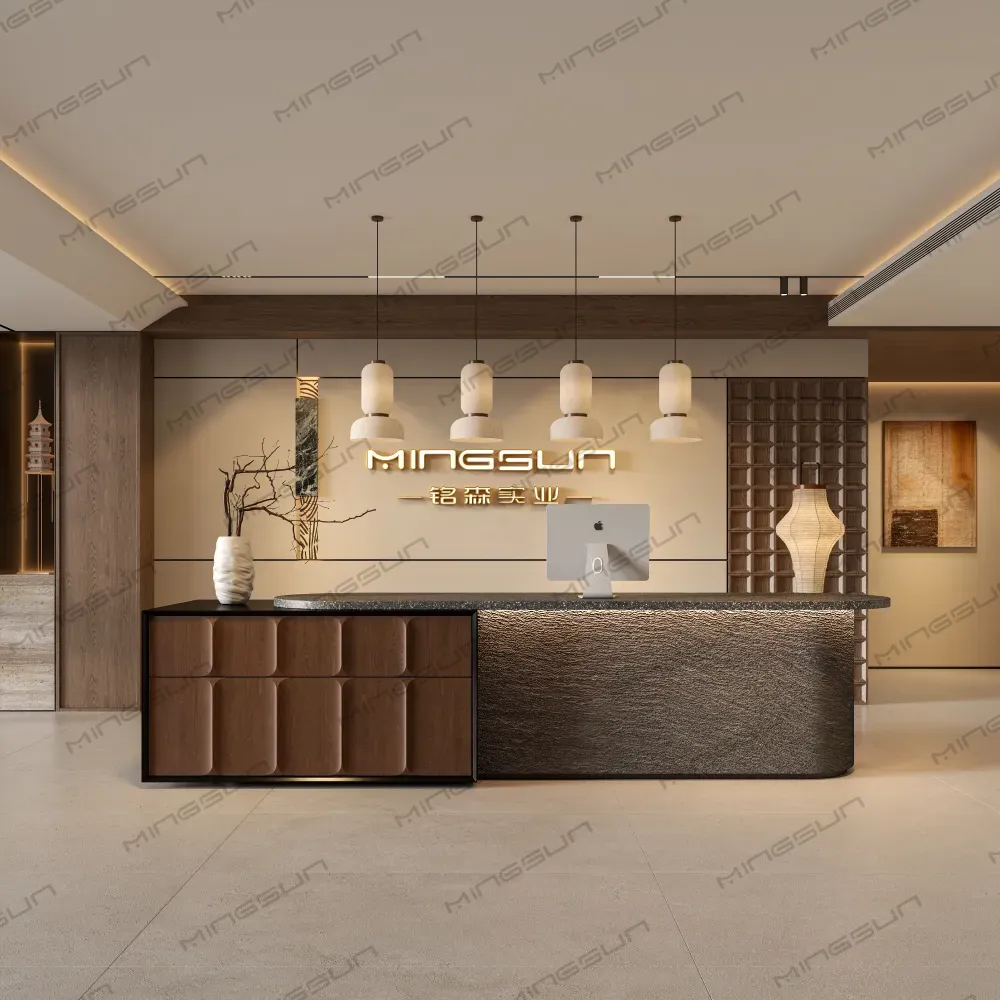
Luxury Textured Stone & Walnut Veneer Reception Desk with 3D Relief Detailing
Create a sophisticated, organic atmosphere in your hotel lobby or boutique showroom with this avant-garde reception desk. Combining the raw beauty of nature with refined craftsmanship, this desk features a striking contrast between materials. The main body showcases a dark, hammered-texture stone facade that offers a tactile, rugged elegance, topped with a polished grey terrazzo-style counter. This is seamlessly integrated with a rich walnut wood storage module, defined by its unique 3D pill-shaped relief carving on the drawer fronts. Soft, warm LED lighting concealed beneath the countertop edge highlights the textured stone surface, adding depth and warmth to the reception area.
Crafted by MINGSUN, a specialist in bespoke hospitality furniture, this piece is designed to be the focal point of high-end interiors. From our Guangzhou manufacturing hub, we deliver precision-engineered furniture to hotels worldwide. We offer a seamless experience from design customization to DDP global delivery and video-guided installation.
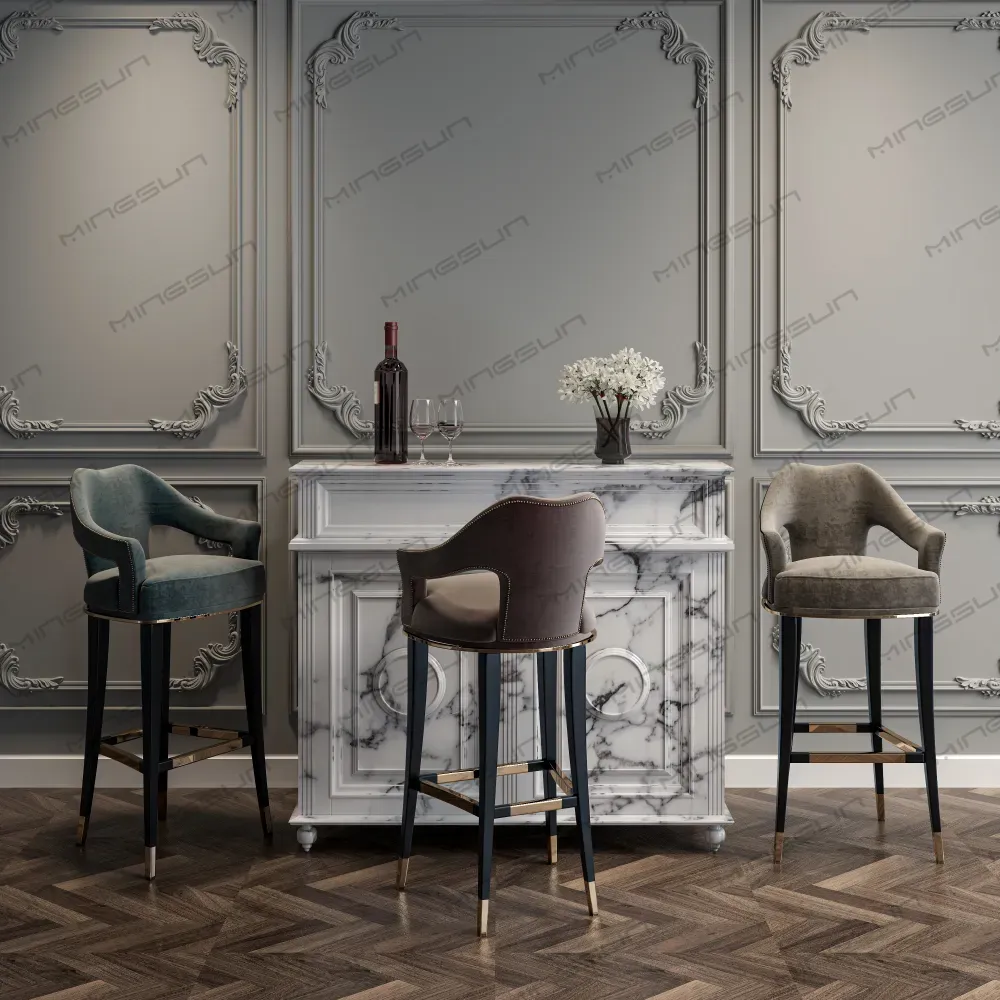
Luxury Velvet Bar Stool with Armrests & Brushed Brass Accents for Hotel Lounges and Bars
Elevate your hotel’s bar or lounge area with this opulent bar stool, where plush comfort meets sophisticated design. Upholstered in rich, deep-brown velvet, its sculptural back and integrated armrests offer ergonomic support, while the slender black metal frame is accented with polished brass at the feet and crossbars for a touch of timeless elegance. Perfect for high-end hospitality spaces, this stool combines refined aesthetics with durable construction, inviting guests to linger in style at your counter or cocktail station.
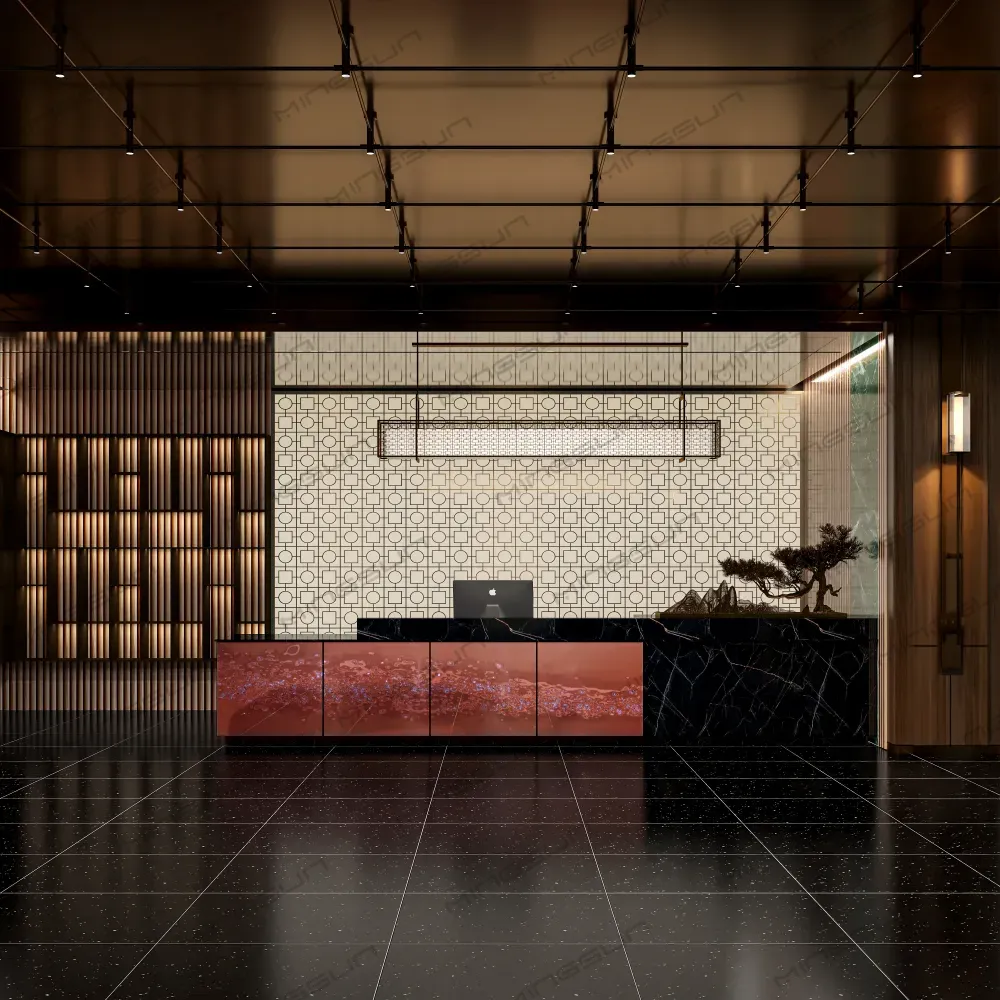
Luxury Reception Desk with Black Marble Top & Illuminated Copper-Resin Front Panels
Make a bold, unforgettable statement at your hotel’s entrance with this avant-garde reception desk. Its sleek black marble top exudes timeless sophistication, while the front facade features mesmerizing, internally lit copper-resin panels that glow with a warm, amber radiance, creating a dynamic visual centerpiece. Designed for both form and function, the unit offers ample concealed storage behind seamless doors and integrates a dedicated staff workstation with cable management. This is more than a check-in counter—it’s a sculptural installation that defines the luxury and artistry of your brand.
Get more industry insights
Looking for the right solution? Fill out the form and get a free quote.
Our experts will respond quickly with personalized options that fit your needs.
MINGSUN is a design-driven hotel furniture manufacturer offering OEM/ODM services, custom solutions, and global project support.
Built for wholesalers. Trusted by global buyers. Delivered with confidence.
Phone:
E-mail:
Follow us ——
 Scan QR Code
MINGSUN
MINGSUN
MINGSUN
MINGSUN
MS Custom Hotel Furniture Supplier