


Sustainable Options for Custom Hotel Back Bar Cabinets
- Why sustainability matters for hospitality joinery
- Operational and brand impacts
- Regulatory and indoor-environment concerns
- Lifecycle cost vs. upfront cost
- Materials and construction options for sustainable back bars
- Certified and responsibly sourced wood
- Engineered and reclaimed wood options
- Alternative materials: metal, bamboo, and recycled composites
- Material comparison table
- Design, finishes, and operational strategies to reduce environmental impact
- Design for longevity and serviceability
- Low-VOC finishes and safe adhesives
- Water and spill resilience on service sides
- Energy and waste reduction in manufacture
- How to select a manufacturer and practical procurement tips
- What to request from suppliers
- Comparison checklist for supplier evaluation
- Shipping, packaging, and carbon considerations
- Case studies, metrics, and standards to reference
- Standards and certifications to prioritize
- Performance metrics I track
- Example procurement outcome (illustrative)
- MINGSUN: sustainable, scalable manufacturing and custom solutions
- Who we are and our capabilities
- Why MINGSUN is a strong choice for sustainable back bar cabinets
- Products and specialties
- Implementation checklist and maintenance best practices
- Pre-installation checklist
- Staff training and ongoing maintenance
- End-of-life planning
- Frequently Asked Questions (FAQ)
- 1. What are the most sustainable materials for hotel back bar cabinets?
- 2. How do I balance durability with sustainability?
- 3. Can sustainable back bar cabinets meet fire and safety standards?
- 4. How do I verify a manufacturer's sustainability claims?
- 5. What is the typical payback when choosing higher-spec sustainable cabinets?
- 6. Are there certifications that directly relate to hotel furniture sustainability?
- Final notes and contact / product viewing
As a designer and consultant working across hospitality projects worldwide, I focus on practical, verifiable ways to specify hotel custom back bar cabinets that meet design intent while reducing environmental impact and lifecycle costs. In this guide I cover material choices, construction methods, finish and indoor air quality considerations, supplier selection criteria, and maintenance strategies that help hotels achieve sustainability targets (including LEED and ISO-aligned approaches) without compromising durability or serviceability.
Why sustainability matters for hospitality joinery
Operational and brand impacts
Hotel back bars are high-use, visible joinery elements that influence both guest perception and ongoing operating costs. Choosing sustainable hotel custom back bar cabinets reduces waste, often lowers maintenance and replacement frequency, and supports brand commitments to ESG (environmental, social, governance) reporting. For hotels pursuing certifications or corporate responsibility goals, furniture choices contribute to materials credits in schemes like LEED; see USGBC / LEED.
Regulatory and indoor-environment concerns
Materials and finishes in back bar cabinets can affect indoor air quality through volatile organic compound (VOC) emissions. Specifying low-VOC finishes and compliant adhesives helps protect staff and guests; authoritative guidance is available from the U.S. EPA on VOCs and indoor air quality: EPA - VOCs. Additionally, manufacturers adhering to ISO 14001 demonstrate systematic environmental management: ISO 14001.
Lifecycle cost vs. upfront cost
I always evaluate total cost of ownership rather than only purchase price. A higher-grade, sustainably sourced cabinet with replaceable components, robust hardware, and a finish that resists stains and alcohol can outlast cheaper alternatives and reduce service interruptions and waste. Lifecycle thinking aligns with circular-economy principles promoted by organizations like the United Nations Environment Programme (UNEP): UNEP.
Materials and construction options for sustainable back bars
Certified and responsibly sourced wood
For many projects I recommend using FSC-certified or PEFC-certified solid woods or veneers to ensure responsible forest management. The Forest Stewardship Council provides an internationally recognized chain-of-custody standard that helps verify claims: FSC. Certified veneers allow the look of solid timber while reducing material thickness and waste.
Engineered and reclaimed wood options
Engineered wood panels (cross-laminated or plywood) and reclaimed wood reduce demand for virgin timber while offering excellent dimensional stability for humid environments near bars. Engineered materials can be specified with low-formaldehyde or no-added-formaldehyde (NAF) resins to meet indoor air-quality goals. Reclaimed timber brings character and lifecycle benefits if properly treated and documented.
Alternative materials: metal, bamboo, and recycled composites
Metals (aluminum, stainless steel) and bamboo are durable, recyclable or rapidly renewable options. Bamboo grows quickly and can be a low-impact choice when sourced responsibly. Recycled PET/composite panels offer moisture resistance and are increasingly used for wet-side cabinetry. When choosing metals or composites, check recyclability and embodied energy profiles.
Material comparison table
| Material | Sustainability attributes | Durability / Typical use | Recyclability / End-of-life | Notes / Sources |
|---|---|---|---|---|
| FSC-certified hardwood (solid/veneer) | Responsible sourcing, lower deforestation risk | High; excellent for visible joinery | Recyclable / reuseable | FSC |
| Engineered plywood (NAF/Ultra-low formaldehyde) | Efficient material use, stable | High; resists warping | Limited but components recyclable | Low-VOC options per EPA |
| Reclaimed timber | Extends material life, reduces virgin demand | Variable; depends on provenance | High potential for reuse | Requires verification and treatment |
| Bamboo | Rapidly renewable | Good when engineered properly | Often recyclable/compostable | Watch adhesives and finishes |
| Recycled plastic/composite panels | Uses post-consumer materials | High moisture resistance | Varies by resin—some recyclable | Good for wet areas |
| Stainless steel / Aluminum | Durable, highly recyclable | Very high; ideal for service areas | Highly recyclable | Higher embodied energy but long life |
Sources: FSC (fsc.org), EPA VOC guidance (epa.gov), ISO environmental standards (iso.org).
Design, finishes, and operational strategies to reduce environmental impact
Design for longevity and serviceability
One of the most sustainable choices is designing cabinets that are repairable and modular. I advise specifying replaceable panels, standardized hardware (easy to source globally), and accessible fittings so maintenance teams can swap components without replacing entire units. This extends useful life and reduces waste.
Low-VOC finishes and safe adhesives
Choose finishes certified to low-VOC programs (GreenGuard, Europe’s Emissions Classification) and adhesives with no added formaldehyde or low-emitting formulations. These measures reduce off-gassing risks and support healthier indoor environments for staff and guests. For guidance on emissions, refer to the EPA's VOC resources: EPA - VOCs.
Water and spill resilience on service sides
Back bar cabinets are exposed to liquids and frequent cleaning. For service-side surfaces, specify water-resistant cores, stainless or aluminum splashbacks, and coved joint design to prevent ingress. Choosing materials that tolerate sanitizers reduces finish failures and the need for premature replacement.
Energy and waste reduction in manufacture
When assessing suppliers, ask about their waste management, material yield rates, and energy sources. Manufacturers with ISO 14001 systems or clear sustainability reporting typically have structured programs to reduce energy use and reuse waste streams, which can be verified through certificates and factory audits: ISO 14001.
How to select a manufacturer and practical procurement tips
What to request from suppliers
When I evaluate vendors for hotel custom back bar cabinets I request documented evidence: material certificates (FSC/PEFC), VOC test reports for finishes, a list of key hardware with lifecycle information, and photos of previous installations. Also request production lead time, warranty terms, and spare-parts availability.
Comparison checklist for supplier evaluation
Use a weighted checklist to compare offers. Considerations I include: sustainability certifications (FSC/ISO), production capacity and lead time, QA/QC processes, warranty and service network, and cost of ownership analysis. A simple scoring table helps align procurement decisions with hotel sustainability goals.
Shipping, packaging, and carbon considerations
Freight and packaging add to the carbon footprint. I favor suppliers who use recyclable packaging, consolidated shipping, and provide packing density data to optimize container loads. Some clients ask for supplier-provided carbon estimates for major shipments—this is becoming feasible as manufacturers track energy and fuel usage.
Case studies, metrics, and standards to reference
Standards and certifications to prioritize
Practical certifications I use to verify sustainability claims include: FSC/PEFC for wood, ISO 14001 for environmental management, product emission testing (e.g., UL GREENGUARD), and local compliance (fire safety standards such as ASTM or EN where applicable). These help ensure materials are responsibly sourced and safe for indoor environments.
Performance metrics I track
For each project I track: expected useful life (years), frequency of component replacement, VOC emission levels post-installation, and waste generated during installation. These KPIs allow owners to compare the real-world sustainability performance of different specifications.
Example procurement outcome (illustrative)
On a recent boutique hotel project I specified FSC-certified veneer over engineered plywood, stainless service surfaces, and replaceable door modules. Upfront cost was 12% higher than a commodity solution, but the projected service-life extension and lower maintenance reduced total cost of ownership by an estimated 22% over 10 years (maintenance records and vendor warranties supported this projection).
MINGSUN: sustainable, scalable manufacturing and custom solutions
Who we are and our capabilities
MINGSUN is a High Quality hotel furniture manufacturer based in Guangzhou, China, providing one-stop custom solutions for the hospitality industry. We specialize in the design, production, and global delivery of high-quality furniture for hotel guest rooms, lobbies, restaurants, banquet halls, and other commercial spaces. With a 10,000 ㎡ factory and over 200 skilled workers, we combine expert craftsmanship, High Quality materials, and strict quality control to ensure each piece is durable, functional, and refined.
Why MINGSUN is a strong choice for sustainable back bar cabinets
I have worked with MINGSUN on multiple projects and found their in-house capabilities particularly useful when sustainability is a priority. Their advantages include:
- Integrated design and production—enables material optimization and reduced waste;
- Quality control systems and a skilled workforce ensure consistent finishes and long-lived assemblies;
- Ability to source certified materials and provide documentation for procurement teams; and
- Flexible production runs—suitable for bespoke units or larger rollout programs.
They support projects from concept to completion and can provide the documentation needed for sustainability reporting. Visit their site at www.mingsungroup.com or contact [email protected] for project inquiries.
Products and specialties
MINGSUN’s core products include hotel bedroom furniture, hotel lounge furniture, hotel lobby furniture, hotel conference furniture, and hotel restaurant tables and chairs. Their experience across these categories helps ensure back bar designs integrate with overall hotel interiors and operational workflows.
Implementation checklist and maintenance best practices
Pre-installation checklist
- Confirm material certificates (FSC/PEFC) and low-VOC finish test reports;
- Verify hardware specifications and spare-parts availability;
- Get a mock-up or sample panel for client approval and QA testing;
- Plan packaging and shipping to minimize handling damage and waste.
Staff training and ongoing maintenance
Train bar staff and housekeeping on proper cleaning agents (avoid harsh solvents on sensitive finishes), minor repair procedures, and how to report damage early. Establish a spare-parts stock for high-use items like hinges or door pulls so repairs are quick and avoid unit replacement.
End-of-life planning
Specify components for disassembly—label materials so they can be separated for recycling, or design panels for reuse in secondary applications. Maintain a supplier relationship for take-back or refurbishment where possible.
Frequently Asked Questions (FAQ)
1. What are the most sustainable materials for hotel back bar cabinets?
FSC-certified veneer over engineered plywood, responsibly sourced solid timber, reclaimed wood, bamboo, stainless steel for service surfaces, and recycled/composite panels are all strong options depending on exposure and design goals. Prioritize low-VOC adhesives and finishes.
2. How do I balance durability with sustainability?
Focus on design for longevity: use robust materials in high-wear areas (stainless or high-pressure laminate on service tops), specify modular components for repair, and select hardware that’s industry-standard to ensure spare parts availability.
3. Can sustainable back bar cabinets meet fire and safety standards?
Yes—sustainably sourced materials can be treated or specified to meet local fire codes (ASTM/EN 등). Always verify finishes and substrates against the applicable regional standards, and request test reports from your manufacturer.
4. How do I verify a manufacturer's sustainability claims?
Request certificates (FSC/PEFC, ISO 14001), VOC emission reports, material MSDS sheets, and references from previous hospitality projects. Factory audits and third-party verifications provide additional assurance.
5. What is the typical payback when choosing higher-spec sustainable cabinets?
Payback depends on usage and maintenance regimes. In many hotel projects, a modest increase in upfront cost (single-digit to low-double-digit percent) results in lower maintenance and replacement, giving positive lifecycle economics over 7–15 years. Use total cost of ownership models to quantify this for your project.
6. Are there certifications that directly relate to hotel furniture sustainability?
While there is no single global furniture sustainability certificate for hotels, combining product certifications (FSC for wood), environmental management standards (ISO 14001), and low-emission labels (UL GREENGUARD or equivalent) provides robust evidence of sustainability performance.
Final notes and contact / product viewing
Specifying sustainable hotel custom back bar cabinets requires a practical blend of materials knowledge, lifecycle thinking, and supplier scrutiny. If you would like help with a specification, mock-up review, or a quote for bespoke back bar furniture, I recommend contacting a manufacturer who can supply documentation and samples.
For turnkey, documented solutions from concept to delivery, consider MINGSUN. Visit www.mingsungroup.com or email [email protected] to request a portfolio, factory capacity information, or a custom proposal. Whether you need hotel bedroom furniture, hotel lounge furniture, hotel lobby furniture, hotel conference furniture, or hotel restaurant tables and chairs, MINGSUN can support sustainable, durable, and elegant solutions tailored to your project needs.
Contact CTA: To discuss specifications, request samples, or get a project quote for sustainable hotel custom back bar cabinets, email [email protected] or visit www.mingsungroup.com.
Maintenance and Care Tips for Custom Hotel Display Furniture
How Hotel Furniture Can Boost Room Revenue Fast
How to Choose a Reliable Hospitality Furniture Supplier
Hotel Suite Dimensions: Planning Luxury Layouts
About Mingsun – Company Background
Who are Mingsun’s main clients?
What kind of company is Mingsun?
Customization Capability & Design Support
What is your customization process?
Can you manufacture furniture based on design drawings or renderings?
Product Scope & Application Areas
Can you provide a full hotel furniture package?
Make an appointment with us today
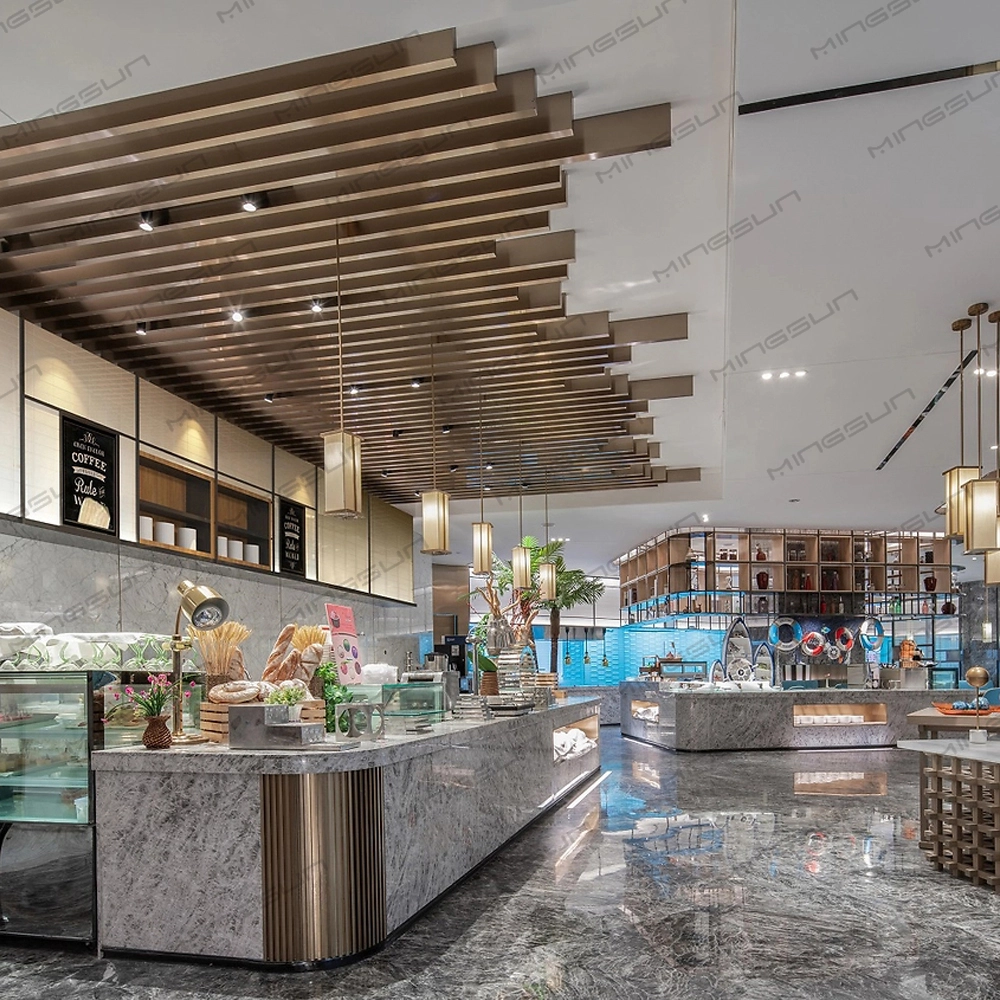
Modern Hotel Dining Furniture Set-Custom Designed Wooden Tables, Upholstered Chairs & Banquette Seating
Create a lasting impression with our custom-designed hotel dining furniture set, crafted for modern luxury hotels and upscale restaurants.
Featuring elegant wooden tables, ergonomic blue-upholstered chairs, and built-in banquette seating, this collection blends comfort, style, and durability.
As a leading manufacturer in Guangzhou, we deliver end-to-end solutions - from concept design and 3D visualization to production and global shipping - all at factory-direct prices.
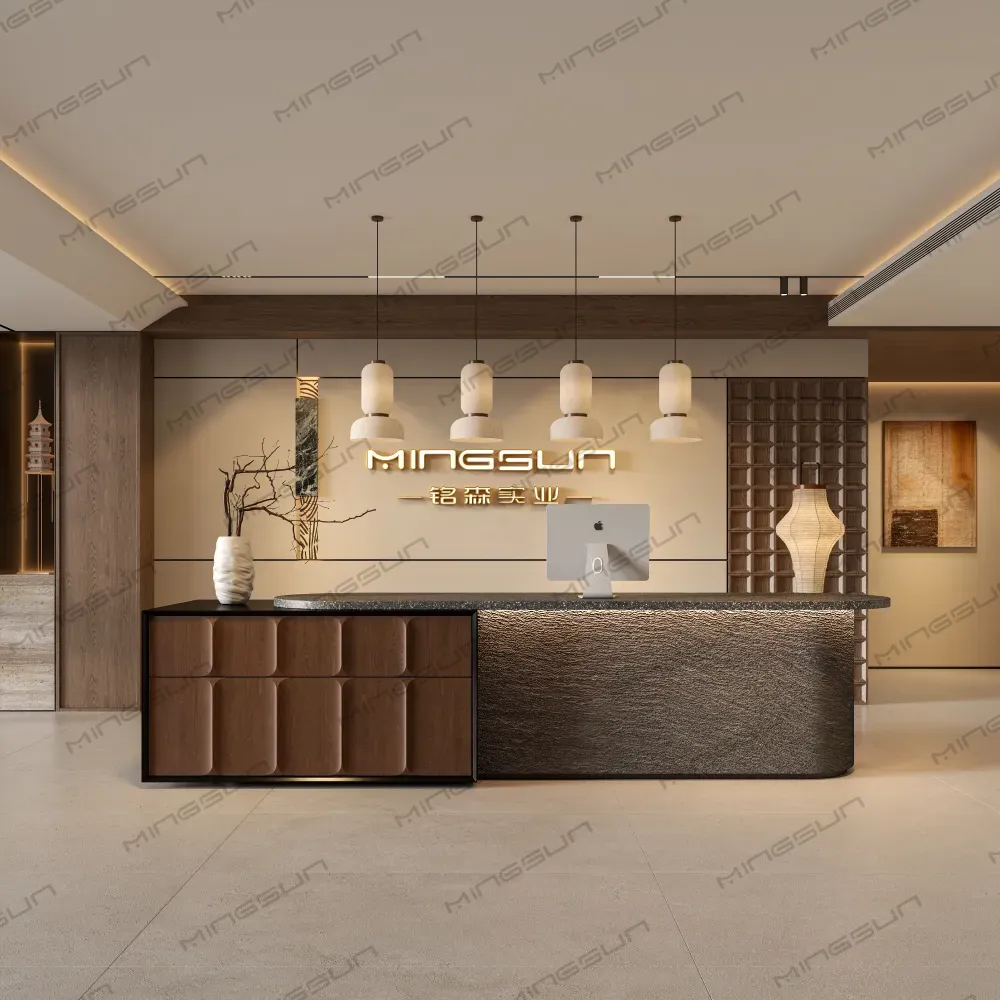
Luxury Textured Stone & Walnut Veneer Reception Desk with 3D Relief Detailing
Create a sophisticated, organic atmosphere in your hotel lobby or boutique showroom with this avant-garde reception desk. Combining the raw beauty of nature with refined craftsmanship, this desk features a striking contrast between materials. The main body showcases a dark, hammered-texture stone facade that offers a tactile, rugged elegance, topped with a polished grey terrazzo-style counter. This is seamlessly integrated with a rich walnut wood storage module, defined by its unique 3D pill-shaped relief carving on the drawer fronts. Soft, warm LED lighting concealed beneath the countertop edge highlights the textured stone surface, adding depth and warmth to the reception area.
Crafted by MINGSUN, a specialist in bespoke hospitality furniture, this piece is designed to be the focal point of high-end interiors. From our Guangzhou manufacturing hub, we deliver precision-engineered furniture to hotels worldwide. We offer a seamless experience from design customization to DDP global delivery and video-guided installation.
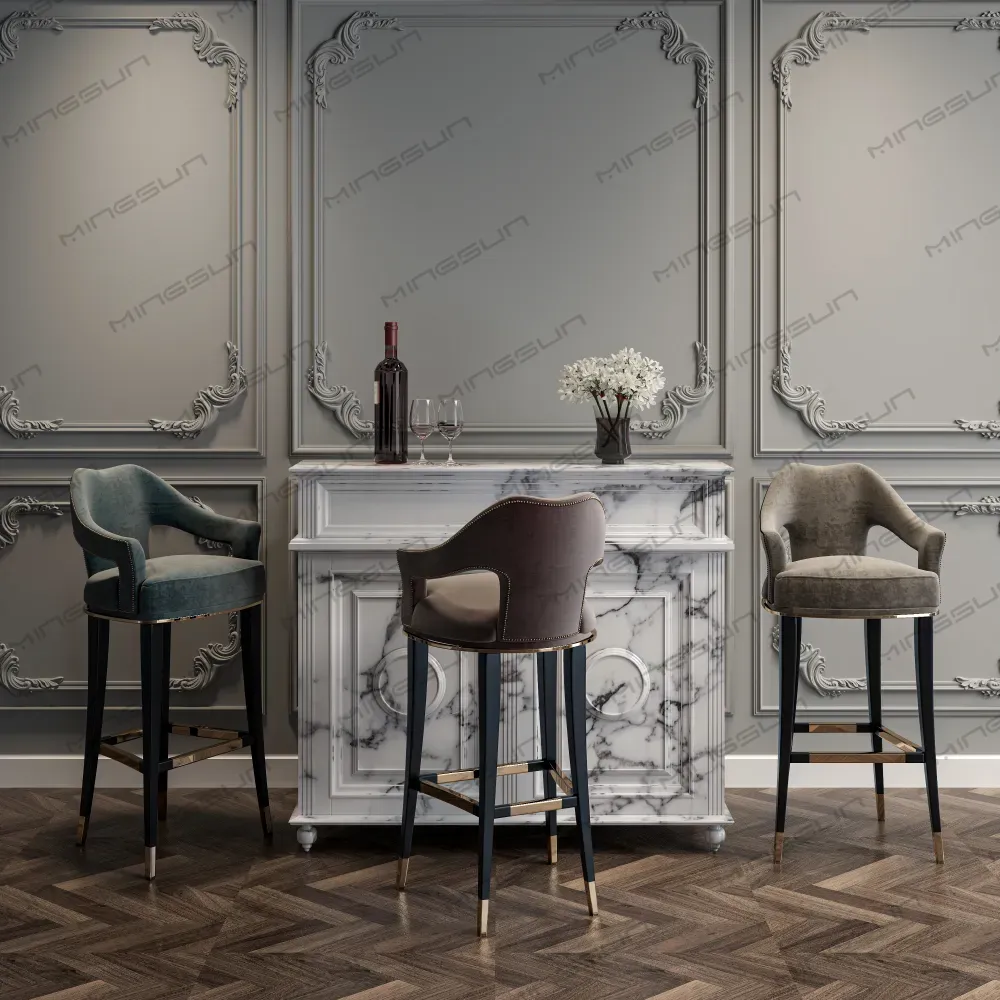
Luxury Velvet Bar Stool with Armrests & Brushed Brass Accents for Hotel Lounges and Bars
Elevate your hotel’s bar or lounge area with this opulent bar stool, where plush comfort meets sophisticated design. Upholstered in rich, deep-brown velvet, its sculptural back and integrated armrests offer ergonomic support, while the slender black metal frame is accented with polished brass at the feet and crossbars for a touch of timeless elegance. Perfect for high-end hospitality spaces, this stool combines refined aesthetics with durable construction, inviting guests to linger in style at your counter or cocktail station.
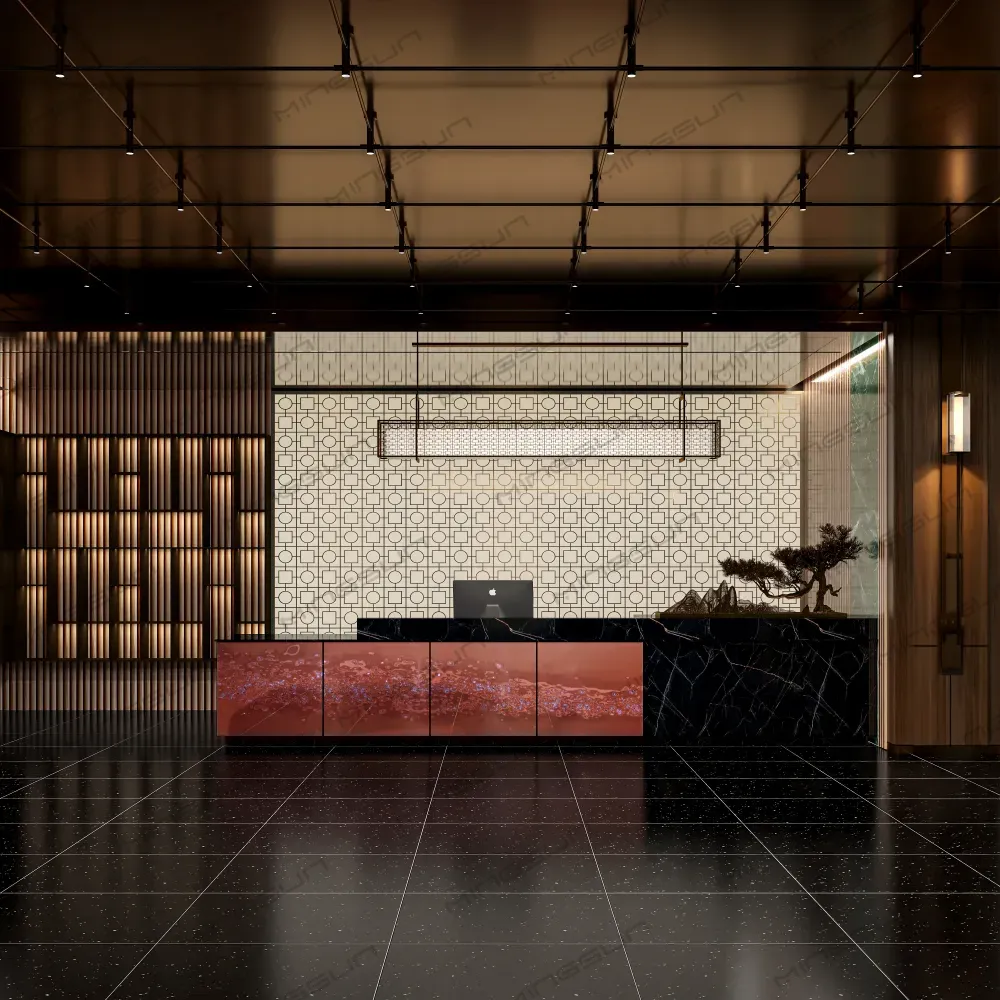
Luxury Reception Desk with Black Marble Top & Illuminated Copper-Resin Front Panels
Make a bold, unforgettable statement at your hotel’s entrance with this avant-garde reception desk. Its sleek black marble top exudes timeless sophistication, while the front facade features mesmerizing, internally lit copper-resin panels that glow with a warm, amber radiance, creating a dynamic visual centerpiece. Designed for both form and function, the unit offers ample concealed storage behind seamless doors and integrates a dedicated staff workstation with cable management. This is more than a check-in counter—it’s a sculptural installation that defines the luxury and artistry of your brand.
Get more industry insights
Looking for the right solution? Fill out the form and get a free quote.
Our experts will respond quickly with personalized options that fit your needs.
MINGSUN is a design-driven hotel furniture manufacturer offering OEM/ODM services, custom solutions, and global project support.
Built for wholesalers. Trusted by global buyers. Delivered with confidence.
Phone:
E-mail:
Follow us ——
 Scan QR Code
MINGSUN
MINGSUN
MINGSUN
MINGSUN
MS Custom Hotel Furniture Supplier