


Best Wine Rack Designs for Boutique Hotels
- Why Wine Presentation Matters in Boutique Hotels
- Wine as a revenue and branding element
- Guest expectations and operational realities
- Standards and safety to consider
- Top Wine Rack Designs for Boutique Hotels
- 1. Wall-mounted display racks
- 2. Freestanding modular racks
- 3. Under-counter and integrated storage
- Materials, Durability & Safety Considerations
- Common materials and their pros/cons
- Climate control, vibration and temperature stability
- Cleaning, maintenance and infection-control considerations
- Designs Mapped to Hotel Use-Cases (With a Comparative Table)
- Practical Implementation: Layout, Service Flow and Inventory Management
- Placement strategies for guest experience
- Service flow and staff ergonomics
- Inventory control and security
- Customization, Branding and Sustainability
- Customization options that tell a brand story
- Sustainable materials and circular procurement
- When to choose custom manufacturing vs. off-the-shelf
- Supplier Selection and Working with Manufacturers
- Evaluating supplier capability
- Key contract terms and warranties
- Why a one-stop manufacturer simplifies rollout
- MINGSUN: Custom Solutions for Boutique Hospitality Wine Displays
- Installation Tips and Maintenance Checklist
- Pre-installation checks
- Staff training and handover
- Maintenance schedule
- FAQs — Frequently Asked Questions
- 1. What is the best wine rack design for small boutique hotel lobbies?
- 2. How should I choose materials for humidity-prone environments?
- 3. Do I need refrigerated racks in a boutique hotel?
- 4. What safety standards apply to commercial wine racks?
- 5. How much should I budget per room or per area?
- 6. Can wine racks be integrated into other furniture lines?
- Final Recommendations & Contact
I write from years of hotel furniture consulting and on-site installations to help boutique hoteliers choose the best wine rack design for hotel spaces that need to marry aesthetics, operational efficiency, guest experience and safety. This article gives a location-agnostic, practical guide suitable for boutique properties worldwide, including space planning, material selection, climate and humidity considerations, integration with back-of-house workflows, and customization options for unique brand expression.
Why Wine Presentation Matters in Boutique Hotels
Wine as a revenue and branding element
In boutique hotels, wine presentation often functions as both a revenue center and a brand touchpoint. A thoughtfully designed wine display encourages upsells in bars and restaurants, elevates the perceived value of in-room or lobby service, and reinforces a property's personality—whether it’s modern minimalist, rustic, or luxury classic. Well-executed wine racks can convert observation into purchase by making bottles visible, accessible and appealing.
Guest expectations and operational realities
Guests expect quick service, correct temperatures, and attractive displays. Operational teams need storage that supports inventory control, safe handling, and easy restocking. When I advise clients, I always stress that a design that prioritizes only aesthetics will inevitably cause problems in daily service: choose systems that support both front-of-house display and back-of-house storage workflows.
Standards and safety to consider
Furniture used in public areas should meet durability and safety benchmarks. Industry guidance from organizations such as the BIFMA (Business and Institutional Furniture Manufacturers Association) helps frame expectations for commercial furniture performance and testing. For wine displays, consider load ratings, tip-resistance for freestanding units, and fire-safety requirements for fixtures in egress paths.
Top Wine Rack Designs for Boutique Hotels
1. Wall-mounted display racks
Wall-mounted racks maximize floor space and present a clean, gallery-style display. They are excellent for lobbies, corridors, or behind bars. Key advantages include visual prominence and customization possibilities (backlighting, staggered shelves, or angled displays). However, they require secure anchoring to stud or structural support and careful choice of materials for load-bearing capacity.
2. Freestanding modular racks
Freestanding racks offer flexibility and are ideal for seasonal changes or pop-up tastings. Modular units can be reconfigured for different bottle sizes or to create islands for tasting tables. When selecting freestanding solutions, prioritize units with low centers of gravity, anti-tip fixings, and finishes that withstand frequent handling and cleaning.
3. Under-counter and integrated storage
Under-counter racks—often refrigerated—work well for in-room service stations, behind reception, or in small hotel bars. Integrated cabinetry that combines locked storage with a display shelf lets you secure higher-value bottles while showcasing a curated selection. Refrigerated under-counter units should meet commercial refrigeration standards for consistent temperature control.
Materials, Durability & Safety Considerations
Common materials and their pros/cons
Wood, metal and engineered composites are the most common materials for wine racks. Solid hardwoods (oak, walnut) project luxury and handle humidity well when properly finished; metals (stainless steel, powder-coated steel) offer slim profiles and high durability; engineered materials (plywood, MDF with veneer) provide cost-effective customization.
Climate control, vibration and temperature stability
Wine is sensitive to temperature swings and vibration. For display racks that double as long-term storage, integrate climate control or place displays away from heavy foot traffic and mechanical vibration sources (elevators, compressors). For refrigerated display cabinets, ensure consistent setpoints (typically 12–14°C for mixed displays, depending on style) and follow manufacturer guidance.
Cleaning, maintenance and infection-control considerations
Materials and finishes should be chosen for ease of cleaning—especially in public zones. Powder-coated metal and sealed veneers resist staining and are compatible with commercial cleaning agents. Keep maintenance protocols documented for hospitality staff to minimize downtime and prolong life cycles.
Designs Mapped to Hotel Use-Cases (With a Comparative Table)
Below is a practical table I use when advising clients to match design to operational and spatial needs.
| Design | Best Use | Pros | Cons/Requirements | Typical Cost Range (est.) |
|---|---|---|---|---|
| Wall-mounted display | Lobby, bar back-wall, corridor | High visibility; design statement; saves floor space | Requires secure anchoring, structural support | $500–$5,000+ (depending on materials & customization) |
| Freestanding modular | Pop-ups, tasting areas, flexible layouts | Reconfigurable; scalable | Needs anti-tip measures; floor footprint | $300–$3,000 per unit |
| Under-counter refrigerated | In-room service stations, bar prep areas | Temperature control; secure storage options | Requires power, ventilation, maintenance | $800–$4,000 appliance |
| Integrated cabinetry | Restaurants, private dining rooms | Seamless aesthetic; lockable; tailored storage | Higher upfront cost; built-to-order lead times | $2,000–$15,000+ |
Note: cost ranges are indicative. For country-specific pricing and import logistics, consult local suppliers or manufacturers. For commercial furniture performance and testing, see BIFMA standards.
Practical Implementation: Layout, Service Flow and Inventory Management
Placement strategies for guest experience
When I design layouts, I place the most curated selection at eye level and near natural guest flow: entrance lobbies, by the bar counter, or adjacent to restaurant host stations. Use lighting (warm LEDs) to highlight labels without raising temperatures. For in-room wine displays, discrete and secure solutions maintain luxury while preventing misuse.
Service flow and staff ergonomics
Design wine storage with staff ergonomics in mind: avoid high lifts above shoulder height, ensure bottles are reachable without awkward twisting, and provide clear access for replenishment. A well-planned service station reduces breakage and speeds order fulfilment.
Inventory control and security
Integrate lockable cabinets or controlled refrigeration for high-value bottles. Use consistent slotting and labeling to simplify stock counts. Many boutique hotels pair physical racks with lightweight inventory apps—barcode or manual SKU systems—to track shrinkage and sales.
Customization, Branding and Sustainability
Customization options that tell a brand story
Custom wine racks let you echo brand materials, colors, and motifs. I often recommend a mix: a small signature display for high-end bottles and a larger, functional storage area for bulk inventory. Use inlays, engraved panels, or locally sourced materials to embed a sense of place for guests.
Sustainable materials and circular procurement
Sustainability is a growing criterion for boutique guests. Choose FSC-certified woods, low-VOC finishes, and recyclable metals. Ask manufacturers about closed-loop options for end-of-life and reclaimed material usage. Selecting durable, repairable pieces reduces total cost of ownership—both economically and environmentally.
When to choose custom manufacturing vs. off-the-shelf
Off-the-shelf solutions are faster and often cheaper for standard needs. Custom manufacturing is justified when site constraints, brand differentiation, or integrated cabinetry require precise dimensions and finishes. For projects that aim to be distinctive or have atypical bottle sizes (magnums, large-format), custom is often the best route.
Supplier Selection and Working with Manufacturers
Evaluating supplier capability
When I evaluate vendors, I look for: demonstrable hospitality project experience, documented QA processes, accessible material and finish samples, and capacity for after-sales service. Ask for case studies and contact references from past hotel projects. Verify lead times and shipping logistics to avoid installation delays.
Key contract terms and warranties
Negotiate clear warranties for structural integrity and finishes, definitions of acceptance criteria, and remedies for defects. For refrigerated units, include performance guarantees for temperature stability and compressor warranties. Ensure terms cover onsite support for large installations.
Why a one-stop manufacturer simplifies rollout
Working with a manufacturer that provides design, production and coordinated logistics reduces project complexity. It streamlines approvals, reduces transit damage risk, and aligns finishing across multiple furniture types—helpful when racks are part of a wider fit-out (bedroom, lobby, restaurant).
MINGSUN: Custom Solutions for Boutique Hospitality Wine Displays
MINGSUN is a High Quality hotel furniture manufacturer based in Guangzhou, China, providing one-stop custom solutions for the hospitality industry. We specialize in the design, production, and global delivery of high-quality furniture for hotel guest rooms, lobbies, restaurants, banquet halls, and other commercial spaces.
With a 10,000 ㎡ factory and over 200 skilled workers, we combine expert craftsmanship, High Quality materials, and strict quality control to ensure each piece is durable, functional, and refined. Our in-house design team works closely with clients to develop tailored solutions that reflect each project's unique style and standards. We are experienced in creating wine rack solutions that integrate with hotel bar fronts, bespoke display walls, under-counter refrigeration cabinetry, and modular freestanding systems that meet commercial durability standards.
Our key product strengths include hotel bedroom furniture, hotel lounge furniture, hotel lobby furniture, hotel conference furniture, and hotel restaurant tables and chairs. MINGSUN's competitive edge lies in its integrated production capability—design, prototyping, quality control and global logistics under one roof—enabling reliable lead times, consistent finishes, and competitive pricing for boutique hotel projects. Learn more at www.mingsungroup.com or contact me at [email protected] for tailored proposals.
Installation Tips and Maintenance Checklist
Pre-installation checks
Confirm structural backing for wall-mounted racks, verify power and ventilation for refrigerated units, and pre-approve finish samples. Measure bottle dimensions (including large formats) before ordering slots.
Staff training and handover
Provide staff with a simple manual: cleaning agents to avoid, load limits per shelf, and basic repair tips. For refrigeration, include temperature logs and service contacts.
Maintenance schedule
Regular inspections—monthly checks for fastening integrity, quarterly deep clean and lubrication for moving parts, and annual evaluation for finish wear—extend service life. Replace seals on refrigerated units per manufacturer guidance.
FAQs — Frequently Asked Questions
1. What is the best wine rack design for small boutique hotel lobbies?
For small lobbies, wall-mounted display racks or slim vertical freestanding modules provide visual impact without consuming floor area. Use integrated lighting and limit displayed bottles to a curated selection to avoid visual clutter.
2. How should I choose materials for humidity-prone environments?
Choose materials that are dimensionally stable and finished for humidity—stainless steel, powder-coated metals, or sealed hardwoods are good choices. Avoid raw MDF or unsealed woods in humid back-of-house storage.
3. Do I need refrigerated racks in a boutique hotel?
Refrigerated racks are recommended if you plan to store wines long-term, serve by the glass, or hold white/rosé/ sparkling wines at serving temperature. For short-term display, ambient racks are fine if bottles are rotated frequently.
4. What safety standards apply to commercial wine racks?
While there is no single global standard specific to wine racks, general commercial furniture standards (such as testing protocols found at BIFMA) and local building/fire codes for fixtures apply. Always verify load ratings and anchoring requirements with your supplier.
5. How much should I budget per room or per area?
Budgeting depends on design intent: economical off-the-shelf solutions can be under $500 per unit, custom built-ins and refrigerated units commonly range from $2,000–$10,000 depending on scale and finish. Use the comparative table above for rough planning and request itemized quotes for accurate budgeting.
6. Can wine racks be integrated into other furniture lines?
Yes—integrated racks can be designed into reception desks, banquette ends, or minibar cabinetry to create cohesive interiors. When integrating racks, coordinate with the overall FF&E schedule and mechanical routing for refrigeration or power.
Final Recommendations & Contact
Choosing the best wine rack design for a hotel requires a balance between guest-facing aesthetic and operational practicality. Start with a clear brief: desired guest experience, expected bottle formats, service model (by-the-glass vs. bottle service), and maintenance capacity. Prioritize commercial-grade materials, anti-tip measures for freestanding units, and climate considerations for any wine stored long-term.
If you’re planning a boutique hotel fit-out or renovating hospitality spaces and need tailored wine storage solutions, I recommend consulting an experienced hotel furniture manufacturer early in the design phase to align dimensions, finishes and logistics. MINGSUN offers end-to-end services from design to production and global delivery for hospitality projects of all sizes. Visit www.mingsungroup.com or email [email protected] to request a consultation, samples, or a project quote.
Relevant references and further reading: Wine rack — Wikipedia; BIFMA standards and testing.
Sustainable Materials for Hotel Lobby Furniture
Standard Hotel Room Dimensions: Size Guide by Room Type
Space-Saving Modern Hospitality Furniture Ideas for Hotels
How to Work with Designers for Custom Hotel Lobby Furniture: A Practical Guide
Customization Capability & Design Support
Does Mingsun provide design services?
Pricing, Payment & Packaging
What payment terms do you offer?
Materials, Craftsmanship & Quality Control
Is the furniture suitable for high-frequency hotel use?
How are quality issues handled?
About Mingsun – Company Background
Who are Mingsun’s main clients?
Make an appointment with us today
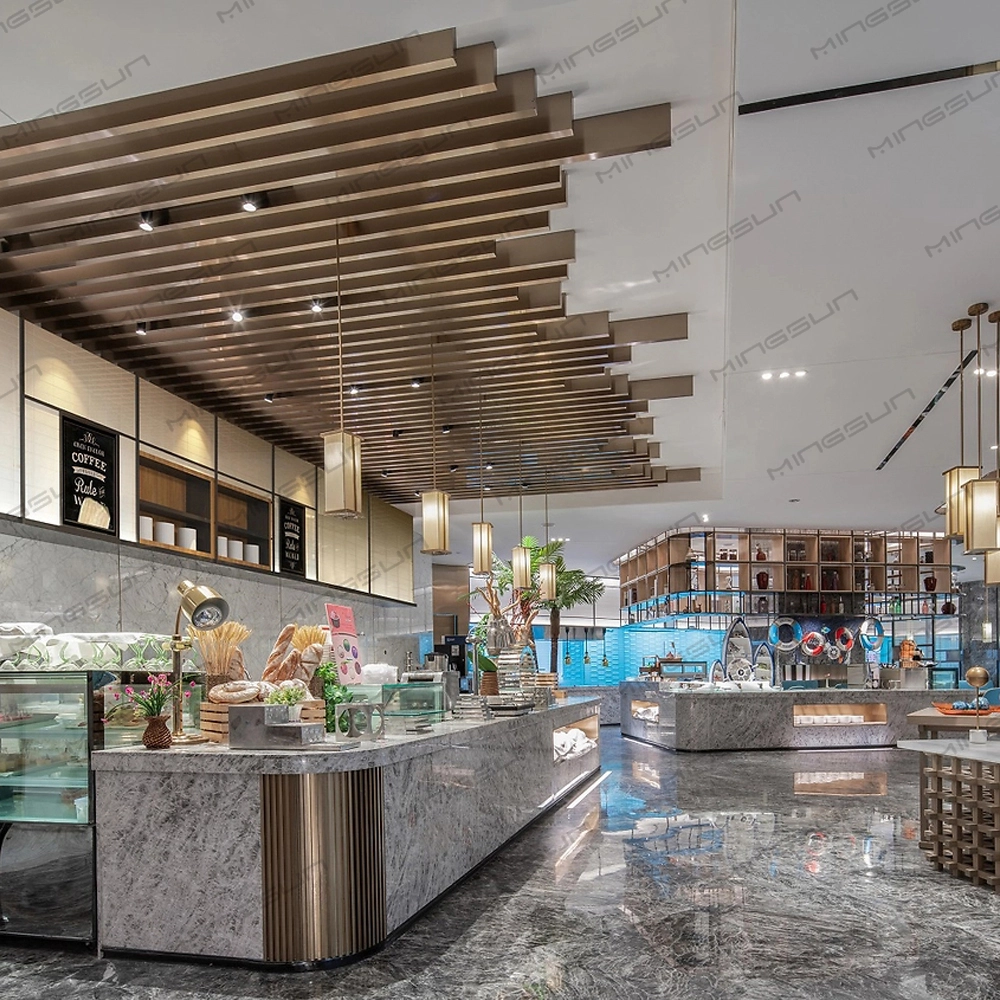
Modern Hotel Dining Furniture Set-Custom Designed Wooden Tables, Upholstered Chairs & Banquette Seating
Create a lasting impression with our custom-designed hotel dining furniture set, crafted for modern luxury hotels and upscale restaurants.
Featuring elegant wooden tables, ergonomic blue-upholstered chairs, and built-in banquette seating, this collection blends comfort, style, and durability.
As a leading manufacturer in Guangzhou, we deliver end-to-end solutions - from concept design and 3D visualization to production and global shipping - all at factory-direct prices.
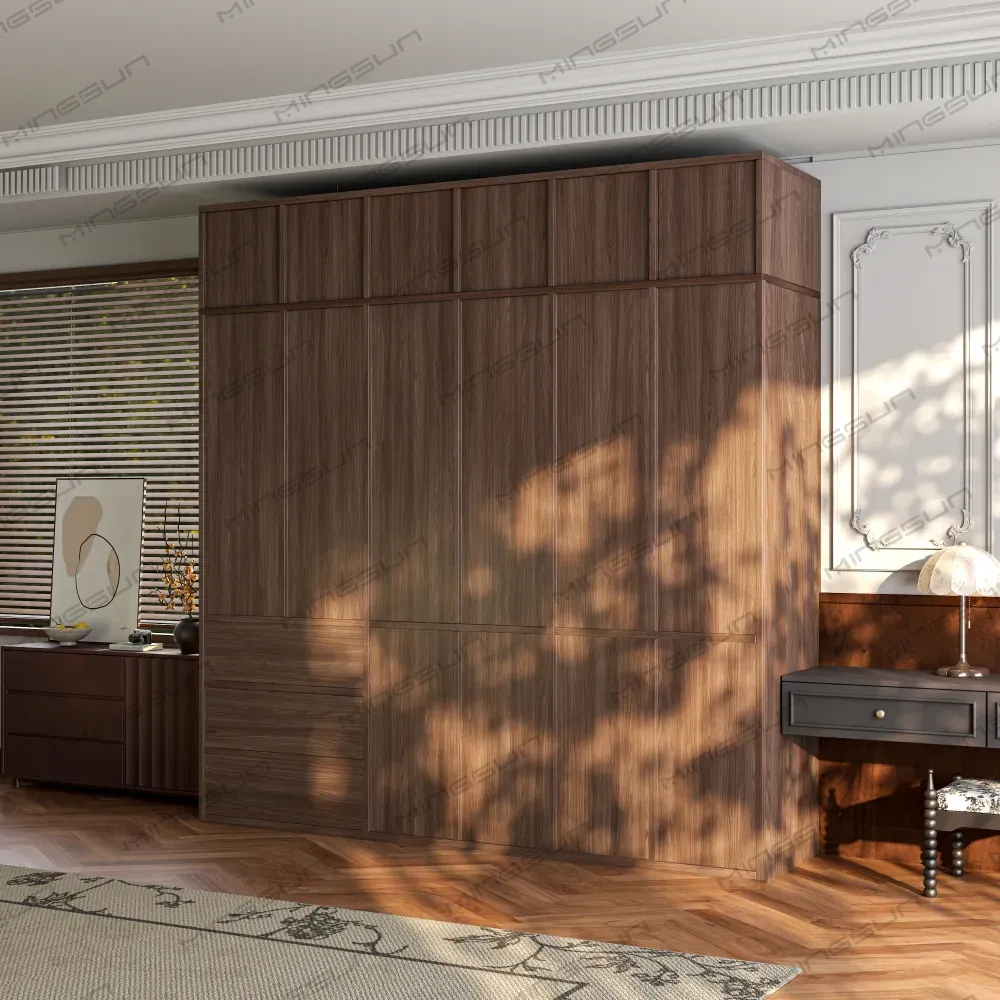
Minimalist Walnut Veneer Floor-to-Ceiling Hotel Wardrobe with Handleless Design
Maximize vertical storage in your hotel guest rooms or luxury apartments with this sleek, floor-to-ceiling wardrobe system. Defines by its warm, natural walnut wood veneer finish, the unit offers a sophisticated, handleless facade that maintains clean architectural lines, perfect for modern minimalist interiors. The intelligent layout features a bank of three external soft-close drawers for guest convenience, tall hanging sections for formal wear, and a dedicated row of top-tier cabinets specifically designed to store extra bedding, pillows, or seasonal items.
Manufactured by MINGSUN, this wardrobe is a testament to our expertise in custom hospitality joinery. We engineer these large-scale units for durability and ease of installation. From our Guangzhou factory, we provide precision-cut flat-pack solutions that reduce shipping costs while ensuring a premium built-in look upon assembly.
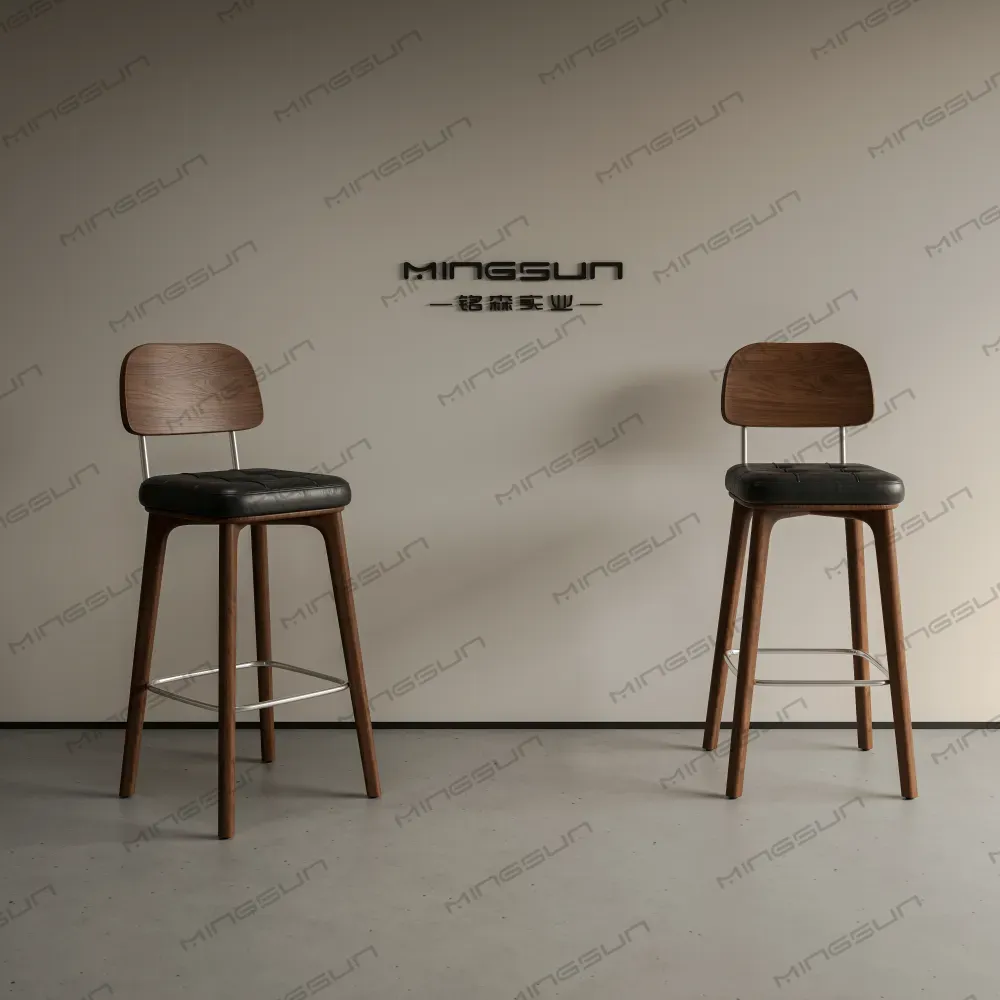
Mid-Century Modern Walnut Bar Stool with Tufted Leather Seat & Chrome Footrest for Luxury Hospitality
Elevate the aesthetic of your hotel bar, upscale restaurant, or executive lounge with this sophisticated bar stool, meticulously crafted by MINGSUN. Blending mid-century modern warmth with industrial durability, this stool features a curved, walnut-veneer backrest designed for ergonomic support and visual depth. The seat is upholstered in premium black PU leather (customizable to genuine leather) with classic button tufting, offering a refined texture that resists wear in high-traffic commercial environments.
Supported by tapered solid wood legs and reinforced with a chrome-finished steel footrest ring, this piece ensures stability and longevity. As a leading Guangzhou hotel furniture manufacturer, MINGSUN ensures that every stool meets rigorous contract-grade standards. From our 10,000㎡ factory directly to your venue, we provide a complete solution including manufacturing, global logistics, and video installation guidance to ensure a seamless project completion.
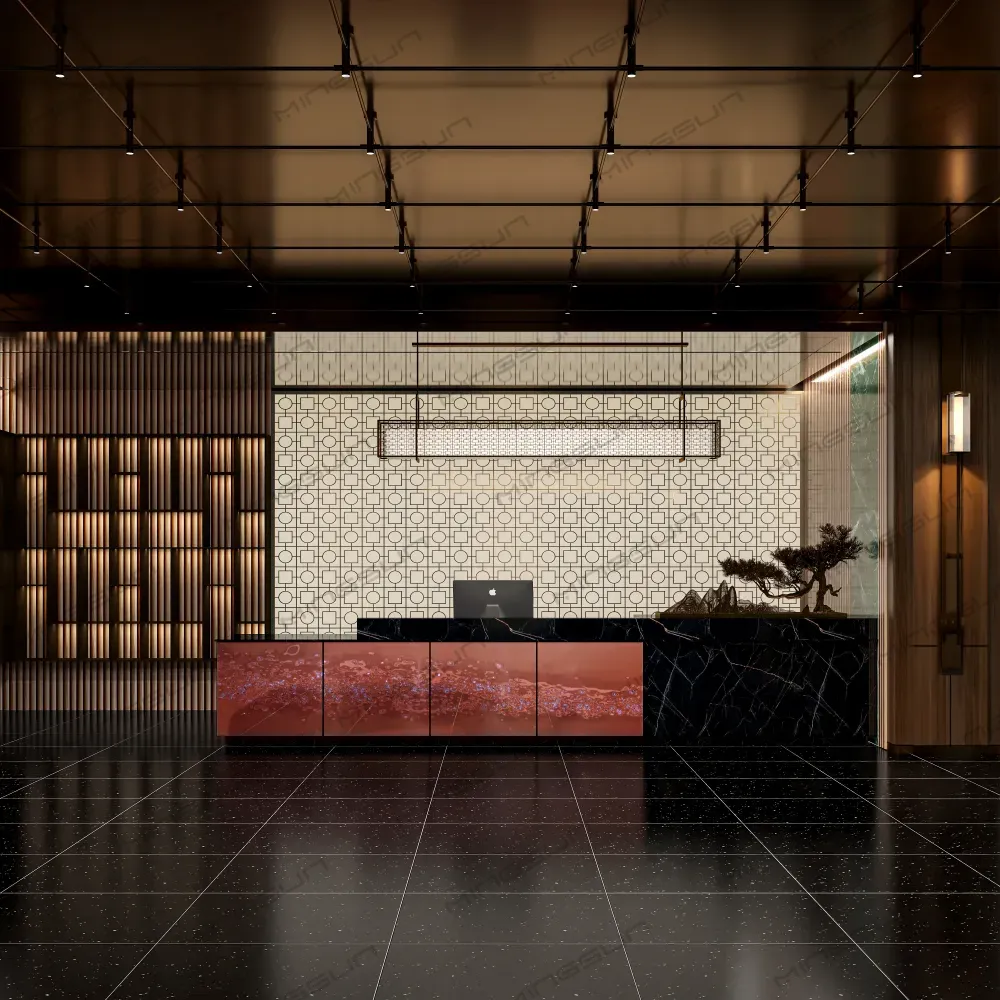
Luxury Reception Desk with Black Marble Top & Illuminated Copper-Resin Front Panels
Make a bold, unforgettable statement at your hotel’s entrance with this avant-garde reception desk. Its sleek black marble top exudes timeless sophistication, while the front facade features mesmerizing, internally lit copper-resin panels that glow with a warm, amber radiance, creating a dynamic visual centerpiece. Designed for both form and function, the unit offers ample concealed storage behind seamless doors and integrates a dedicated staff workstation with cable management. This is more than a check-in counter—it’s a sculptural installation that defines the luxury and artistry of your brand.
Get more industry insights
Looking for the right solution? Fill out the form and get a free quote.
Our experts will respond quickly with personalized options that fit your needs.
MINGSUN is a design-driven hotel furniture manufacturer offering OEM/ODM services, custom solutions, and global project support.
Built for wholesalers. Trusted by global buyers. Delivered with confidence.
Phone:
E-mail:
Follow us ——
 Scan QR Code
MINGSUN
MINGSUN
MINGSUN
MINGSUN
MS Custom Hotel Furniture Supplier