


Standard Hotel Room Dimensions: Size Guide by Room Type
- How Room Size Shapes Guest Experience
- Typical Hotel Room Dimensions by Room Type (hotel room dimensions)
- Practical Dimension Rules: Beds, Clearances, and Circulation (hotel furniture)
- Accessible Rooms and Regulatory Minimums (hotel room dimensions, ADA)
- How Room Size Affects Financial Performance (hotel room dimensions, revenue)
- Furniture Footprint and Space-Saving Strategies (hotel furniture, guestroom layout)
- MINGSUN: Custom Hotel Furniture Solutions to Match Room Dimensions and Brand Standards
- MINGSUN Competitive Advantages & Main Products (hotel bedroom furniture, hotel lounge furniture)
- Planning Checklist: From Concept to Move-In (hotel room dimensions, hotel renovation)
- Frequently Asked Questions (FAQ)
- 1) What is the minimum acceptable hotel room size?
- 2) How much space should I allocate for a king bed in a hotel room?
- 3) Do larger rooms always lead to higher revenue?
- 4) What are the key accessibility dimension requirements I should know?
- 5) How can I maximize perceived space in a small room?
- 6) When should I involve a hotel furniture manufacturer?
- Contact & Next Steps
- References
How Room Size Shapes Guest Experience
The size of a hotel room is more than a number — it determines guest comfort, operational efficiency, and revenue potential. This guide explains standard hotel room dimensions by room type, provides practical furniture and circulation recommendations for planners and operators, and shows how furniture choices affect usable area. Whether you are designing a new property, renovating guestrooms, or sourcing custom hotel furniture, understanding typical dimensions and standards will help you make decisions that balance guest expectations, brand positioning, and cost.
Typical Hotel Room Dimensions by Room Type (hotel room dimensions)
Below are commonly accepted floor-area targets used in hotel design and feasibility studies. Actual sizes vary by brand, location, and target market, but these figures provide a reliable baseline for planning:
| Room Type | Typical Area (sq ft) | Typical Area (m²) | Typical Bed Type | Target Market / Notes |
|---|---|---|---|---|
| Economy / Budget Room | 160–230 sq ft | 15–21 m² | Twin / Full / Queen | Limited amenities, business travel where price is key |
| Midscale / Standard Room | 230–320 sq ft | 21–30 m² | Queen / King | Most urban midscale brands; balance of comfort and efficiency |
| Upscale / Deluxe Room | 320–450 sq ft | 30–42 m² | King; some with seating area | Extended-stay, boutique and upper-upscale segments |
| Junior Suite / Studio | 450–600 sq ft | 42–56 m² | King + small lounge | Business and leisure seeking extra space |
| Suite (1BR) | 600–1,000+ sq ft | 56–93+ m² | King + living area | Luxury and long-stay segments; more storage and amenities |
| Family / Connecting Rooms | Varies; combination units often 400–800 sq ft | 37–74 m² | Multiple beds / sofa bed configurations | Designed to accommodate 3–4+ guests |
Sources for these conventions include industry benchmark reports and hotel design guidance commonly used by architects and operators (see references at the end).
Practical Dimension Rules: Beds, Clearances, and Circulation (hotel furniture)
Designers must plan not only overall floor area but also how furniture, circulation, and service spaces fit inside that envelope. The table below summarizes mattress sizes and recommended clearances used in professional hotel layouts.
| Item | Typical Size (inches) | Typical Size (cm) | Recommended Clearances / Notes |
|---|---|---|---|
| Twin Bed | 38 × 75 | 97 × 190 cm | Allow 24–30 (60–75 cm) at sides/foot for circulation |
| Full / Double | 54 × 75 | 137 × 190 cm | 25–30 (65–75 cm) minimum clearance |
| Queen | 60 × 80 | 152 × 203 cm | 26–36 (65–90 cm) clearances; fits most 230+ sq ft rooms |
| King | 76 × 80 | 193 × 203 cm | 36 (90 cm) desirable at at least one side; allow generous circulation for luxury rooms |
| Desk / Workstation | 36–60 wide | 90–150 cm | Provide 30 (75 cm) knee space and 36 (90 cm) front clearance |
| Sofa (2-seat) | 60–78 wide | 150–200 cm | Allocate seating area 4–6 ft deep including circulation |
These clearances are practical guidelines used by hospitality designers to ensure guest comfort and housekeeping efficiency. Tight clearances increase turnover time and reduce perceived room quality.
Accessible Rooms and Regulatory Minimums (hotel room dimensions, ADA)
Accessible guestrooms must comply with accessibility codes (for example, the 2010 ADA Standards in the U.S.). Key requirements include a 60-inch (1525 mm) diameter turning circle in some spaces, unobstructed clearances at doors, and maneuvering space in bathrooms. Designers should consult the relevant national and local codes (ADA, IBC) and brand standards because minimum accessible room area is typically larger than a standard room to accommodate turning radii and accessible fixtures.
- Turning radius: 60 (1525 mm) clear space for wheelchair turning where applicable.
- Door clearances: Minimum 32 clear opening at doors; lever hardware preferred.
- Bathroom: Clear floor spaces at toilets and sinks; roll-in shower clearances where provided.
Failing to meet accessibility standards risks non-compliance penalties and excludes a segment of guests. For precise dimensional requirements reference the 2010 ADA Standards and local building codes.
How Room Size Affects Financial Performance (hotel room dimensions, revenue)
Room size impacts both revenue and operating cost:
- Average daily rate (ADR): Larger, better-appointed rooms typically command higher ADRs, but the rental High Quality must cover higher construction and furnishing costs per key.
- Construction cost per key: Increasing average room area increases cost per key; developers may trade off room size and number of keys to hit target ROI.
- Operational efficiency: Smaller rooms may increase housekeeping time per square foot if layouts are poorly optimized; good furniture planning reduces cost impacts.
Feasibility studies by hospitality consultants commonly model the revenue uplift from larger room categories against the incremental construction cost. For a reliable budgetary approach, use local construction cost benchmarks and brand minimums.
Furniture Footprint and Space-Saving Strategies (hotel furniture, guestroom layout)
Smart furniture selection can make smaller rooms feel larger and improve functionality. Consider the following strategies:
- Wall-mounted desks and fold-away tables to free floor area.
- Integrated headboard systems with bedside lighting to reduce separate lamp furniture.
- Custom-fit wardrobes with shallow depths for boutique rooms to preserve circulation.
- Modular solutions for connecting rooms and family units (sofas that convert to beds).
Below is a comparative furniture footprint table useful in early space planning.
| Furniture Piece | Typical Footprint (sq ft) | Notes |
|---|---|---|
| Queen bed + nightstands | ~40–55 sq ft | Includes clearance on both sides/foot |
| King bed + nightstands | ~55–75 sq ft | Wider footprint; affects desk and seating placement |
| Desk + chair | ~15–25 sq ft | Depends on depth and storage |
| Sofa + coffee table | ~30–60 sq ft | Space varies by seating type |
Use these footprints to create a bubble diagram during schematic design; this helps verify that the intended guest experience fits within the planned floor area.
MINGSUN: Custom Hotel Furniture Solutions to Match Room Dimensions and Brand Standards
MINGSUN is a High Quality hotel furniture manufacturer based in Guangzhou, China, providing one-stop custom solutions for the hospitality industry. We specialize in the design, production, and global delivery of high-quality furniture for hotel guest rooms, lobbies, restaurants, banquet halls, and other commercial spaces.
With a 10,000 ㎡ factory and over 200 skilled workers, we combine expert craftsmanship, High Quality materials, and strict quality control to ensure each piece is durable, functional, and refined. Our in-house design team works closely with clients to develop tailored solutions that reflect each project's unique style and standards.
Committed to professionalism, reliability, and creativity, MINGSUN helps clients bring their hospitality visions to life—from concept to completion.
MINGSUN Competitive Advantages & Main Products (hotel bedroom furniture, hotel lounge furniture)
- Scale and capacity: 10,000 ㎡ factory and a workforce able to handle volume projects and custom runs.
- Design collaboration: In-house designers translate brand standards and room dimension constraints into furniture that maximizes usable space and guest comfort.
- Quality & QC: Material sourcing, finish standards, and systematic quality checks reduce defects and ensure durability under high occupancy.
- Global logistics: Experience with international shipping and customs to deliver complete furniture packages on schedule.
Main product categories: hotel bedroom furniture, hotel lounge furniture, hotel lobby furniture, hotel conference furniture, hotel restaurant tables and chairs. MINGSUN can produce fixed and modular systems, integrated headboards, bespoke casegoods, and public-area seating that align with your room size and operational needs.
Planning Checklist: From Concept to Move-In (hotel room dimensions, hotel renovation)
Use this checklist when you plan room sizes and furniture procurement:
- Define target guest segment and ADR expectations — determine baseline room-size needed for perceived value.
- Confirm brand and code requirements (local building code, IBC, ADA or local accessibility rules).
- Create bubble diagrams with furniture footprints (beds, desks, seating) before finalizing plan.
- Engage a furniture supplier early (e.g., MINGSUN) to cost and adapt designs to fit the room envelope.
- Prototype a show room or mock-up to validate circulation, sightlines, and housekeeping access.
- Plan for future flexibility — modular furniture allows room reconfiguration for changing demand.
Frequently Asked Questions (FAQ)
1) What is the minimum acceptable hotel room size?
Minimum size depends on brand and local code; however, many economy hotels provide rooms around 160–200 sq ft (15–19 m²). Accessible rooms require larger areas to meet turning and clearance standards, so baseline planning should account for a portion of larger keys.
2) How much space should I allocate for a king bed in a hotel room?
Plan roughly 55–75 sq ft (5–7 m²) for a king bed including minimum clearances. Ensure at least one side has 36 (90 cm) clearance if possible for a High Quality feel; both sides at 30 (75 cm) are a practical minimum.
3) Do larger rooms always lead to higher revenue?
Not necessarily. Larger rooms can command higher ADRs if the market and brand support it, but they also increase construction and furnishing costs per key. A feasibility model should compare ADR uplift vs incremental cost to determine optimal room size.
4) What are the key accessibility dimension requirements I should know?
Follow the relevant accessibility standard in your jurisdiction. In the U.S., the 2010 ADA Standards specify 60 turning clearances, minimum door clear widths (32 clear), and bathroom clearances for accessible fixtures. Local codes or brand guidelines may add further requirements.
5) How can I maximize perceived space in a small room?
Use light colors, integrated lighting, wall-mounted furniture, glass shower doors, mirrors, and multi-functional furniture (e.g., desks that double as dressers). Custom casegoods fitted to the room dimensions help avoid wasted voids and improve circulation.
6) When should I involve a hotel furniture manufacturer?
Early. Engage furniture suppliers during schematic design so that casegoods, headboards, and modular pieces are tailored to the room envelope. Early engagement reduces redesign, keeps lead times manageable, and ensures quality alignment.
Contact & Next Steps
If you are planning a new hotel, renovation, or sourcing custom furniture that must align precisely with planned guestroom dimensions, contact MINGSUN to discuss tailored solutions. Our team can provide design collaboration, dimensioned shop drawings, prototypes, and turnkey delivery to meet brand and operational requirements.
Ready to get started? Request a consultation or product catalog to review suitable furniture lines and case studies that match your room types and target market.
References
- 2010 ADA Standards for Accessible Design — U.S. Department of Justice. https://www.ada.gov/2010ADAstandards_index.htm (Accessed 2025-11-20)
- International Building Code (IBC) — International Code Council. https://codes.iccsafe.org/ (Accessed 2025-11-20)
- Hotel Room Sizes — HotelPlanner (industry summary and averages). https://www.hotelplanner.com/Stats/Hotel-Room-Sizes.cfm (Accessed 2025-11-18)
- How big should a hotel room be? — ArchDaily (design perspectives on room size). https://www.archdaily.com/876977/how-big-should-a-hotel-room-be (Accessed 2025-11-18)
- Hospitality design & finance practices — HVS (industry analysis and feasibility approaches). https://www.hvs.com/ (Accessed 2025-11-18)
Local vs Overseas Sourcing for Hotel Room Furniture
ADA-Compliant Custom Front Desks for Hotels
How to Choose Hotel Furniture Manufacturers in China: A Practical Guide
Hotel Front Desk Design Trends for 2026: Custom Solutions
Product Scope & Application Areas
Do you provide samples?
After-Sales Service & Long-Term Cooperation
Do you provide after-sales support?
Is long-term cooperation or repeat ordering supported?
What types of clients is Mingsun best suited for?
Materials, Craftsmanship & Quality Control
How are quality issues handled?
Make an appointment with us today
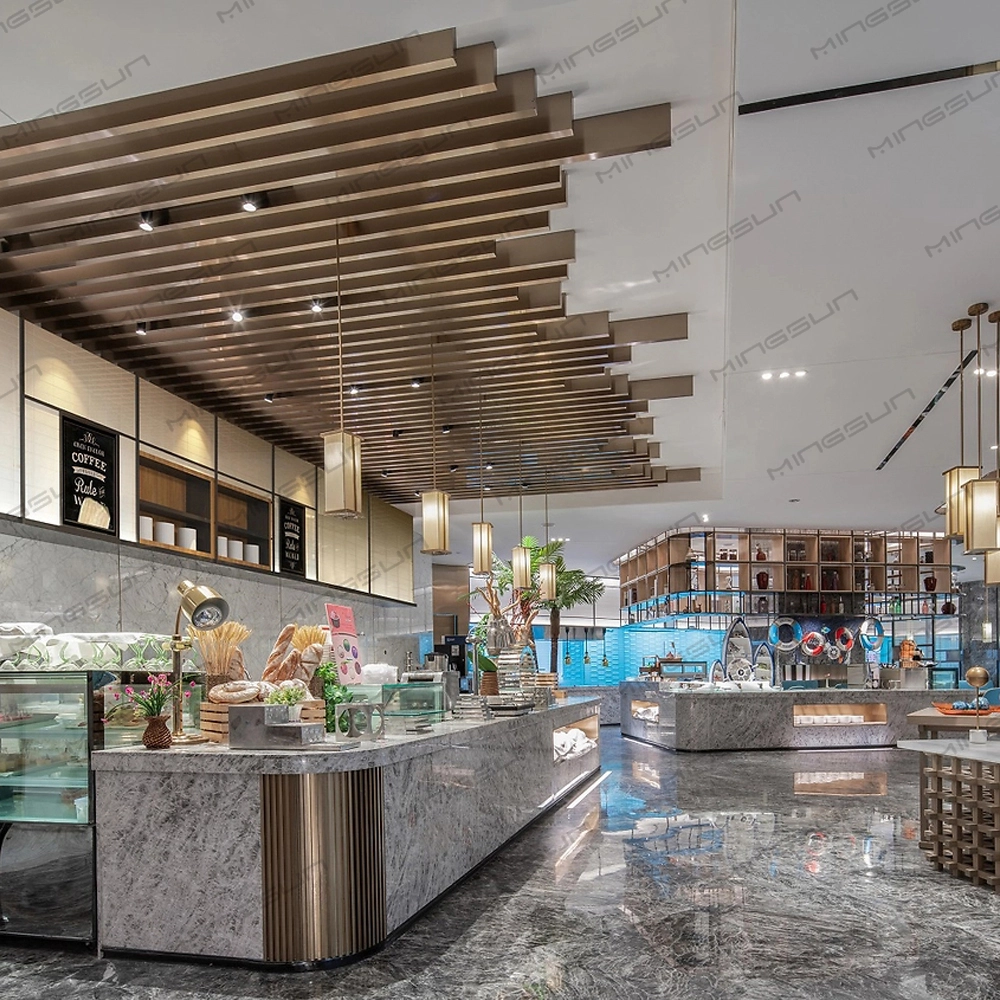
Modern Hotel Dining Furniture Set-Custom Designed Wooden Tables, Upholstered Chairs & Banquette Seating
Create a lasting impression with our custom-designed hotel dining furniture set, crafted for modern luxury hotels and upscale restaurants.
Featuring elegant wooden tables, ergonomic blue-upholstered chairs, and built-in banquette seating, this collection blends comfort, style, and durability.
As a leading manufacturer in Guangzhou, we deliver end-to-end solutions - from concept design and 3D visualization to production and global shipping - all at factory-direct prices.
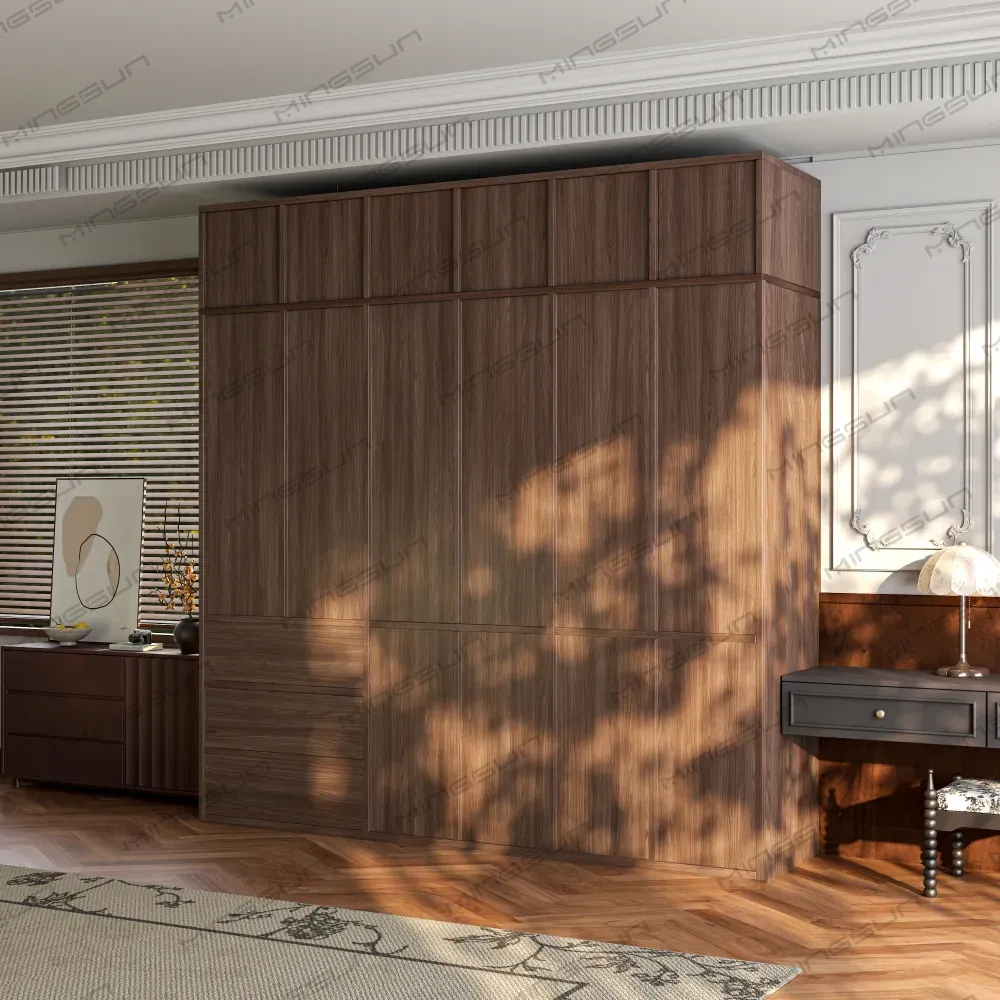
Minimalist Walnut Veneer Floor-to-Ceiling Hotel Wardrobe with Handleless Design
Maximize vertical storage in your hotel guest rooms or luxury apartments with this sleek, floor-to-ceiling wardrobe system. Defines by its warm, natural walnut wood veneer finish, the unit offers a sophisticated, handleless facade that maintains clean architectural lines, perfect for modern minimalist interiors. The intelligent layout features a bank of three external soft-close drawers for guest convenience, tall hanging sections for formal wear, and a dedicated row of top-tier cabinets specifically designed to store extra bedding, pillows, or seasonal items.
Manufactured by MINGSUN, this wardrobe is a testament to our expertise in custom hospitality joinery. We engineer these large-scale units for durability and ease of installation. From our Guangzhou factory, we provide precision-cut flat-pack solutions that reduce shipping costs while ensuring a premium built-in look upon assembly.
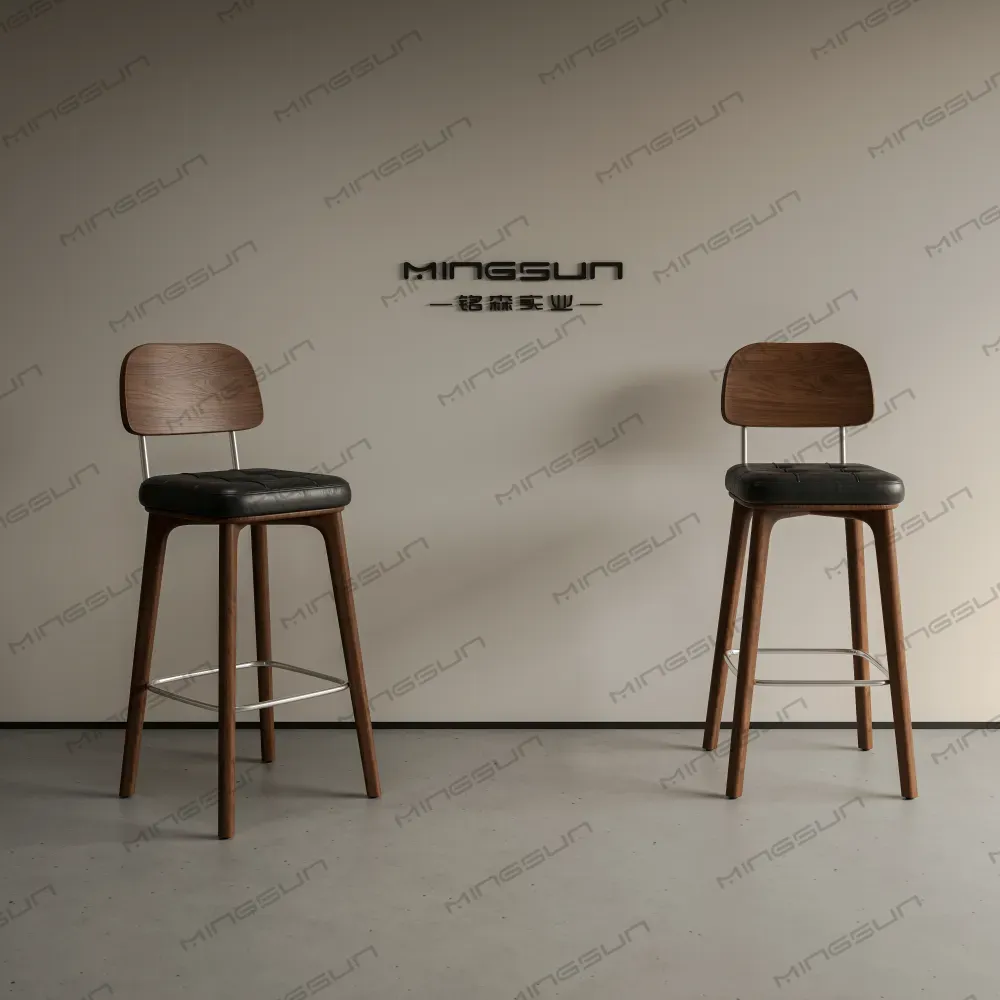
Mid-Century Modern Walnut Bar Stool with Tufted Leather Seat & Chrome Footrest for Luxury Hospitality
Elevate the aesthetic of your hotel bar, upscale restaurant, or executive lounge with this sophisticated bar stool, meticulously crafted by MINGSUN. Blending mid-century modern warmth with industrial durability, this stool features a curved, walnut-veneer backrest designed for ergonomic support and visual depth. The seat is upholstered in premium black PU leather (customizable to genuine leather) with classic button tufting, offering a refined texture that resists wear in high-traffic commercial environments.
Supported by tapered solid wood legs and reinforced with a chrome-finished steel footrest ring, this piece ensures stability and longevity. As a leading Guangzhou hotel furniture manufacturer, MINGSUN ensures that every stool meets rigorous contract-grade standards. From our 10,000㎡ factory directly to your venue, we provide a complete solution including manufacturing, global logistics, and video installation guidance to ensure a seamless project completion.
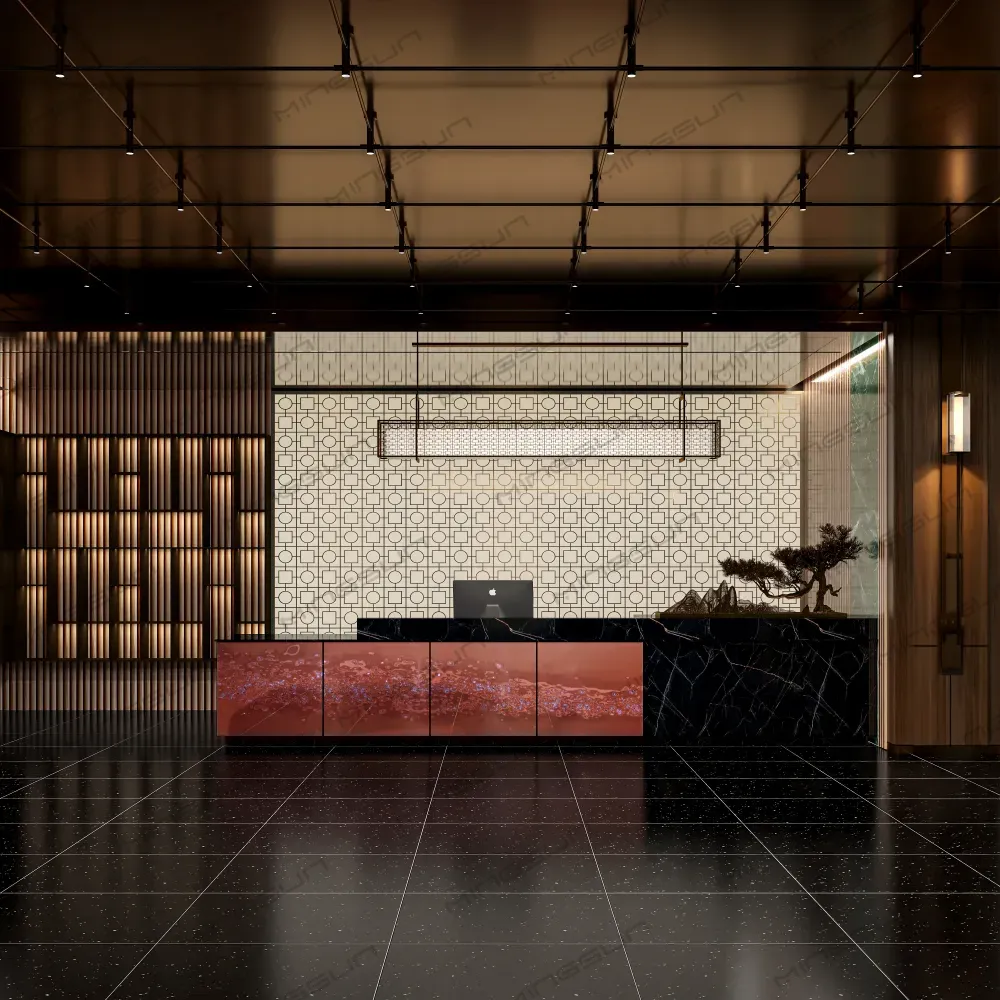
Luxury Reception Desk with Black Marble Top & Illuminated Copper-Resin Front Panels
Make a bold, unforgettable statement at your hotel’s entrance with this avant-garde reception desk. Its sleek black marble top exudes timeless sophistication, while the front facade features mesmerizing, internally lit copper-resin panels that glow with a warm, amber radiance, creating a dynamic visual centerpiece. Designed for both form and function, the unit offers ample concealed storage behind seamless doors and integrates a dedicated staff workstation with cable management. This is more than a check-in counter—it’s a sculptural installation that defines the luxury and artistry of your brand.
Get more industry insights
Looking for the right solution? Fill out the form and get a free quote.
Our experts will respond quickly with personalized options that fit your needs.
MINGSUN is a design-driven hotel furniture manufacturer offering OEM/ODM services, custom solutions, and global project support.
Built for wholesalers. Trusted by global buyers. Delivered with confidence.
Phone:
E-mail:
Follow us ——
 Scan QR Code
MINGSUN
MINGSUN
MINGSUN
MINGSUN
MS Custom Hotel Furniture Supplier