


The Ultimate Guide to Hotel Room Dimensions: Standards, Layouts, and Design for Every Stay
This comprehensive guide dives into the intricate world of hotel room dimensions, essential for travelers, designers, and hoteliers. It covers standard square footage across various star ratings, contrasting US standards with international norms. We explore specific dimensions for sleeping, bathing, and working zones, alongside crucial ADA compliance requirements. Whether you are planning a layout or seeking the perfect stay, this article provides vital insights into optimizing hotel room functionality and guest experience.
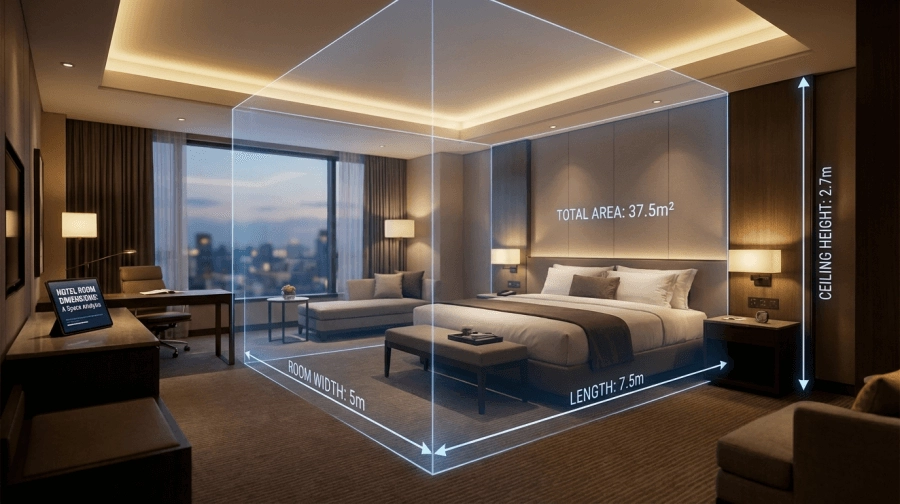
- Introduction: Unlocking the World of Hotel Room Dimensions
- What Constitutes a "Standard" Hotel Room Size?
- The US Standard
- International Variations
- Key Factors Influencing Hotel Room Dimensions
- Hotel Star Rating
- Location and Market
- Target Audience
- A Detailed Look at Hotel Room Type Dimensions
- Economy & Midscale Rooms
- Upscale & Boutique Rooms
- Luxury & Premium Rooms
- Suites (Junior to Presidential)
- Bed Configurations
- Critical Dimensions for Key Areas Within a Hotel Room
- Sleeping Area
- Work & Relaxation Zones
- Storage Solutions
- Bathroom Dimensions
- Accessibility: Understanding ADA Compliant Hotel Room Dimensions
- Maximizing Comfort and Functionality Through Smart Space Planning
- Conclusion
- Frequently Asked Questions (FAQ)
- What is the average size of a standard hotel room?
- How do hotel room dimensions vary by star rating?
- Are hotel rooms in Europe generally smaller than in the US?
- What are the key dimensions for an ADA compliant hotel room?
- What is the typical size of a luxury hotel suite?
- How much space is usually allocated for a hotel bathroom?
- Do different bed types affect the overall room dimensions?
- Besides square footage, what other factors determine a comfortable hotel room?
- References
Whether you are a weary traveler seeking a restful night's sleep, a hotelier aiming to maximize property value, or an interior designer tasked with optimizing a floor plan, understanding hotel room dimensions is fundamental. The size and layout of a hotel room do more than just dictate where the furniture goes; they define the guest experience, influence price points, and determine the operational efficiency of the establishment.
In this guide, we unlock the standards, variations, and critical design elements that shape the spaces where the world sleeps.
Introduction: Unlocking the World of Hotel Room Dimensions
Space is a luxury, but in the hospitality industry, it is also a commodity. The dimensions of a hotel room impact everything from the perception of comfort to the functionality of the amenities provided. A room that feels too cramped can ruin a guest's relaxation, while a poorly planned large room can feel cavernous and impersonal.
For designers and architects, the challenge lies in balancing aesthetics with strict spatial requirements. For travelers, knowing what constitutes an average hotel room square footage can manage expectations and help in selecting the right accommodation for their needs. This guide covers the spectrum of room types, international differences, and the critical design elements that turn empty space into a sanctuary.
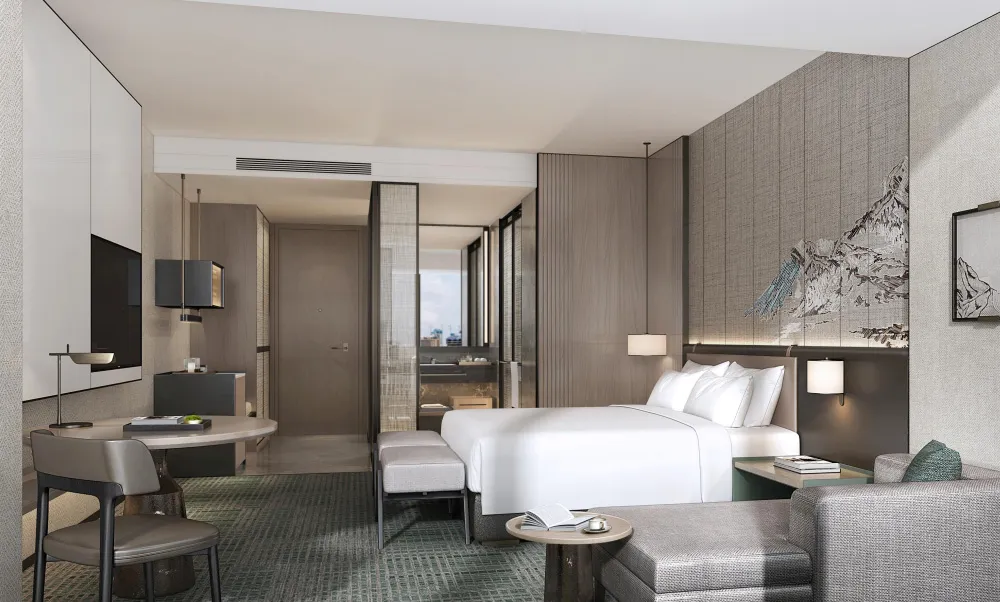
What Constitutes a "Standard" Hotel Room Size?
When we speak of a standard hotel room size, we are generally referring to a room that accommodates a king or queen bed, a bathroom, and basic storage and working areas. However, "standard" is a relative term heavily influenced by geography.
The US Standard
In the United States, the average standard hotel room typically falls within the range of 300 to 400 square feet (approximately 28 to 37 square meters). Industry data suggests the sweet spot for a modern mid-scale US hotel room is often cited around 300-325 square feet. This allows enough room for a distinct entryway, a full three-fixture bathroom, and a sleeping area that doesn't feel congested.
International Variations
Travelers often notice a stark contrast when crossing the Atlantic or Pacific. In Europe and dense Asian metropolises like Tokyo or Hong Kong, space is at a premium due to high land costs and historical urban planning. Consequently, a standard room in these regions often ranges from 200 to 300 square feet (18 to 28 square meters).
These variations are not just arbitrary; they are dictated by market expectations. A guest in a historic Parisian boutique hotel accepts a smaller footprint as part of the charm, whereas a guest at a Texan roadside hotel expects ample room to spread out.
Key Factors Influencing Hotel Room Dimensions
Several variables dictate the architectural footprint of a guest room. Understanding these helps in predicting the experience based on the booking details.
Hotel Star Rating
There is a direct correlation between star rating and square footage:
- 1-Star / Budget: Focus is purely on sleeping. Rooms may range from 150 to 300 sq ft. Furniture is minimal, often lacking desks or large wardrobes.
- 3-Star / Midscale: The industry workhorse. Dimensions usually hover between 300 and 350 sq ft, accommodating business travelers with desks and reasonable closet space.
- 5-Star / Luxury: Space is a primary selling point. Luxury hotel suite dimensions and standard premium rooms often start at 400+ sq ft and can easily exceed 600 sq ft.
Location and Market
- Urban: High-density city center hotels maximize revenue per square foot, often resulting in smaller hotel room layouts.
- Resort/Suburban: Properties with more land availability offer larger rooms, often including balconies or patios which visually extend the living space.
Target Audience
- Business Travelers: Require efficient hotel room design with dedicated workstations, favoring functionality over vast empty space.
- Families: Require larger dimensions or connecting rooms to accommodate multiple beds and play areas.
-
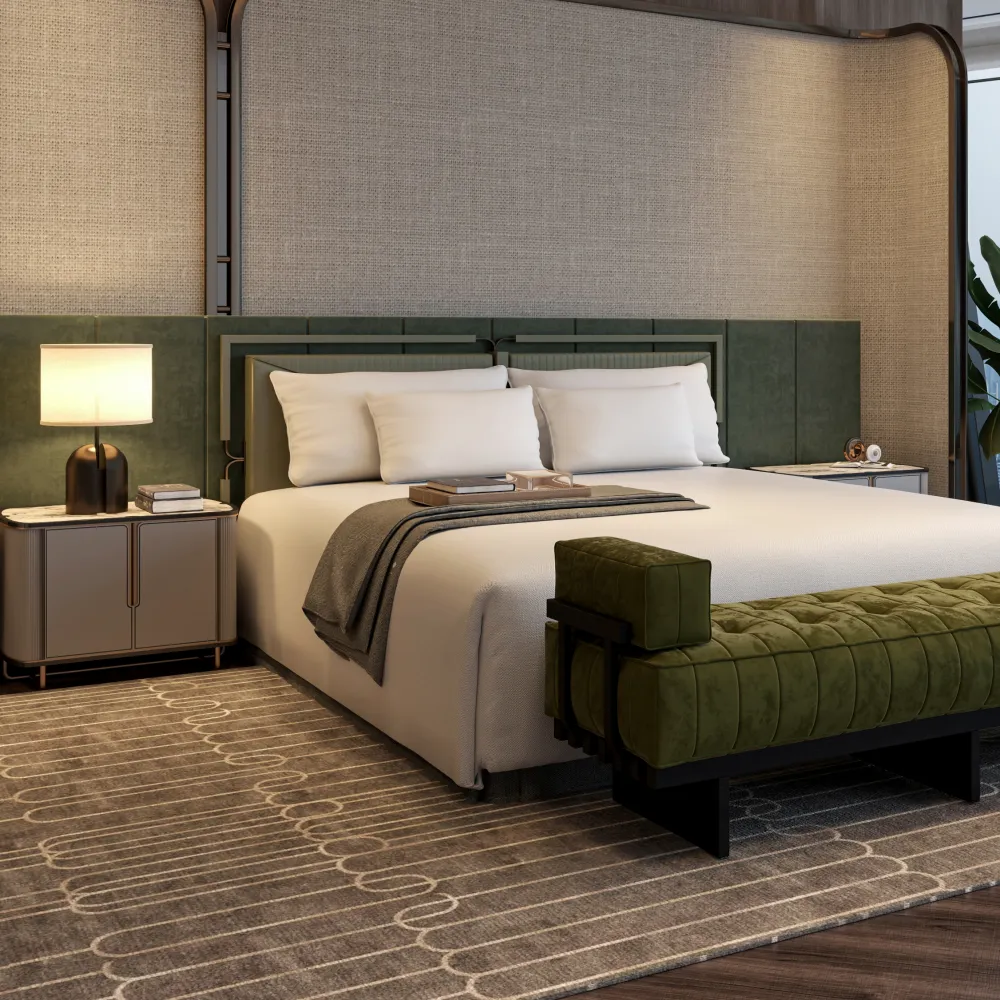
A Detailed Look at Hotel Room Type Dimensions
To plan effectively, one must look at specific categories of rooms.
Economy & Midscale Rooms
Dimensions: 190 – 300 sq ft. In this segment, every inch counts. The layout typically features an open closet or wall hooks instead of armoires to save floor space. The bathroom is often compact, sometimes utilizing a shower-only configuration to maximize the sleeping area.
Upscale & Boutique Rooms
Dimensions: 300 – 390 sq ft. Here, the balance shifts toward style and comfort. Designers have enough width to include a lounge chair or a dedicated vanity area. The entry hallway is wider, creating a better sense of arrival.
Luxury & Premium Rooms
Dimensions: 400 – 650 sq ft. These rooms allow for distinct "zones." You might find a bench at the foot of the bed, a sofa, and a four-fixture bathroom (separate tub and shower).
Suites (Junior to Presidential)
Dimensions: 390 – 4,000+ sq ft.
- Junior Suites: usually feature a small sitting area integrated into the bedroom.
- One-Bedroom Suites: Provide a physical separation (wall and door) between the living room and bedroom.
- Presidential Suites: These are residences within a hotel, featuring dining rooms, kitchenettes, and multiple bedrooms.
Bed Configurations
- King Rooms: Generally require 300-350 sq ft. A King bed dictates a specific width, but allows for a focused layout.
- Double/Queen-Queen Rooms: require more width, typically 325-375 sq ft, to accommodate two beds with a nightstand between them and clearance on the outer sides.
Critical Dimensions for Key Areas Within a Hotel Room
Successful hotel room layouts are a game of inches. Here are the critical measurements designers use:
Sleeping Area
- Bed Sizes: A King is 76x80 inches; a Queen is 60x80 inches.
- Clearance: To avoid shin-bumping, there should be a minimum of 18-24 inches of clearance around the bed for nightstands and walkways. In luxury settings, 36 inches is preferred.
Work & Relaxation Zones
- Desks: A functional hotel desk should be at least 48 inches long and 24 inches deep to accommodate a laptop and documents.
- Seating: Lounge chairs require a footprint of roughly 30x30 inches, plus room for an ottoman or side table.
Storage Solutions
- Closets: Standard wardrobes are roughly 3 feet wide with a depth of 24 inches. A height of 5-6 feet is necessary for hanging long coats or dresses.
Bathroom Dimensions
- Overall Size: A standard luxury bathroom ranges from 60 to 100 sq ft.
- Vanity: A single sink vanity needs roughly 36 inches of width.
- Showers: A comfortable walk-in shower should be a minimum of 36x36 inches, though 36x48 or larger is preferred for upscale properties.
- Toilet Clearance: A minimum width of 30 inches is standard for the toilet niche.
-
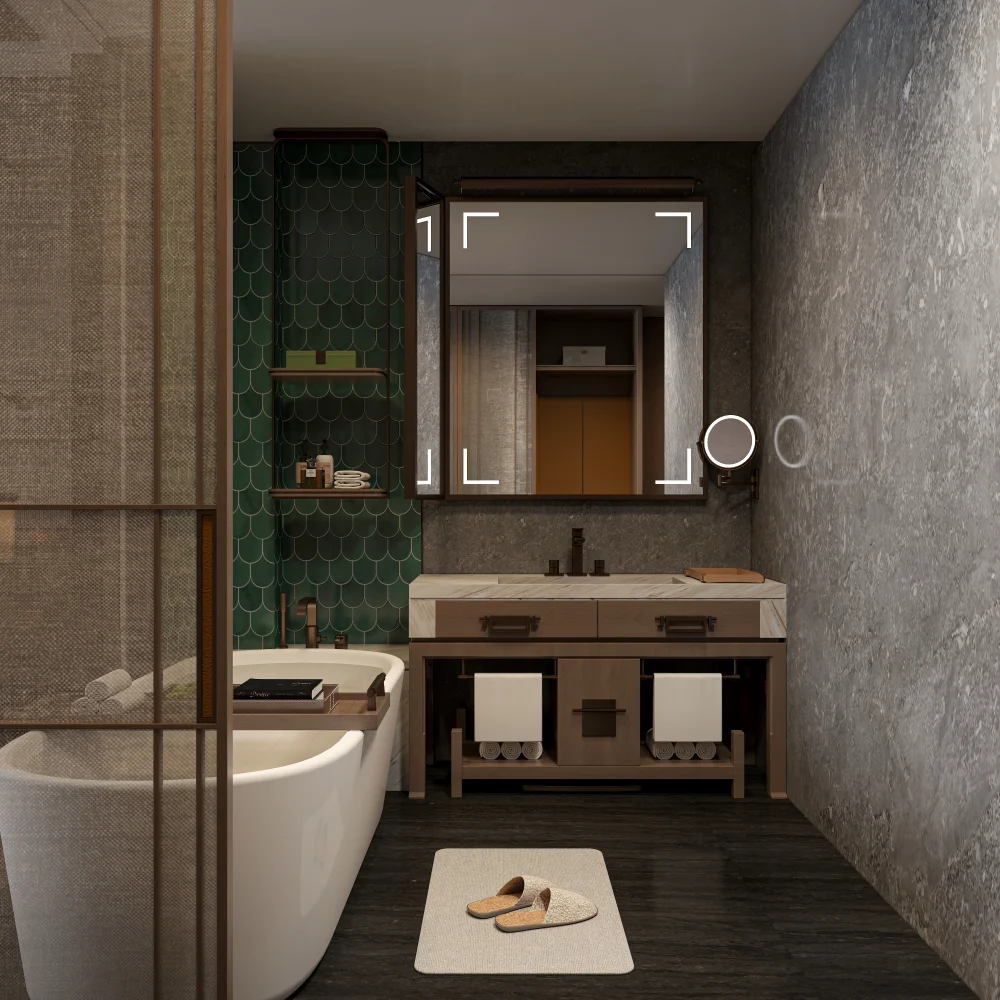
Accessibility: Understanding ADA Compliant Hotel Room Dimensions
ADA compliant hotel rooms are not just a legal requirement in the US; they are a moral imperative for inclusive design.
- Doorways: Must provide a minimum clear opening of 32 inches (often requiring a 36-inch door slab). This allows wheelchair passage.
- Turning Radius: The room layout must include a 60-inch diameter (1500-1600 mm) clear turning space for wheelchairs, usually located between the beds or in the center of the room.
- Bathroom Access: Roll-in showers require specific dimensions (min 1500x1500 mm or similar depending on codes) with grab bars installed at regulated heights.
- Furniture Clearance: There must be an accessible route to the bed, with specific clearance on at least one side for transfer.
Maximizing Comfort and Functionality Through Smart Space Planning
Square footage is only half the battle. A 300 sq ft room can feel larger than a 400 sq ft room if designed correctly.
- Zoning: Even in a single room, visual cues (like area rugs or lighting changes) can separate the "sleep" zone from the "work" zone.
- Circulation: The path of travel is critical. A "straight shot" from the entry to the window often makes a room feel longer and more open.
- Multi-functional Furniture: In smaller rooms, using a desk that doubles as a vanity, or an ottoman that serves as storage, saves precious floor space.
- Lighting and Mirrors: Floor-to-ceiling mirrors and layered lighting (ambient, task, accent) eliminate dark corners, expanding the perceived volume of the room.
Conclusion
The science of hotel room dimensions is a complex blend of industry standards, guest expectations, and design ingenuity. While the numbers—300 square feet for a standard room, 60 inches for a turning radius—provide a baseline, it is the thoughtful execution of the layout that transforms a box into an experience.
Whether you are a traveler looking for the best value or a designer creating the next great hotel, paying attention to these dimensions ensures that comfort and functionality are never compromised.
Frequently Asked Questions (FAQ)
What is the average size of a standard hotel room?
A standard hotel room typically ranges from 300 to 400 square feet (about 28 to 37 square meters) in the US, with an average often cited around 300-325 square feet. International standards may be smaller.
How do hotel room dimensions vary by star rating?
Room sizes generally increase with star ratings. 1-star hotels may offer 150-300 sq ft, while 5-star luxury hotels typically exceed 400 sq ft, often reaching 600 sq ft or more for premium rooms and suites.
Are hotel rooms in Europe generally smaller than in the US?
Yes, hotel rooms in Europe and parts of Asia are often smaller than in the US, typically ranging from 200-300 square feet. This is largely due to higher land costs, urban density, and historical building constraints.
What are the key dimensions for an ADA compliant hotel room?
ADA compliant rooms require a minimum doorway clearance of 32 inches, a 60-inch (1500 mm) turning radius for wheelchairs, and specific bathroom features like roll-in showers (minimum 1500 x 1500 mm) with appropriate grab bar placements.
What is the typical size of a luxury hotel suite?
Luxury suites can vary significantly. Junior Suites range from 390-520 sq ft, while one-bedroom suites are typically 400-600+ sq ft. Expansive Presidential Suites can range from 1,000 to 4,000 square feet or more.
How much space is usually allocated for a hotel bathroom?
A standard luxury hotel bathroom might be 60-100 square feet, while master or ensuite bathrooms in larger suites can be 100-200 square feet, accommodating features like double vanities, larger showers, or separate tubs.
Do different bed types affect the overall room dimensions?
Yes. Rooms with King beds typically require less overall square footage (e.g., 300-350 sq ft) compared to rooms with two Queen beds (e.g., 325-375 sq ft), as the latter requires more width for adequate circulation space around both beds.
Besides square footage, what other factors determine a comfortable hotel room?
Beyond square footage, comfort is heavily influenced by smart furniture layout, adequate circulation space, efficient storage solutions, strategic lighting, appropriate ceiling height, and the overall design aesthetic that maximizes perceived space and functionality.
References
- Americans with Disabilities Act (ADA) Standards for Accessible Design. (2010). Department of Justice. Details regarding clearance and turning radius requirements.
- HVS Global Hospitality Services. (Various Reports). Industry data regarding hotel development costs and average room sizes by tier.
- Architectural Graphic Standards. (American Institute of Architects). Standard dimensions for furniture clearance and room layouts.
- U.S. General Services Administration (GSA). Federal hotel accommodations and room size guidelines.

9 Essential Design Principles for Five-Star Hotel Restaurants: Creating a Luxury Dining Experience

OEM vs. Standard: How to Custom-Design Your Luxury Hotel Stone Tea Table Top Set

How a Bespoke Hotel Custom Coffee Bar Cabinet Transforms the Suite Experience

The Ultimate Guide to Hotel Lobby Design: Creating Unforgettable Guest Experiences in 2026
Materials, Craftsmanship & Quality Control
What materials are commonly used for hotel furniture?
Is the furniture suitable for high-frequency hotel use?
Customization Capability & Design Support
Does Mingsun provide design services?
Does Mingsun support customized hotel furniture?
After-Sales Service & Long-Term Cooperation
Do you provide after-sales support?
Make an appointment with us today
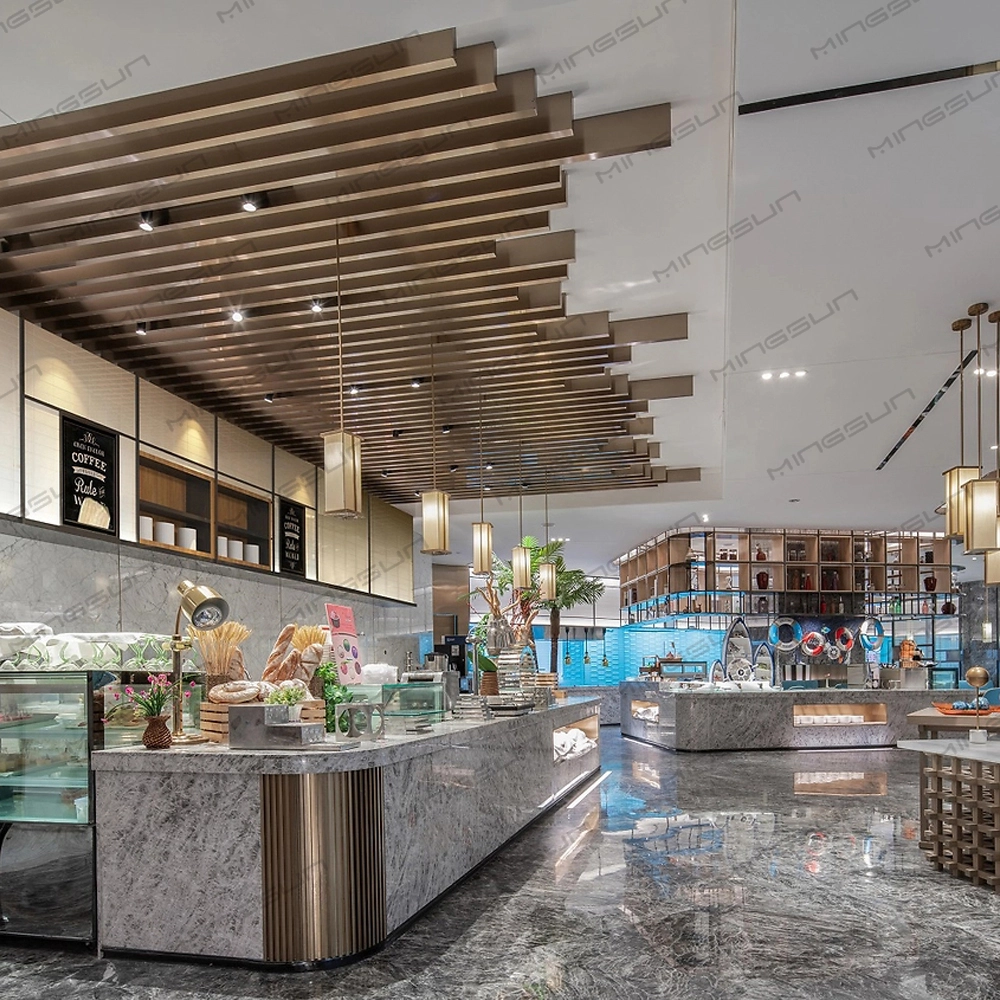
Modern Hotel Dining Furniture Set-Custom Designed Wooden Tables, Upholstered Chairs & Banquette Seating
Create a lasting impression with our custom-designed hotel dining furniture set, crafted for modern luxury hotels and upscale restaurants.
Featuring elegant wooden tables, ergonomic blue-upholstered chairs, and built-in banquette seating, this collection blends comfort, style, and durability.
As a leading manufacturer in Guangzhou, we deliver end-to-end solutions - from concept design and 3D visualization to production and global shipping - all at factory-direct prices.
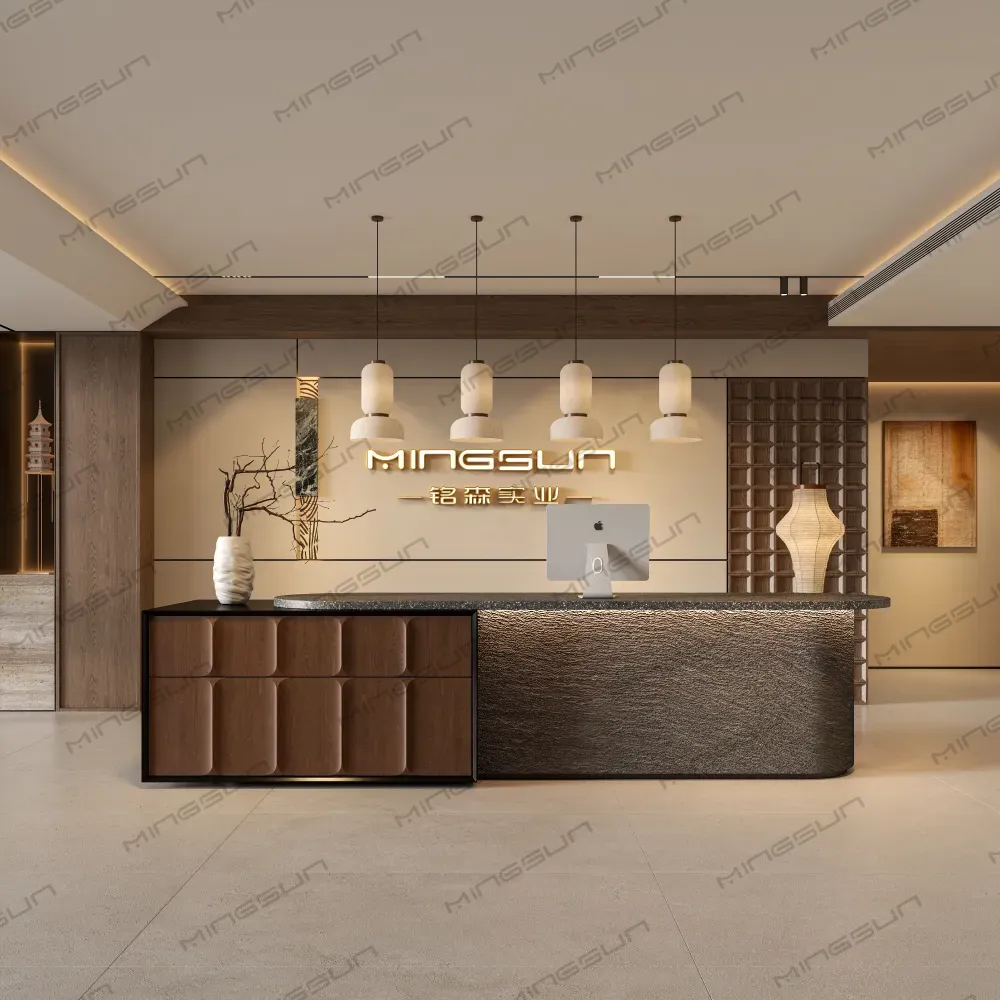
Luxury Textured Stone & Walnut Veneer Reception Desk with 3D Relief Detailing
Create a sophisticated, organic atmosphere in your hotel lobby or boutique showroom with this avant-garde reception desk. Combining the raw beauty of nature with refined craftsmanship, this desk features a striking contrast between materials. The main body showcases a dark, hammered-texture stone facade that offers a tactile, rugged elegance, topped with a polished grey terrazzo-style counter. This is seamlessly integrated with a rich walnut wood storage module, defined by its unique 3D pill-shaped relief carving on the drawer fronts. Soft, warm LED lighting concealed beneath the countertop edge highlights the textured stone surface, adding depth and warmth to the reception area.
Crafted by MINGSUN, a specialist in bespoke hospitality furniture, this piece is designed to be the focal point of high-end interiors. From our Guangzhou manufacturing hub, we deliver precision-engineered furniture to hotels worldwide. We offer a seamless experience from design customization to DDP global delivery and video-guided installation.
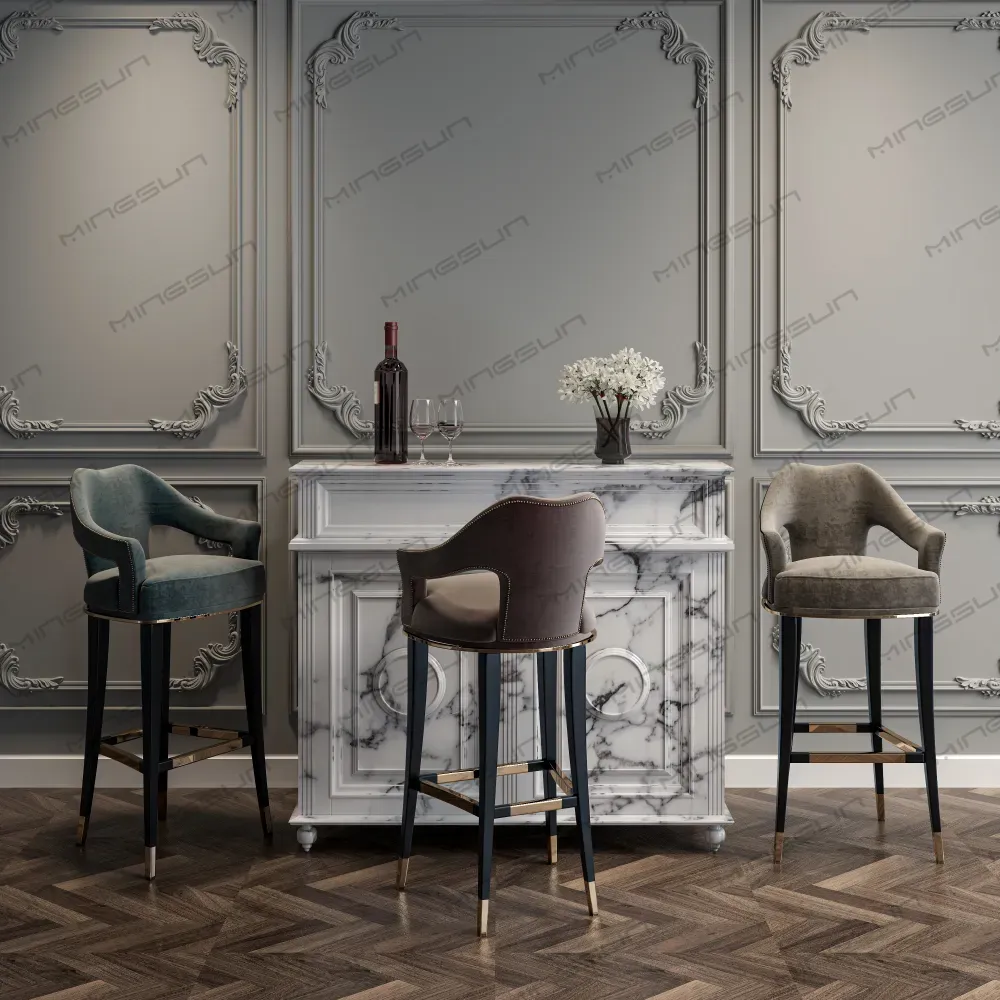
Luxury Velvet Bar Stool with Armrests & Brushed Brass Accents for Hotel Lounges and Bars
Elevate your hotel’s bar or lounge area with this opulent bar stool, where plush comfort meets sophisticated design. Upholstered in rich, deep-brown velvet, its sculptural back and integrated armrests offer ergonomic support, while the slender black metal frame is accented with polished brass at the feet and crossbars for a touch of timeless elegance. Perfect for high-end hospitality spaces, this stool combines refined aesthetics with durable construction, inviting guests to linger in style at your counter or cocktail station.
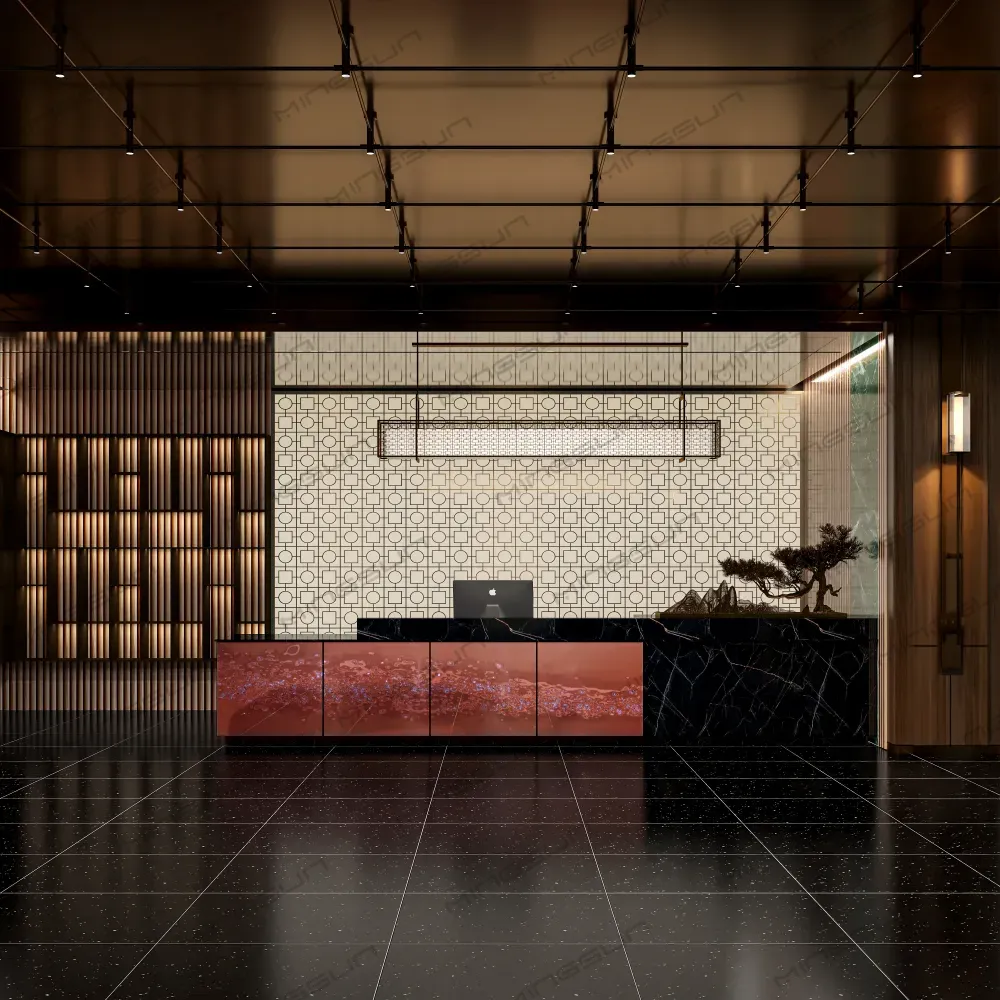
Luxury Reception Desk with Black Marble Top & Illuminated Copper-Resin Front Panels
Make a bold, unforgettable statement at your hotel’s entrance with this avant-garde reception desk. Its sleek black marble top exudes timeless sophistication, while the front facade features mesmerizing, internally lit copper-resin panels that glow with a warm, amber radiance, creating a dynamic visual centerpiece. Designed for both form and function, the unit offers ample concealed storage behind seamless doors and integrates a dedicated staff workstation with cable management. This is more than a check-in counter—it’s a sculptural installation that defines the luxury and artistry of your brand.
Get more industry insights
Looking for the right solution? Fill out the form and get a free quote.
Our experts will respond quickly with personalized options that fit your needs.
MINGSUN is a design-driven hotel furniture manufacturer offering OEM/ODM services, custom solutions, and global project support.
Built for wholesalers. Trusted by global buyers. Delivered with confidence.
Phone:
E-mail:
Follow us ——
 Scan QR Code
MINGSUN
MINGSUN
MINGSUN
MINGSUN
MS Custom Hotel Furniture Supplier