


Modular Bar Furniture Solutions for Hotel Renovations
- Why modularity matters in hospitality interiors
- 1. Operational drivers behind modular bar adoption
- 2. Design flexibility and brand consistency
- 3. Risk management and quality control
- Design and specification: translating hotel bar design goals into modular units
- 1. Defining programmatic requirements
- 2. Module typologies and dimensions
- 3. Materials, finishes and durability criteria
- Manufacturing, delivery and installation: achieving predictable outcomes
- 1. Factory workflow and quality assurance
- 2. Transport, site coordination and MEP integration
- 3. Installation sequencing and commissioning
- Cost, timeline, sustainability and performance comparison
- 1. Comparative overview
- 2. Interpreting trade-offs
- 3. Sustainability and lifecycle considerations
- Project planning checklist and procurement strategy
- 1. Pre-bid and design deliverables
- 2. Supplier evaluation criteria
- 3. Contracts, warranties and spare-part strategy
- Case scenarios and practical recommendations
- 1. Fast-track renovation for urban boutique hotel
- 2. Large-scale brand rollout across multiple properties
- 3. Hybrid approach for signature design elements
- MINGSUN: one-stop modular and custom hotel furniture solutions
- Frequently Asked Questions (FAQ)
- 1. What is the difference between modular bar furniture and custom-built bars?
- 2. Can modular bars accommodate refrigeration, plumbing and electrical needs?
- 3. How long does it typically take to install a modular bar on-site?
- 4. Are modular bar components easy to repair or replace?
- 5. Do modular solutions meet fire and building codes?
- 6. How do I choose between full modular, hybrid, or site-built for my hotel bar renovation?
Modular bar furniture is increasingly used in hotel renovations to accelerate project timelines, control costs, and adapt to evolving F&B concepts. This article outlines practical strategies for integrating modular bar design into hotel renovation projects—covering planning, specification, manufacturing, installation, maintenance and sustainability—so decision-makers can align aesthetics, functionality and operational needs for long-term value.
Why modularity matters in hospitality interiors
1. Operational drivers behind modular bar adoption
Hotel operators face tight renovation windows, often needing to keep revenue-generating outlets open while upgrades occur. Modular bar furniture reduces on-site construction time because assemblies can be prefabricated off-site and quickly installed. This approach supports phased renovations, pop-up outlets, and rapid concept changes while minimizing guest disruption and lost revenue.
2. Design flexibility and brand consistency
Modular systems allow designers to maintain a consistent brand language across multiple properties while tailoring modules (e.g., service counters, shelving, seating banks) to site-specific constraints. For hotels pursuing brand standards across regions, modular components speed replication without sacrificing finish quality.
3. Risk management and quality control
Prefabrication concentrates quality control in the factory, reducing variability found in on-site carpentry. A standardized production process—material sourcing, CNC cutting, finish application, QA checks—lowers the risk of delays and rework common in traditional site-built bars.
Design and specification: translating hotel bar design goals into modular units
1. Defining programmatic requirements
Start from the service model: full bar, grab-and-go, cocktail lounge, late-night club, or multifunctional event bar. Each model imposes distinct equipment, plumbing, electrical and storage requirements. A clear program avoids costly changes later and ensures modules are specified with correct MEP (mechanical, electrical, plumbing) interfaces.
2. Module typologies and dimensions
Common module types include: service core (POS, under-counter refrigeration), backbar units (shelving, display), island counters (customer-facing prep), and ancillary storage modules. Standardizing module widths (e.g., 600mm, 900mm, 1200mm) simplifies manufacturing and replacement logistics. Consider sightlines, ADA access, and local code clearances when setting dimensions.
3. Materials, finishes and durability criteria
Select materials by expected traffic, cleaning regimes and lifespan. Solid-surface tops (e.g., quartz) provide durability; laminated panels balance cost and aesthetics; stainless steel is recommended for areas requiring hygiene and water resistance. Specify abrasion, stain and slip resistance where applicable and request material test data from manufacturers.
Manufacturing, delivery and installation: achieving predictable outcomes
1. Factory workflow and quality assurance
Choose suppliers that document production steps—cutting, edge-banding, finishing, assembly and inspection—and provide digital shop drawings and 3D visualizations. Factory assembly of sub-components reduces site labor. For assurance, request factory inspection reports and material certificates.
2. Transport, site coordination and MEP integration
Modular elements must be designed for transport (doorway widths, elevator access) and on-site handling. Pre-locate service penetrations and provide clear MEP connection points. Coordinate a delivery/install window tied to hotel operations to minimize downtime.
3. Installation sequencing and commissioning
Establish an installation sequence that prioritizes habitability and revenue flow—e.g., install temporary service counters before full bar removal. Define commissioning tests for plumbing, refrigeration and electrical systems. Document as-built conditions and provide maintenance manuals and spare-part lists.
Cost, timeline, sustainability and performance comparison
1. Comparative overview
Below is a practical comparison of modular vs. bespoke site-built bar solutions across common decision metrics. The ranges presented are typical industry observations; for the underlying principles of modular approaches, see Modular design (Wikipedia) and for general interior design context see Interior design (Wikipedia).
| Metric | Modular Bar Furniture | Traditional Site-Built |
|---|---|---|
| Typical project timeline impact | Shorter on-site time; many installations complete in days to a few weeks depending on size | Longer on-site works; weeks to months including finishing trades and coordination |
| Cost predictability | Higher predictability due to factory BOMs and controlled processes | Variable costs due to site conditions and trade availability |
| Flexibility and scalability | High—modules can be reconfigured or replaced | Low—changes often require demolition and rebuild |
| Quality control | Consistent—factory QA reduces defects | Variable—depends on on-site trades and supervision |
| Sustainability | Potentially lower waste through precision cutting and reuse of modules | Higher site waste; material over-ordering common |
2. Interpreting trade-offs
While modular systems speed execution and reduce variability, they require comprehensive upfront design and exact MEP coordination. For high-design signature bars with extensive bespoke joinery or sculptural elements, hybrid approaches (prefab core with custom cladding) often offer the best balance.
3. Sustainability and lifecycle considerations
Modular furniture can improve sustainability metrics by enabling reuse, easier refurbishment, and centralized waste management during manufacture. Request product environmental data (e.g., FSC certification for wood, VOC ratings for finishes) to support hotel sustainability targets and reporting.
Project planning checklist and procurement strategy
1. Pre-bid and design deliverables
Include the following items in tender documents: detailed module types with dimensions, MEP connection points, finish schedules, expected service life, cleaning and maintenance regimes, warranty terms, and delivery/install constraints tied to hotel operations.
2. Supplier evaluation criteria
Evaluate suppliers on these axes: factory capability (sqm of production space, tooling), workforce skill, sample quality, QA processes, case studies for hotel projects, capacity to supply spare parts, and ability to provide CE/ISO or equivalent certifications. For context on manufacturing benchmarks, review successful modular suppliers and their shop-floor practices.
3. Contracts, warranties and spare-part strategy
Contract for lead times, penalties for late delivery, agreed acceptance tests, and clear warranty coverage for finishes, hardware and integrated equipment. Maintain an inventory of critical spare modules to reduce future downtime.
Case scenarios and practical recommendations
1. Fast-track renovation for urban boutique hotel
Situation: A 120-key boutique hotel needs to refresh its rooftop bar during off-season with minimal closure. Recommendation: Use prefinished modular counters and backbar units that break down into truck-friendly sizes. Schedule deliveries during low occupancy windows and pre-connect refrigeration lines to factory-supplied manifolds. Benefit: Reduced outlet downtime and predictable cost.
2. Large-scale brand rollout across multiple properties
Situation: A hotel brand wants a uniform bar experience across 30 properties in different markets. Recommendation: Design a kit-of-parts with interchangeable modules (service core, display, seating) and global sourcing for standardized finishes. Provide local site adjustment allowances in the design pack. Benefit: Faster rollouts and consistent guest experience.
3. Hybrid approach for signature design elements
Situation: A luxury hotel specifies a sculptural bar front that must feel artisanal. Recommendation: Prefab core modules for MEP and refrigeration; apply on-site artisan cladding for the sculptural face. Benefit: Retains signature look while capturing modular benefits for functionality.
MINGSUN: one-stop modular and custom hotel furniture solutions
MINGSUN is a High Quality hotel furniture manufacturer based in Guangzhou, China, providing one-stop custom solutions for the hospitality industry. We specialize in the design, production, and global delivery of high-quality furniture for hotel guest rooms, lobbies, restaurants, banquet halls, and other commercial spaces. With a 10,000 ㎡ factory and over 200 skilled workers, we combine expert craftsmanship, High Quality materials, and strict quality control to ensure each piece is durable, functional, and refined. Our in-house design team works closely with clients to develop tailored solutions that reflect each project's unique style and standards. Committed to professionalism, reliability, and creativity, MINGSUN helps clients bring their hospitality visions to life—from concept to completion.
Core product lines and strengths:
- Hotel bedroom furniture—beds, bedside tables, dressers, wardrobes
- Hotel lounge furniture—sofas, coffee tables, modular seating
- Hotel lobby furniture—reception desks, benches, concierge units
- Hotel conference furniture—tables, chairs, AV-ready podiums
- Hotel restaurant tables and chairs—customizable finishes and dimensions
MINGSUN differentiators and technical capabilities:
- Integrated design-to-delivery workflow that reduces lead times and improves quality control.
- Scalable production capacity (10,000 ㎡ factory, 200+ workers) enabling multi-property rollouts.
- Custom engineering for modular bar modules with strict MEP coordination, factory QA, and packaging designed for international shipping.
- Proven hospitality portfolio and client collaboration processes that support local code compliance, warranty management and spare-part provisioning.
Contact MINGSUN to discuss a modular bar furniture solution for your next hotel renovation: www.mingsungroup.com or email [email protected].
Frequently Asked Questions (FAQ)
1. What is the difference between modular bar furniture and custom-built bars?
Modular bar furniture is prefabricated into repeatable modules that are manufactured off-site and assembled on-site; custom-built bars are constructed and finished entirely in-situ. Modular approaches emphasize speed, repeatability and easier future adaptation; custom-built approaches excel for one-off, highly sculptural designs.
2. Can modular bars accommodate refrigeration, plumbing and electrical needs?
Yes. Properly designed modules include designated MEP interfaces and knockouts for plumbing and electrical connections. Ensure early coordination between designer, MEP engineer and manufacturer to align connection heights, velocities and service access points.
3. How long does it typically take to install a modular bar on-site?
Installation time varies by scope. Small bars may be installed in a few days; medium to large bars often install over 1–3 weeks including commissioning. Prefabrication significantly reduces on-site trade time compared with full site-built options.
4. Are modular bar components easy to repair or replace?
Yes. One advantage of modular design is the ability to replace single modules or components without full demolition. Ensure the contract and handover package includes spare-part lists and individual module drawings for future maintenance.
5. Do modular solutions meet fire and building codes?
They can. Modules must be specified with materials and assemblies that meet local code requirements (e.g., fire ratings, egress clearance). Manufacturers should provide compliance documentation and testing data. Coordinate with local authorities during design and procurement.
6. How do I choose between full modular, hybrid, or site-built for my hotel bar renovation?
Assess based on timeline constraints, budget predictability, design intent and operational needs. If fast reopening, repeatability or phased rollouts are priorities, modular or hybrid solutions are preferable. For fully bespoke, iconic pieces where on-site craft is essential, traditional site-built may be appropriate.
If you’d like tailored recommendations for your hotel renovation—from concept to delivery—contact MINGSUN for a consultation and product catalog: www.mingsungroup.com or email [email protected].
Sourcing Private-Label Coffee Bar Cabinets for Hotel Chains
Cost per square meter: furniture budgeting for hotels
Design-to-Delivery Process for Themed Room Furniture
Lighting and Furniture: Creating an Inviting Lobby Ambience
Customization Capability & Design Support
What is your customization process?
Does Mingsun provide design services?
After-Sales Service & Long-Term Cooperation
Is long-term cooperation or repeat ordering supported?
Pricing, Payment & Packaging
How is pricing calculated? Does customization increase the cost?
About Mingsun – Company Background
Does Mingsun have experience with overseas projects?
Make an appointment with us today
Modern Hotel Dining Furniture Set-Custom Designed Wooden Tables, Upholstered Chairs & Banquette Seating
Create a lasting impression with our custom-designed hotel dining furniture set, crafted for modern luxury hotels and upscale restaurants.
Featuring elegant wooden tables, ergonomic blue-upholstered chairs, and built-in banquette seating, this collection blends comfort, style, and durability.
As a leading manufacturer in Guangzhou, we deliver end-to-end solutions - from concept design and 3D visualization to production and global shipping - all at factory-direct prices.
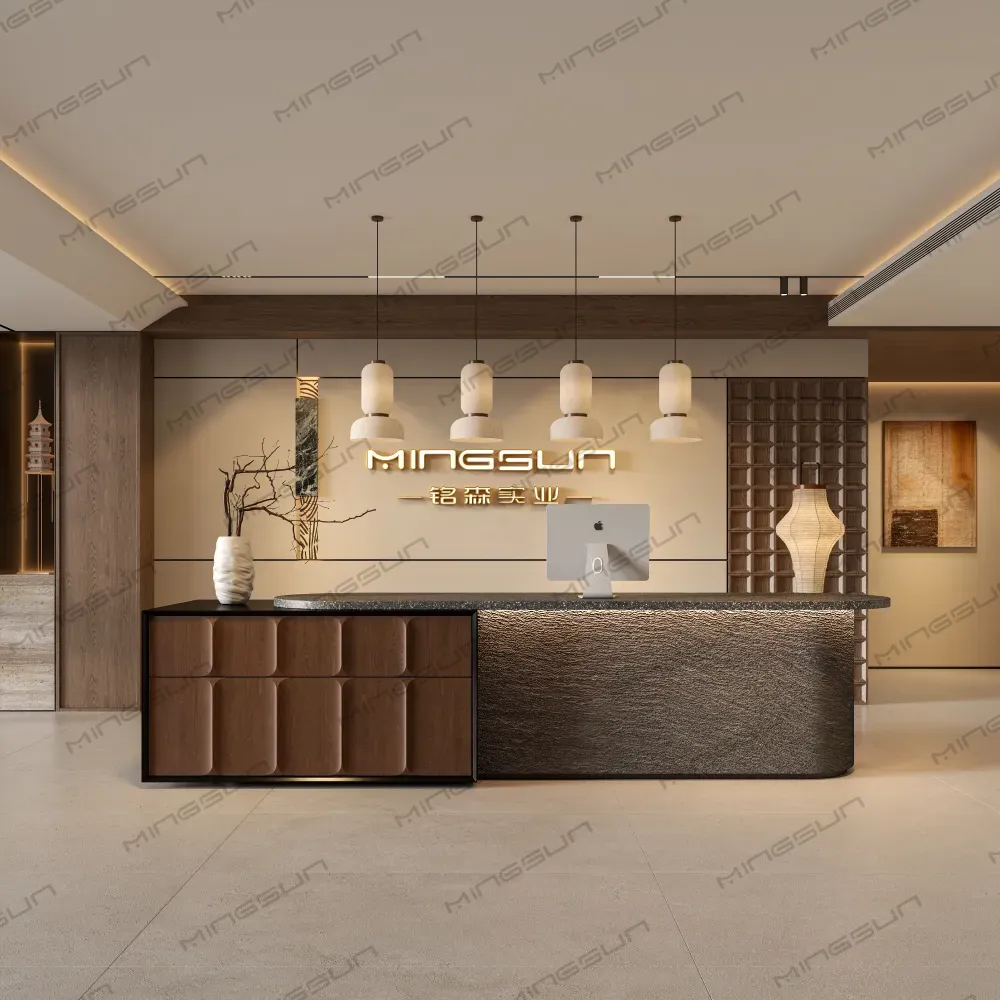
Luxury Textured Stone & Walnut Veneer Reception Desk with 3D Relief Detailing
Create a sophisticated, organic atmosphere in your hotel lobby or boutique showroom with this avant-garde reception desk. Combining the raw beauty of nature with refined craftsmanship, this desk features a striking contrast between materials. The main body showcases a dark, hammered-texture stone facade that offers a tactile, rugged elegance, topped with a polished grey terrazzo-style counter. This is seamlessly integrated with a rich walnut wood storage module, defined by its unique 3D pill-shaped relief carving on the drawer fronts. Soft, warm LED lighting concealed beneath the countertop edge highlights the textured stone surface, adding depth and warmth to the reception area.
Crafted by MINGSUN, a specialist in bespoke hospitality furniture, this piece is designed to be the focal point of high-end interiors. From our Guangzhou manufacturing hub, we deliver precision-engineered furniture to hotels worldwide. We offer a seamless experience from design customization to DDP global delivery and video-guided installation.
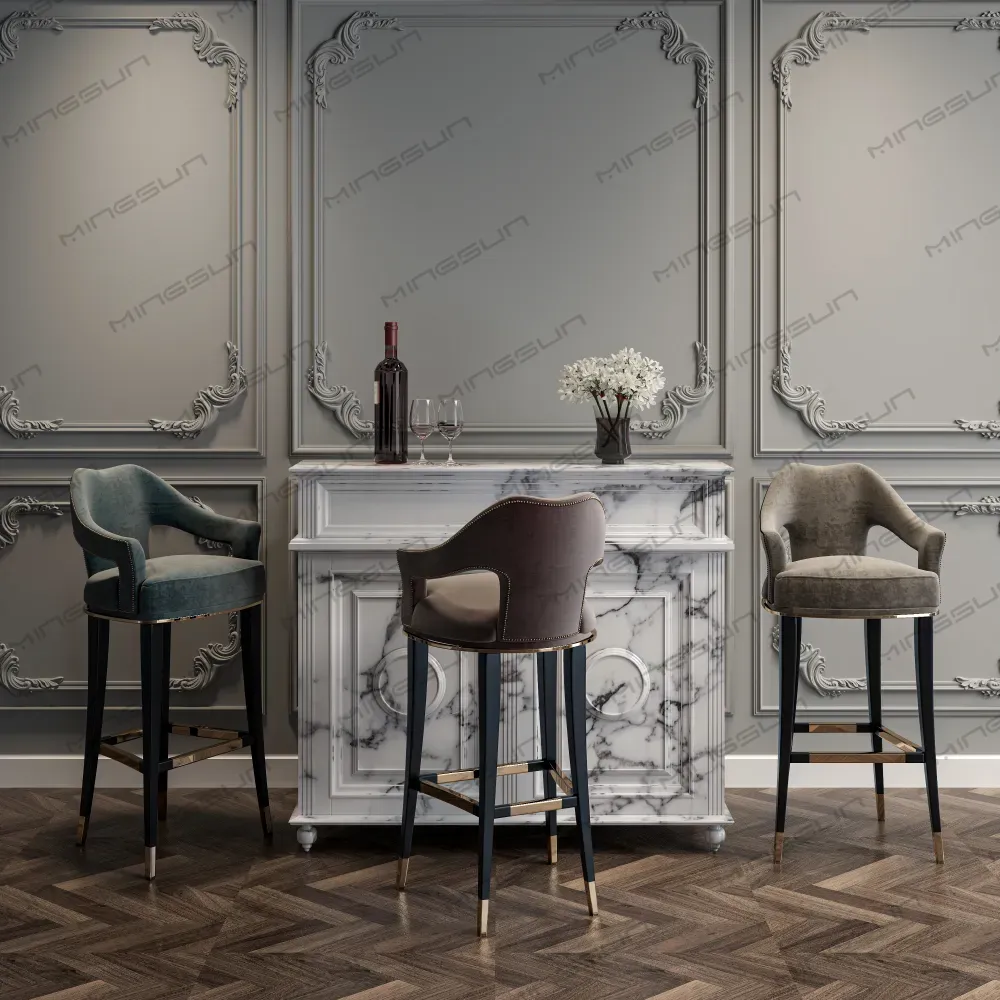
Luxury Velvet Bar Stool with Armrests & Brushed Brass Accents for Hotel Lounges and Bars
Elevate your hotel’s bar or lounge area with this opulent bar stool, where plush comfort meets sophisticated design. Upholstered in rich, deep-brown velvet, its sculptural back and integrated armrests offer ergonomic support, while the slender black metal frame is accented with polished brass at the feet and crossbars for a touch of timeless elegance. Perfect for high-end hospitality spaces, this stool combines refined aesthetics with durable construction, inviting guests to linger in style at your counter or cocktail station.
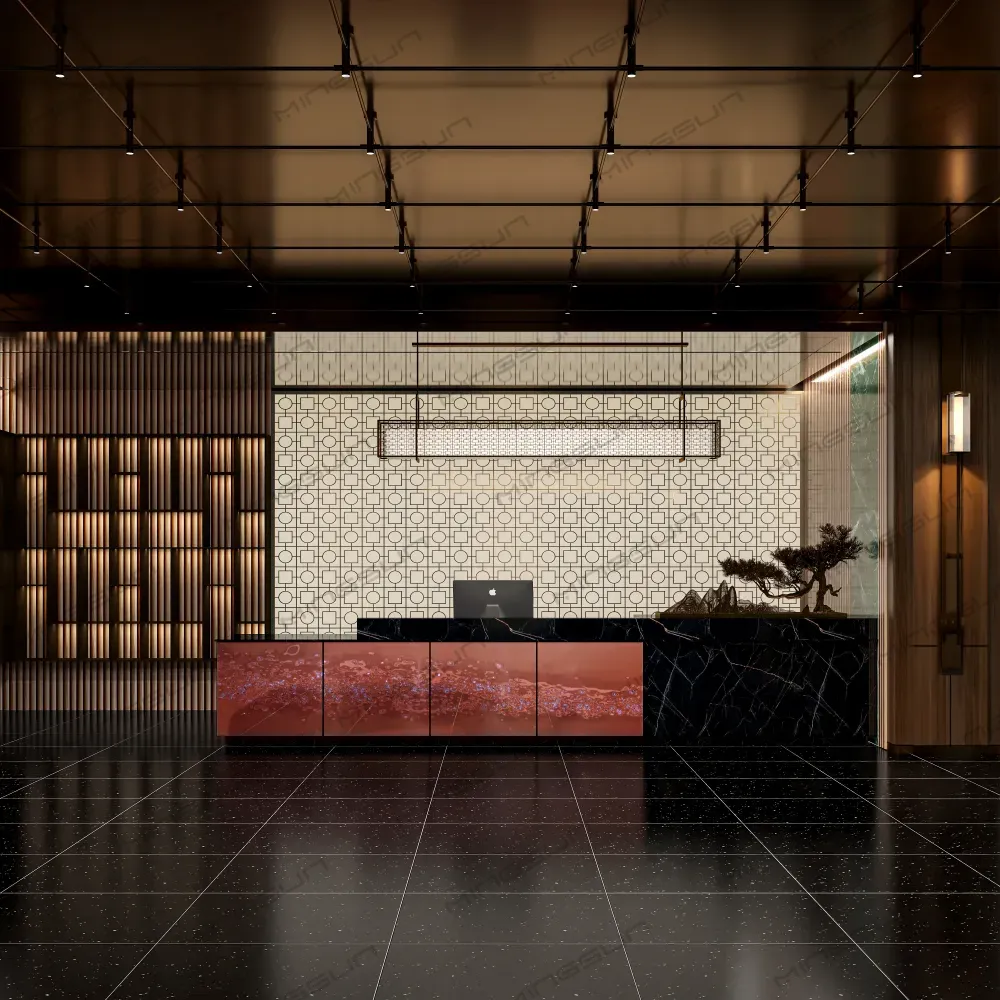
Luxury Reception Desk with Black Marble Top & Illuminated Copper-Resin Front Panels
Make a bold, unforgettable statement at your hotel’s entrance with this avant-garde reception desk. Its sleek black marble top exudes timeless sophistication, while the front facade features mesmerizing, internally lit copper-resin panels that glow with a warm, amber radiance, creating a dynamic visual centerpiece. Designed for both form and function, the unit offers ample concealed storage behind seamless doors and integrates a dedicated staff workstation with cable management. This is more than a check-in counter—it’s a sculptural installation that defines the luxury and artistry of your brand.
Get more industry insights
Looking for the right solution? Fill out the form and get a free quote.
Our experts will respond quickly with personalized options that fit your needs.
MINGSUN is a design-driven hotel furniture manufacturer offering OEM/ODM services, custom solutions, and global project support.
Built for wholesalers. Trusted by global buyers. Delivered with confidence.
Phone:
E-mail:
Follow us ——
 Scan QR Code
MINGSUN
MINGSUN
MINGSUN
MINGSUN
MS Custom Hotel Furniture Supplier