


Choosing Modular Furniture for Variable Hotel Room Sizes
- Designing Flexibility: Modular Furniture for Every Hotel Room Size
- Why hotel room size matters for furniture selection
- Core principles: modular design responses to variable hotel room size
- Space planning strategies by room-size category (integrating hotel room size into layout)
- Compact rooms (typically small guestrooms and economy hotel room size)
- Mid-size rooms (standard hotel room size for many midscale hotels)
- Large rooms and suites (High Quality hotel room size)
- Comparison: modular vs. bespoke vs. ready-made for varied hotel room size
- Specification checklist: what to require when buying modular hotel furniture
- Operational advantages: cost, delivery, and lifecycle
- Material and finish guidance for different hotel room size pressures
- Case study framework: applying modular systems across a mixed-size portfolio
- Procurement & installation best practices for modular hotel furniture
- How MINGSUN helps hotels adapt furniture to variable hotel room size
- Measuring success: KPIs to track after deploying modular furniture
- Common pitfalls and how to avoid them
- Conclusion
- Frequently Asked Questions (FAQ)
- 1. What hotel room sizes work best with modular furniture?
- 2. Will modular furniture compromise hotel aesthetics or perceived quality?
- 3. How does modular furniture affect renovation timelines?
- 4. What should I specify to ensure modular furniture is durable enough for hotels?
- 5. How do I evaluate suppliers for modular hotel furniture?
- 6. Can modular furniture help reduce environmental impact?
- Contact & Product Inquiry
- References
Designing Flexibility: Modular Furniture for Every Hotel Room Size
Why hotel room size matters for furniture selection
Hotel room size is a primary driver of guest comfort, operational efficiency, and profitability. A 20 m² economy room has very different furnishing needs than a 40 m² suite: circulation paths, storage, work areas, seating, and lighting all change with square footage. Choosing the right hotel furniture—especially modular furniture—lets owners and operators align fit, function, and cost across a portfolio with variable room sizes. In this section we outline how hotel room size affects furnishing decisions and why modular solutions are often the most practical choice.
Core principles: modular design responses to variable hotel room size
Modular furniture addresses three recurring problems created by varying hotel room size: inefficient space use, high customization costs, and slow reconfiguration when market needs change. Key design principles include:
- Scalable components: furniture broken into repeatable modules (bedsides, headboards, wardrobes, desks) that can be combined to fit different footprints.
- Fixed circulation margins: designing modules that maintain minimum clearances (e.g., 600–900 mm in front of storage/desk) so guest movement remains comfortable regardless of room size.
- Layered function: integrating storage, lighting, power and work surfaces into vertical modules to free floor area in smaller rooms.
Space planning strategies by room-size category (integrating hotel room size into layout)
Practical planning treats room types as a continuum rather than discrete boxes. Below are common approaches, with actionable tips for modular furniture specification for each hotel room size tier.
Compact rooms (typically small guestrooms and economy hotel room size)
- Prioritize vertical solutions: wall-mounted fold-away desks, headboard-integrated lighting, and compact modular wardrobes.
- Choose multifunctional pieces: ottomans with storage, bench seating with luggage racks, and modular bedside units that serve as both power hub and surface.
- Use proportionally scaled modules: narrow-depth wardrobes (450–500 mm) and floating shelves to keep clearances.
Mid-size rooms (standard hotel room size for many midscale hotels)
- Introduce flexible seating modules that can be combined into a single lounge area or split between work and leisure zones.
- Specify plug-and-play headboard modules that allow for TV, artwork or minibar modules to be added without redesign.
- Consider modular beds with attachable bedside tables to increase variety without extra SKUs.
Large rooms and suites (High Quality hotel room size)
- Use larger modular systems to create distinct zones—work, sleeping, living—while keeping modules standardized for production efficiency.
- Offer convertible modules (sofa-to-bed, extendable tables) to support longer stays and multi-guest configurations.
- Specify high-durability finishes and larger storage modules for guest convenience and longevity.
Comparison: modular vs. bespoke vs. ready-made for varied hotel room size
When selecting furniture for rooms of different sizes, hotel operators typically consider three procurement routes. The table below summarizes trade-offs relevant to project managers and purchasing teams.
| Criteria | Modular Furniture | Bespoke (Fully Custom) | Ready-made (Off-the-shelf) |
|---|---|---|---|
| Fit for variable hotel room size | High — components recombine to fit many footprints | High — tailored to exact dimensions but costly to replicate | Low — fixed dimensions limit adaptability |
| Unit cost (per piece) | Medium — savings from repeatable modules | High — custom tooling and design fees | Low — economies of scale but limited customization |
| Lead time | Medium — streamlined production for modules | Long — design approvals and custom production | Short — immediate availability but limited options |
| Lifecycle / maintenance | High — replace or upgrade single modules | Medium — bespoke parts harder to replace | Low — replacements easy but may not match brand aesthetics |
| Design consistency across room types | High — same language of modules across sizes | High — consistent if budget permits | Medium — mix-and-match often mismatched |
Specification checklist: what to require when buying modular hotel furniture
To ensure modular furniture suits different hotel room size scenarios, include these specification items in tender documents or RFQs:
- Module dimensions and tolerance matrix (clear width, depth, height limits) so modules fit corridors, elevators and rooms.
- Interconnectivity options (mechanical fixings, concealed connectors, electrical/data pass-throughs).
- Finish options with wear ratings (e.g., abrasion resistance, anti-scratch, cleanability standards like EN 12720/EN 13329 if relevant).
- Serviceability requirements: spare part lists, single-module replacement lead times, and repair protocols.
- Sustainability and material certifications (FSC, CARB phase 2, low-VOC standards) if environmental credentials matter for the brand.
Operational advantages: cost, delivery, and lifecycle
Modular furniture reduces total cost of ownership in multiple ways when room sizes vary across a portfolio. Procurement benefits include lower SKU counts, batch production efficiencies, and faster deployments. Operationally, modularity simplifies housekeeping (uniform interfaces for cleaning), enables targeted repairs, and reduces waste when a room is reconfigured or upgraded. These advantages translate to measurable savings over a 5–10 year lifecycle—especially for brands that renovate on a rolling schedule.
Material and finish guidance for different hotel room size pressures
Smaller rooms concentrate wear in high-touch zones; choose durable surfaces and finishes for touchpoints. For mid and large rooms, aesthetics become more important alongside durability. Recommended practice:
- High-use surfaces: laminate or engineered veneer with abrasion ratings; consider antimicrobial coatings where appropriate.
- Soft seating: foam density and abrasion tests (e.g., Martindale rub counts) should be specified per expected daily usage.
- Connectors & hardware: specify tested mechanical connectors that can withstand repeated reconfiguration without loosening.
Case study framework: applying modular systems across a mixed-size portfolio
Imagine a 200-room hotel portfolio with a mix of compact, standard, and suite rooms. By switching to three headboard widths (narrow, standard, wide) and two wardrobe depths, the operator can cover all room sizes while reducing unique SKUs by up to 40%. This approach lowers inventory, simplifies ordering, and reduces lead times for replacements. When implemented with a vendor who provides spare-module logistics, the hotel gains operational resilience during peak-season maintenance.
Procurement & installation best practices for modular hotel furniture
To maximize the value of modular furniture across varied hotel room size types, follow these steps:
- Prototype: build full-scale mock-ups in key room types to test ergonomics and clearances with real housekeeping and operations staff.
- Pilot: deploy in a sample of rooms (one of each size) to measure installation time, guest feedback, and maintenance issues.
- Standardize: finalize module specifications and create a master SKU list, spare parts catalog, and installation manual.
- Training & handover: ensure on-site teams understand how to reconfigure modules safely and who to contact for warranty/parts.
How MINGSUN helps hotels adapt furniture to variable hotel room size
MINGSUN is a High Quality hotel furniture manufacturer based in Guangzhou, China, providing one-stop custom solutions for the hospitality industry. We specialize in the design, production, and global delivery of high-quality furniture for hotel guest rooms, lobbies, restaurants, banquet halls, and other commercial spaces. With a 10,000 ㎡ factory and over 200 skilled workers, MINGSUN combines expert craftsmanship, High Quality materials, and strict quality control to ensure each piece is durable, functional, and refined.
Our in-house design team works closely with clients to develop tailored modular systems that reflect each project's hotel room size distribution and brand standards. Typical MINGSUN advantages for projects with variable room sizes include:
- Modular system design and prototyping — rapid mock-ups to validate ergonomics across compact to suite room sizes.
- Low-SKU strategies — reducing procurement complexity by standardizing modules that scale across room categories.
- Manufacturing capability — a 10,000 ㎡ facility and 200+ skilled workers ensure reliable production capacity and quality control.
- Customization and compliance — tailored finishes, certification support (FSC, CARB, low-VOC) and hospitality-grade durability testing.
- Global logistics and aftercare — coordinated shipping, spare-part management and post-installation support to keep rooms operational.
MINGSUN's core product lines suited to modular strategies include hotel bedroom furniture, hotel lounge furniture, hotel lobby furniture, hotel conference furniture, and hotel restaurant tables and chairs. These product families can be delivered as modular kits ready for reconfiguration, which is ideal for portfolios with mixed hotel room size demands.
Measuring success: KPIs to track after deploying modular furniture
After installation, monitor the following KPIs to measure the impact of modular furniture on operations and guest experience:
- Occupancy-adjusted refurbishment cost per room — to assess capital efficiency.
- Maintenance tickets per room per month — to evaluate durability and serviceability improvements.
- Average downtime for furniture repairs — shorter times indicate better spare-part strategy.
- Guest satisfaction scores for room comfort and functionality — to ensure modularity did not compromise experience.
Common pitfalls and how to avoid them
Avoid these typical mistakes when specifying modular furniture for variable hotel room size:
- Under-specifying connectors: choose tested mechanical connectors to prevent loosening after repeated reconfigurations.
- Neglecting mock-ups: failing to prototype can lead to poor ergonomics in real rooms, especially compact ones.
- Ignoring operations input: include housekeeping, maintenance and F&B teams early to ensure modules meet turnover and cleaning needs.
- Overlooking spare parts: ensure a documented spare parts program and acceptable lead times are contractually defined.
Conclusion
Selecting modular furniture with an informed focus on hotel room size transforms a common portfolio challenge into a strategic advantage. Modularity reduces complexity, accelerates refurbishments, and supports operational resilience while preserving brand consistency across room types. By specifying robust connectors, verified finishes, and clear spare-part logistics—preferably with a full-service partner like MINGSUN—hotels can achieve flexible, cost-effective interiors that scale with market changes.
Frequently Asked Questions (FAQ)
1. What hotel room sizes work best with modular furniture?
Modular furniture works across all hotel room sizes. It is particularly beneficial in portfolios with mixed sizes because modules can be recombined to fit compact rooms, mid-size rooms, and suites with minimal new tooling or SKUs.
2. Will modular furniture compromise hotel aesthetics or perceived quality?
No — modern modular systems are designed for high-end aesthetics and hospitality-grade finishes. Good modular design retains consistent brand language while allowing different configurations for varied hotel room size requirements.
3. How does modular furniture affect renovation timelines?
Renovation timelines typically shorten because modules are produced in batches and installation is faster than bespoke joinery. Also, single-module replacements reduce room downtime for maintenance.
4. What should I specify to ensure modular furniture is durable enough for hotels?
Specify hospitality-grade materials (high-density core panels, abrasion-resistant finishes), test protocols (abrasion, load and connector fatigue), and clearly documented spare parts and maintenance plans.
5. How do I evaluate suppliers for modular hotel furniture?
Evaluate suppliers based on factory capacity, quality assurance (QA) systems, experience with hospitality projects, prototyping capability, logistics support, and post-installation service. Ask for case studies that show solutions across varying hotel room sizes.
6. Can modular furniture help reduce environmental impact?
Yes. Modular strategies often reduce waste by replacing single modules rather than whole units, use standardized production runs to minimize offcuts, and can incorporate certified sustainable materials (FSC wood, low-VOC finishes).
Contact & Product Inquiry
If you are planning a refurbishment or new hotel project and want modular solutions optimized for your hotel room size distribution, contact MINGSUN for a consultation and sample prototyping. View our hotel bedroom furniture, hotel lounge furniture, hotel lobby furniture, hotel conference furniture, and hotel restaurant tables and chairs, and request a tailored modular strategy to fit MINGSUN, budget and schedule.
References
- “Modular furniture,” Wikipedia. https://en.wikipedia.org/wiki/Modular_furniture (accessed 2025-12-23).
- “Hotel room,” Wikipedia. https://en.wikipedia.org/wiki/Hotel_room (accessed 2025-12-23).
- American Hotel & Lodging Association (AHLA) — industry guidance and resources. https://www.ahla.com (accessed 2025-12-23).
- Hospitality Design and operations articles on modular hospitality interiors. Example resources: Hospitality Design (https://www.hospitalitydesign.com) and Hospitality Net (https://www.hospitalitynet.org) (accessed 2025-12-23).
- International standards and certifications pages related to furniture materials and formaldehyde emission standards (FSC, CARB). FSC: https://fsc.org (accessed 2025-12-23). CARB: https://ww2.arb.ca.gov/ (accessed 2025-12-23).
Cost Breakdown: Installing Hotel Furniture in Singapore
Budget-Friendly Hotel Lobby Furniture Options
Space-Saving Hotel Bar Furniture for Small Properties
Custom vs. modular hospitality furniture pros
Pricing, Payment & Packaging
What payment terms do you offer?
How is packaging handled to ensure transportation safety?
About Mingsun – Company Background
Does Mingsun have experience with overseas projects?
Materials, Craftsmanship & Quality Control
What materials are commonly used for hotel furniture?
Product Scope & Application Areas
Do you provide samples?
Make an appointment with us today
Modern Hotel Dining Furniture Set-Custom Designed Wooden Tables, Upholstered Chairs & Banquette Seating
Create a lasting impression with our custom-designed hotel dining furniture set, crafted for modern luxury hotels and upscale restaurants.
Featuring elegant wooden tables, ergonomic blue-upholstered chairs, and built-in banquette seating, this collection blends comfort, style, and durability.
As a leading manufacturer in Guangzhou, we deliver end-to-end solutions - from concept design and 3D visualization to production and global shipping - all at factory-direct prices.
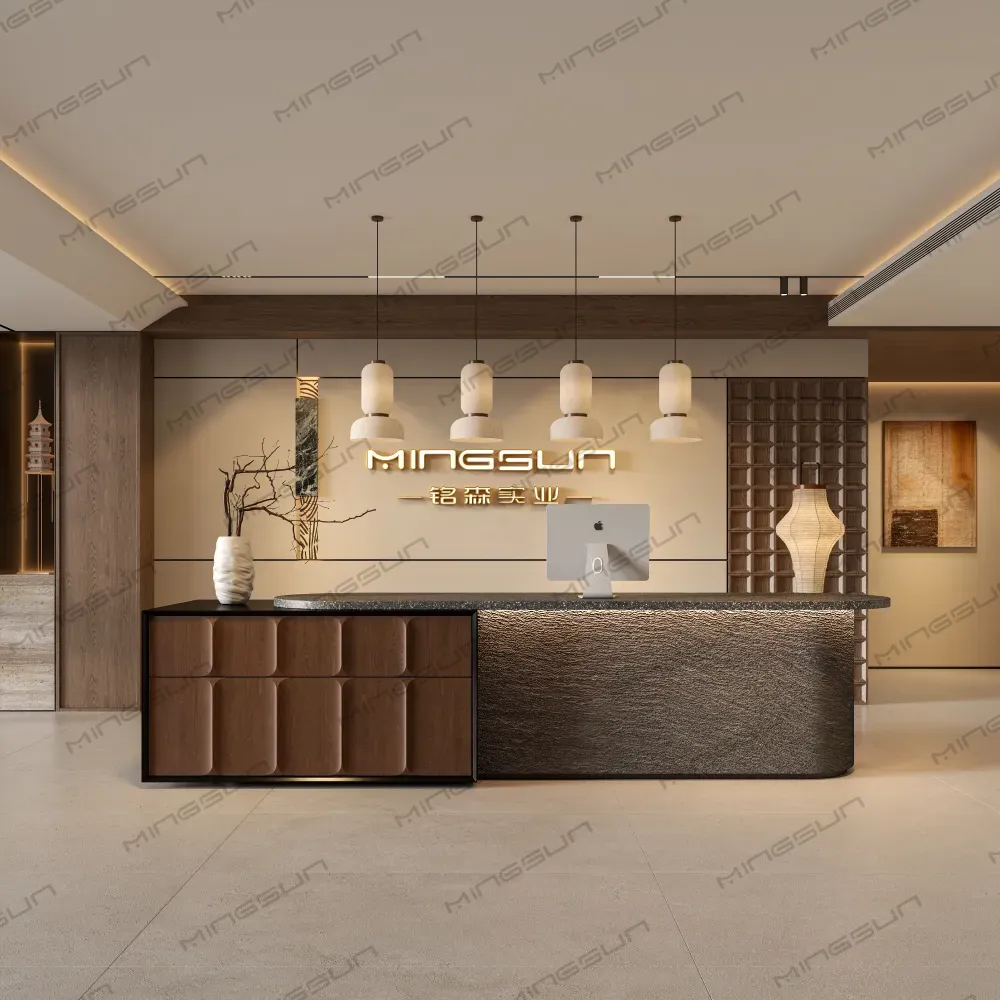
Luxury Textured Stone & Walnut Veneer Reception Desk with 3D Relief Detailing
Create a sophisticated, organic atmosphere in your hotel lobby or boutique showroom with this avant-garde reception desk. Combining the raw beauty of nature with refined craftsmanship, this desk features a striking contrast between materials. The main body showcases a dark, hammered-texture stone facade that offers a tactile, rugged elegance, topped with a polished grey terrazzo-style counter. This is seamlessly integrated with a rich walnut wood storage module, defined by its unique 3D pill-shaped relief carving on the drawer fronts. Soft, warm LED lighting concealed beneath the countertop edge highlights the textured stone surface, adding depth and warmth to the reception area.
Crafted by MINGSUN, a specialist in bespoke hospitality furniture, this piece is designed to be the focal point of high-end interiors. From our Guangzhou manufacturing hub, we deliver precision-engineered furniture to hotels worldwide. We offer a seamless experience from design customization to DDP global delivery and video-guided installation.
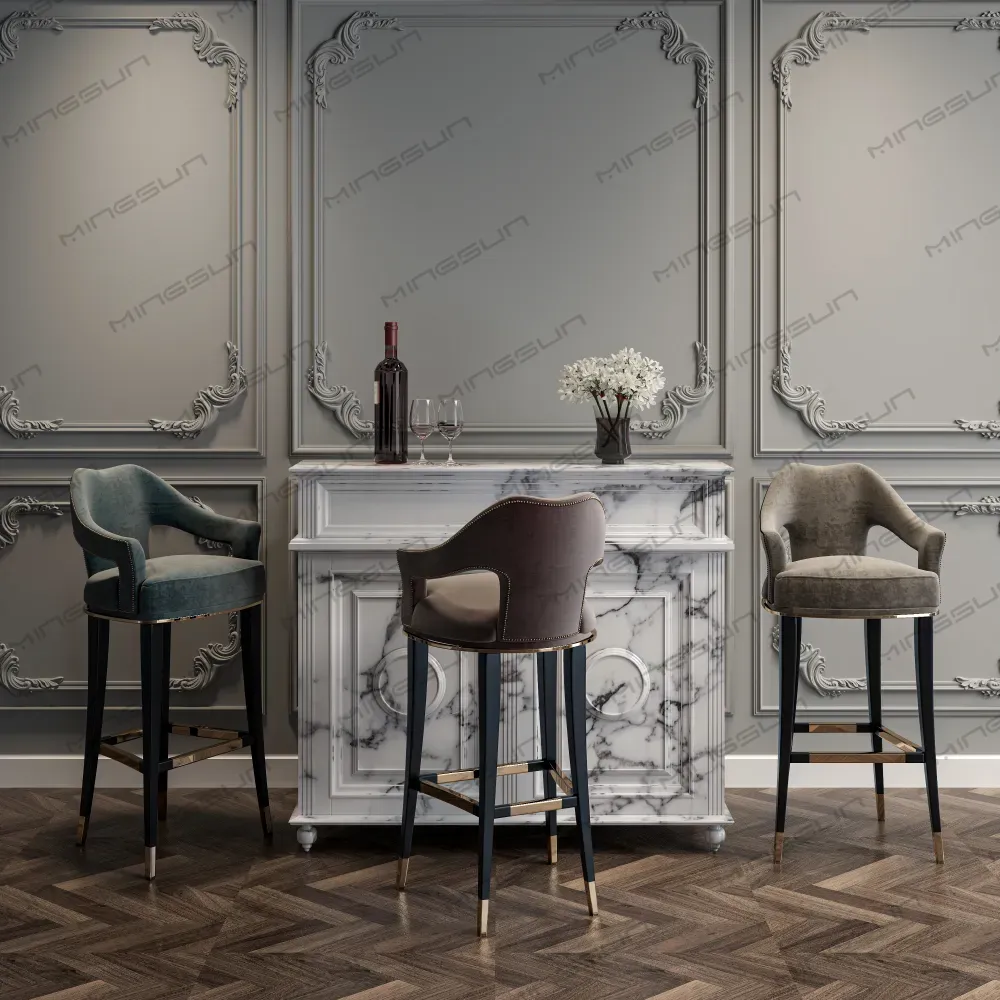
Luxury Velvet Bar Stool with Armrests & Brushed Brass Accents for Hotel Lounges and Bars
Elevate your hotel’s bar or lounge area with this opulent bar stool, where plush comfort meets sophisticated design. Upholstered in rich, deep-brown velvet, its sculptural back and integrated armrests offer ergonomic support, while the slender black metal frame is accented with polished brass at the feet and crossbars for a touch of timeless elegance. Perfect for high-end hospitality spaces, this stool combines refined aesthetics with durable construction, inviting guests to linger in style at your counter or cocktail station.
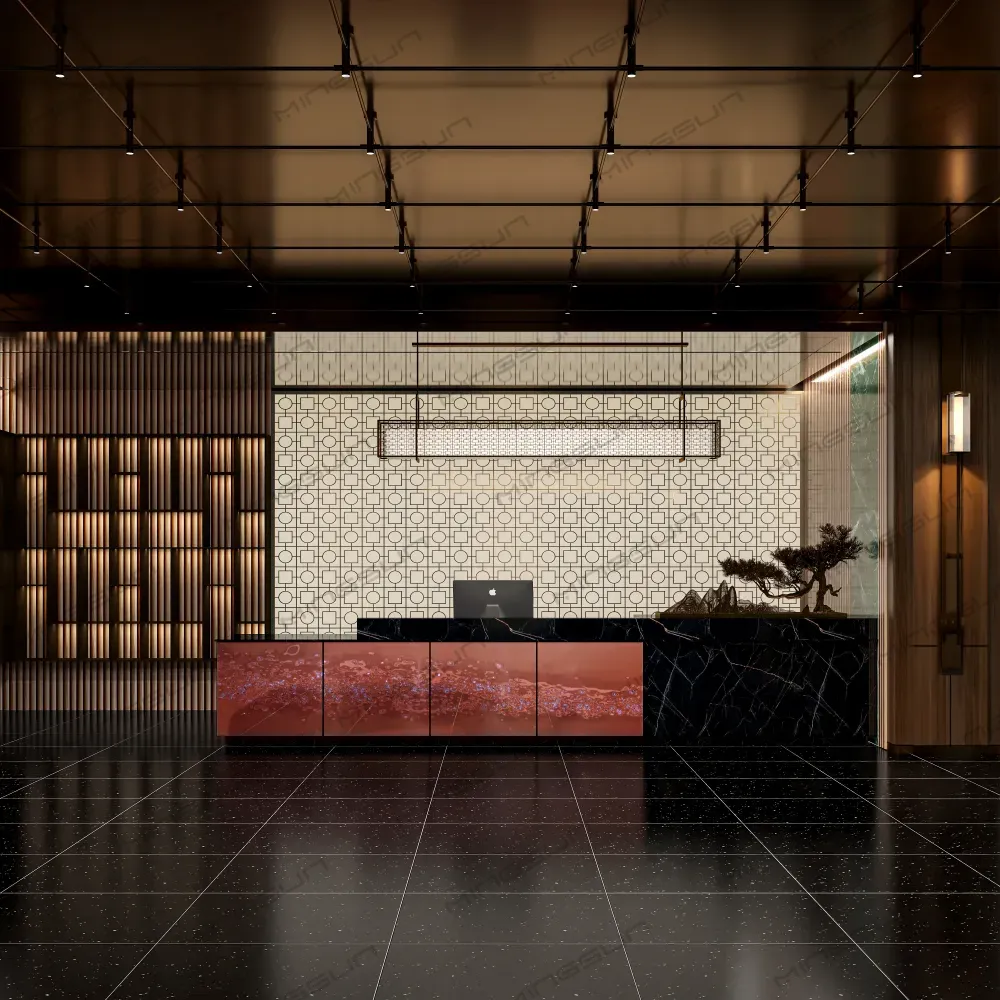
Luxury Reception Desk with Black Marble Top & Illuminated Copper-Resin Front Panels
Make a bold, unforgettable statement at your hotel’s entrance with this avant-garde reception desk. Its sleek black marble top exudes timeless sophistication, while the front facade features mesmerizing, internally lit copper-resin panels that glow with a warm, amber radiance, creating a dynamic visual centerpiece. Designed for both form and function, the unit offers ample concealed storage behind seamless doors and integrates a dedicated staff workstation with cable management. This is more than a check-in counter—it’s a sculptural installation that defines the luxury and artistry of your brand.
Get more industry insights
Looking for the right solution? Fill out the form and get a free quote.
Our experts will respond quickly with personalized options that fit your needs.
MINGSUN is a design-driven hotel furniture manufacturer offering OEM/ODM services, custom solutions, and global project support.
Built for wholesalers. Trusted by global buyers. Delivered with confidence.
Phone:
E-mail:
Follow us ——
 Scan QR Code
MINGSUN
MINGSUN
MINGSUN
MINGSUN
MS Custom Hotel Furniture Supplier