


How to Choose Materials for Custom Hotel Furniture
- How to Choose Materials for Custom Hotel Furniture
- Why material choice matters for custom hotel furniture
- Understand project requirements and guest profile
- Match materials to hotel segment and guest expectations
- Wood choices and engineered wood options
- Solid wood, veneer, plywood and MDF — where to use each
- Metal selection for frames and accents
- Steel, stainless steel and aluminum — pick by strength and environment
- Upholstery fabrics and leather options
- Durability, cleanability and aesthetics for hospitality fabrics
- Foam, springs and seat construction
- Comfort that holds up: foam density and spring systems
- Finishes and surface protection
- Lacquers, UV-cured and waterborne coatings for durability and look
- Sustainability and indoor air quality
- Certifications and low-emission materials build guest trust
- Cost vs. lifecycle: balancing budget and total cost of ownership
- Invest wisely: higher upfront cost can reduce maintenance and replacement costs
- Maintenance, cleaning and repairability
- Design for maintainability to keep furniture looking new longer
- Compliance, safety and local regulations
- Ensure furniture meets fire, safety and accessibility requirements
- Material recommendations by space (comparison)
- Quick reference: best material choices for common hotel areas
- Working with a manufacturer — questions to ask
- Due diligence when sourcing custom hotel furniture
- Case example: integrating design and material selection
- How coordinated choices deliver better outcomes
- About MINGSUN: your partner for custom hotel furniture
- Why choose MINGSUN for custom hotel furniture solutions
- FAQ
- What materials are best for high-traffic hotel lobbies?
- How do I ensure fabrics meet hygiene and cleaning needs?
- Are sustainable materials more expensive?
- How important is test documentation?
- Can MINGSUN provide samples and prototypes?
- How should I balance cost and longevity?
How to Choose Materials for Custom Hotel Furniture
Why material choice matters for custom hotel furniture
Choosing the right materials for custom hotel furniture affects durability, guest comfort, maintenance cost, safety compliance, and the overall look and lifecycle cost of the asset. For hospitality projects, materials must balance aesthetics with heavy daily use, cleaning procedures, and local fire and safety rules. Using the right materials from the start reduces total cost of ownership and improves guest satisfaction.
Understand project requirements and guest profile
Match materials to hotel segment and guest expectations
Before selecting materials, define the hotel category (economy, mid-scale, upscale, luxury) and guest behaviors. Economy properties prioritize cost and ease of maintenance; luxury properties emphasize High Quality veneers, leather, and bespoke finishes. Consider local climate (humidity, coastal salt air), cleaning routines, turnover rate, and intended lifespan. These factors will guide choices for frames, finishes, and upholstery.
Wood choices and engineered wood options
Solid wood, veneer, plywood and MDF — where to use each
Solid hardwoods (oak, maple, walnut, teak) offer longevity and can be refinished, making them suitable for high-end furniture and visible joinery. Veneers applied to engineered substrates (plywood, MDF) give a High Quality look at lower cost and greater dimensional stability. Plywood is stronger and more moisture-resistant than MDF, so use plywood for structural parts and MDF for painted or machined components. Always specify low-formaldehyde or E0/E1-grade panels where indoor air quality is a concern.
Metal selection for frames and accents
Steel, stainless steel and aluminum — pick by strength and environment
Metal frames deliver excellent strength for public areas. Cold-rolled steel is economical and strong; stainless steel (grade 304) is corrosion-resistant and widely used indoors, while grade 316 is recommended for coastal or high-corrosion environments. Aluminum is lightweight and corrosion-resistant but may require thicker sections for equivalent strength. Finishes such as powder coating or brushed chrome add protection and style.
Upholstery fabrics and leather options
Durability, cleanability and aesthetics for hospitality fabrics
Choose upholstery tested for heavy commercial use. For woven fabrics, look for abrasion resistance measured in double rubs — hospitality seats commonly require 30,000+ double rubs (Wyzenbeek or Martindale) depending on use. Synthetic blends (polyester, acrylic) offer excellent stain resistance and colorfastness; treated natural blends and performance textiles can combine comfort with cleanability. Genuine leather provides High Quality feel and longevity but needs proper maintenance; high-quality faux leather and coated fabrics can mimic the look while improving stain resistance and cost-control.
Foam, springs and seat construction
Comfort that holds up: foam density and spring systems
Seat comfort and resilience come from a combination of foam density, foam type, and suspension. High-resilience (HR) foam with densities typically in the 35–50 kg/m³ range performs well in hospitality seating; higher density yields longer-lasting support. Pocket springs or sinuous spring systems in combination with HR foam extend comfort and life. For public seating you may also require fire-retardant foam formulations that comply with local regulations.
Finishes and surface protection
Lacquers, UV-cured and waterborne coatings for durability and look
Choose surface finishes for abrasion resistance, chemical resistance (cleaning agents), and aesthetic longevity. UV-cured and catalyzed lacquers deliver hard, durable surfaces for high-use areas. Waterborne polyurethane finishes offer lower VOCs and good performance. For tabletops and high-traffic surfaces, consider additional protective layers (anti-scratch, anti-stain treatments) and edge sealing to prevent moisture ingress.
Sustainability and indoor air quality
Certifications and low-emission materials build guest trust
Sustainable sourcing can be a differentiator. Look for certified wood (FSC), low-VOC finishes and adhesives, and panels that meet E1/E0 or similar formaldehyde emission classes. Recyclability, reclaimed wood options, and materials with transparent supply chains help hotels meet ESG goals. Ensure any sustainability claims are backed by certificates or supplier documentation.
Cost vs. lifecycle: balancing budget and total cost of ownership
Invest wisely: higher upfront cost can reduce maintenance and replacement costs
Assess total cost of ownership rather than purchase price alone. A higher quality frame or upholstery that doubles the service life may be more cost-effective when factoring labor, downtime, and guest satisfaction. Create scenarios comparing initial cost, expected lifespan, and maintenance needs to inform decisions for each furniture type.
Maintenance, cleaning and repairability
Design for maintainability to keep furniture looking new longer
Select materials that align with the property's cleaning protocols. Stain-resistant fabrics, replaceable seat cushions, modular components, easily refinished veneers, and standardized hardware reduce downtime and repair cost. Provide clear cleaning instructions for housekeeping and specify compatible cleaning agents in procurement documents.
Compliance, safety and local regulations
Ensure furniture meets fire, safety and accessibility requirements
All custom hotel furniture must comply with local fire safety and building codes. Verify requirements for upholstered furniture, flame retardancy of materials, and accessibility standards that affect dimensions and clearances. Work with manufacturers who can provide test reports and certificates to demonstrate compliance during inspections and insurance review.
Material recommendations by space (comparison)
Quick reference: best material choices for common hotel areas
Below is a concise comparison of recommended materials and reasons for typical hotel spaces. Use this table to match material performance to functional needs.
| Space | Recommended Materials | Why |
|---|---|---|
| Guest Room | Engineered plywood frames, veneer finishes, HR foam (35–50 kg/m³), performance upholstery (30,000+ double rubs), stainless/brass accents | Comfort, durability, ease of cleaning, refined appearance |
| Lobby & Public Areas | Solid hardwoods or high-quality veneers, stainless or powder-coated steel frames, heavy-duty upholstery (50,000+ double rubs), robust finishes | High traffic and visibility require maximum durability and High Quality finishes |
| Restaurant | Stain-resistant coated fabrics or leather, sealed tabletops (UV/PU), welded steel or solid wood frames | Frequent spills, abrasion, and hygiene considerations |
| Banquet & Conference | Stackable metal frames, commercial-grade fabrics, replaceable cushioning | Flexibility, heavy usage, easy storage and maintenance |
Working with a manufacturer — questions to ask
Due diligence when sourcing custom hotel furniture
Ask potential manufacturers for material samples, test reports (abrasion, flammability, moisture resistance), production photos, and warranty terms. Confirm in-house capabilities: design, prototyping, quality control, and global logistics. Request references for similar hotel projects and ask for lead times and MOQ details to ensure the supplier fits your schedule and quality expectations.
Case example: integrating design and material selection
How coordinated choices deliver better outcomes
A coordinated workflow—designer, procurement, and manufacturer—ensures materials chosen support the intended look and durability. For example, pairing a mid-tone veneer with performance upholstery and sealed edges reduces visible wear and simplifies maintenance while achieving a High Quality aesthetic. Early collaboration avoids costly changes and shortens lead time.
About MINGSUN: your partner for custom hotel furniture
Why choose MINGSUN for custom hotel furniture solutions
MINGSUN is a High Quality hotel furniture manufacturer based in Guangzhou, China, offering one-stop custom solutions. With a 10,000 ㎡ factory and over 200 skilled workers, we combine craftsmanship, High Quality materials, and strict quality control. Our in-house design team works closely with clients to develop tailored solutions for guest rooms, lobbies, restaurants, and banquet halls. We provide material samples, prototyping, test documentation, and global delivery to ensure each project meets design intent and performance expectations.
FAQ
What materials are best for high-traffic hotel lobbies?
Choose solid or high-quality veneer woods, stainless or powder-coated steel frames, heavy-duty upholstery rated for high double rub counts, and durable finishes such as UV-cured lacquers. These choices balance appearance with required abrasion and stain resistance.
How do I ensure fabrics meet hygiene and cleaning needs?
Specify performance fabrics that resist stains and can tolerate approved cleaning agents. Request cleaning instructions from the supplier and choose fabrics with proven abrasion and colorfastness ratings. Consider antimicrobial treatments where appropriate, verified by test reports.
Are sustainable materials more expensive?
Sustainability can increase initial cost, but certified materials and low-emission panels often deliver long-term benefits through better indoor air quality, potential marketing value, and sometimes longer service life. Evaluate total lifecycle cost rather than upfront price alone.
How important is test documentation?
Test reports for flammability, abrasion, formaldehyde emissions, and structural strength are essential for regulatory compliance, insurance, and quality assurance. Always request certificates and lab reports before final approval.
Can MINGSUN provide samples and prototypes?
Yes. MINGSUN offers material samples, prototypes, and mock-ups so clients can evaluate look, feel, and performance before production. Contact the MINGSUN design team early in the project to streamline decisions and timelines.
How should I balance cost and longevity?
Prioritize durability in high-use areas and consider mid-range options for lower-impact zones. Use modular designs and replaceable cushions to extend life. A cost-vs-lifespan analysis helps determine when higher initial investment is justified.
Modular lounge sofas for flexible hotel layouts
Modern Hospitality Furniture Trends to Watch in 2025
Comparing Wood, Metal and Laminate Coffee Bar Cabinets
Furniture Layouts That Increase Occupancy Rates
Product Scope & Application Areas
Can you provide a full hotel furniture package?
After-Sales Service & Long-Term Cooperation
Is long-term cooperation or repeat ordering supported?
What types of clients is Mingsun best suited for?
Pricing, Payment & Packaging
What payment terms do you offer?
Customization Capability & Design Support
Does Mingsun support customized hotel furniture?
Make an appointment with us today
Modern Hotel Dining Furniture Set-Custom Designed Wooden Tables, Upholstered Chairs & Banquette Seating
Create a lasting impression with our custom-designed hotel dining furniture set, crafted for modern luxury hotels and upscale restaurants.
Featuring elegant wooden tables, ergonomic blue-upholstered chairs, and built-in banquette seating, this collection blends comfort, style, and durability.
As a leading manufacturer in Guangzhou, we deliver end-to-end solutions - from concept design and 3D visualization to production and global shipping - all at factory-direct prices.
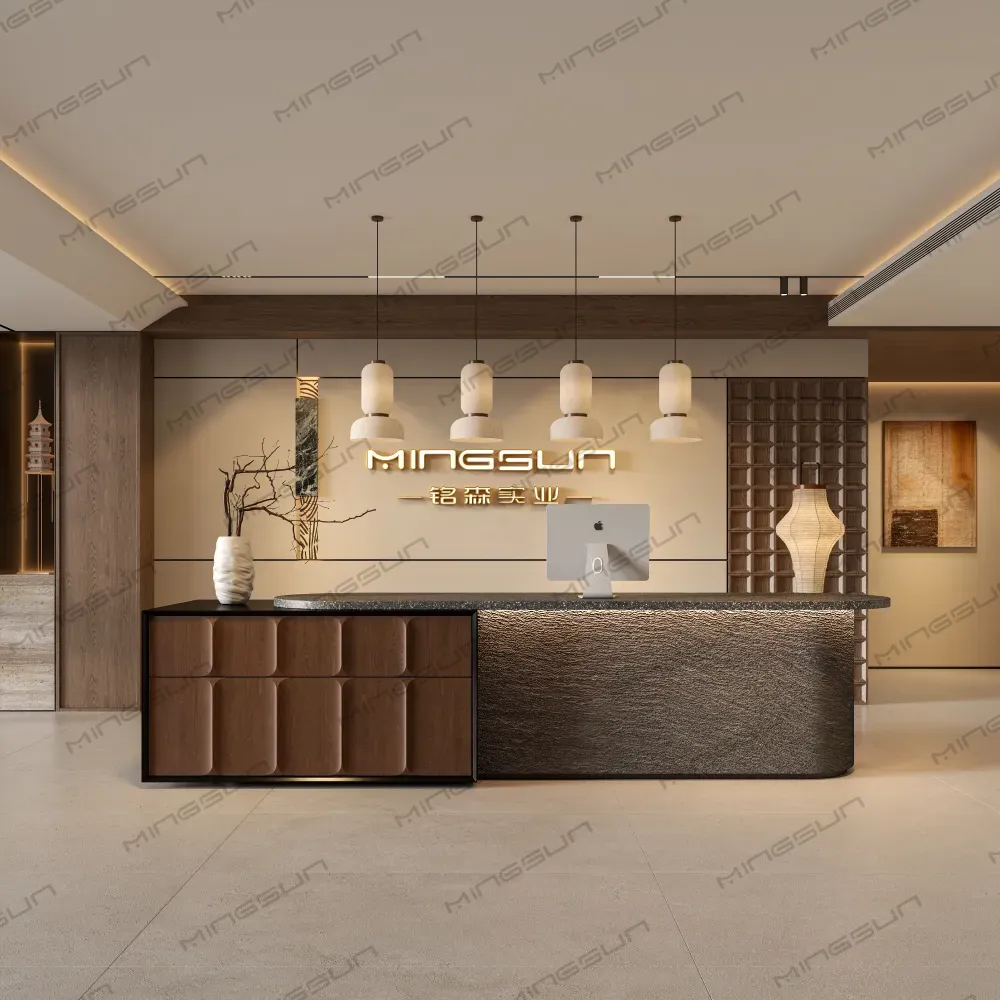
Luxury Textured Stone & Walnut Veneer Reception Desk with 3D Relief Detailing
Create a sophisticated, organic atmosphere in your hotel lobby or boutique showroom with this avant-garde reception desk. Combining the raw beauty of nature with refined craftsmanship, this desk features a striking contrast between materials. The main body showcases a dark, hammered-texture stone facade that offers a tactile, rugged elegance, topped with a polished grey terrazzo-style counter. This is seamlessly integrated with a rich walnut wood storage module, defined by its unique 3D pill-shaped relief carving on the drawer fronts. Soft, warm LED lighting concealed beneath the countertop edge highlights the textured stone surface, adding depth and warmth to the reception area.
Crafted by MINGSUN, a specialist in bespoke hospitality furniture, this piece is designed to be the focal point of high-end interiors. From our Guangzhou manufacturing hub, we deliver precision-engineered furniture to hotels worldwide. We offer a seamless experience from design customization to DDP global delivery and video-guided installation.
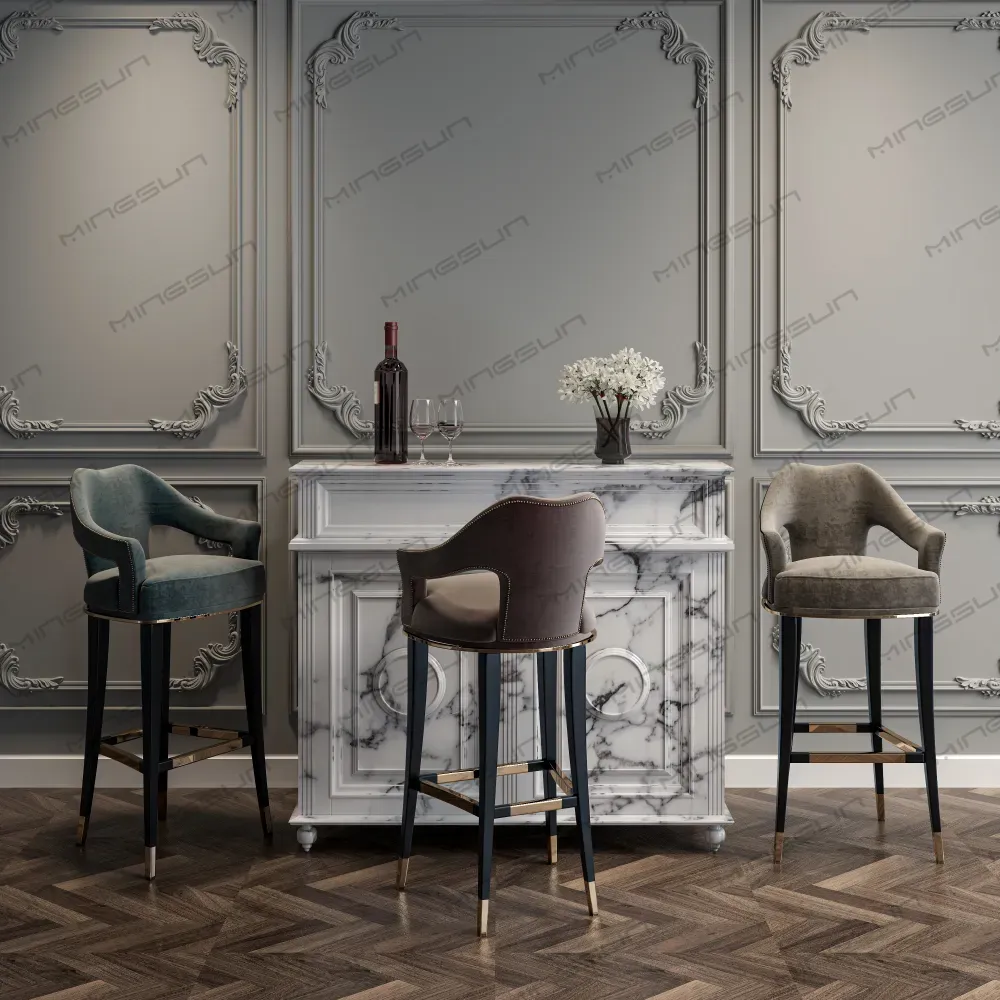
Luxury Velvet Bar Stool with Armrests & Brushed Brass Accents for Hotel Lounges and Bars
Elevate your hotel’s bar or lounge area with this opulent bar stool, where plush comfort meets sophisticated design. Upholstered in rich, deep-brown velvet, its sculptural back and integrated armrests offer ergonomic support, while the slender black metal frame is accented with polished brass at the feet and crossbars for a touch of timeless elegance. Perfect for high-end hospitality spaces, this stool combines refined aesthetics with durable construction, inviting guests to linger in style at your counter or cocktail station.
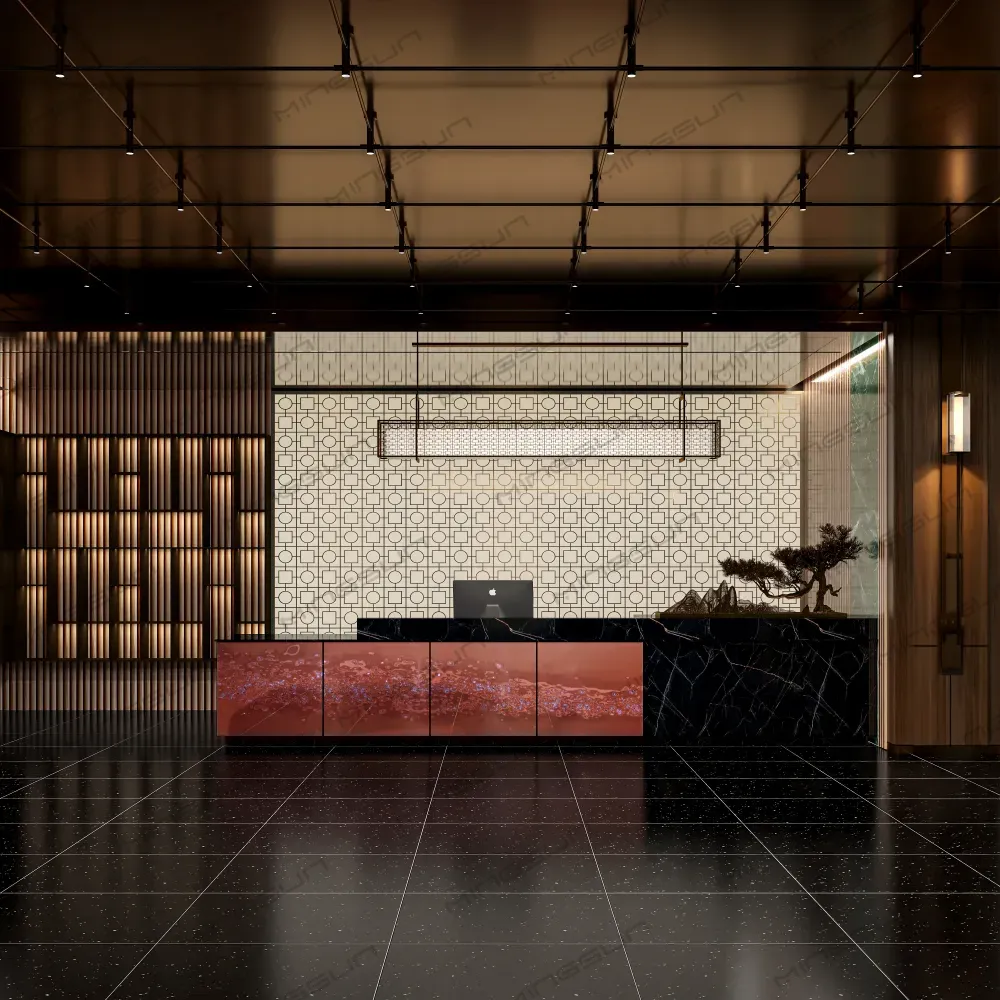
Luxury Reception Desk with Black Marble Top & Illuminated Copper-Resin Front Panels
Make a bold, unforgettable statement at your hotel’s entrance with this avant-garde reception desk. Its sleek black marble top exudes timeless sophistication, while the front facade features mesmerizing, internally lit copper-resin panels that glow with a warm, amber radiance, creating a dynamic visual centerpiece. Designed for both form and function, the unit offers ample concealed storage behind seamless doors and integrates a dedicated staff workstation with cable management. This is more than a check-in counter—it’s a sculptural installation that defines the luxury and artistry of your brand.
Get more industry insights
Looking for the right solution? Fill out the form and get a free quote.
Our experts will respond quickly with personalized options that fit your needs.
MINGSUN is a design-driven hotel furniture manufacturer offering OEM/ODM services, custom solutions, and global project support.
Built for wholesalers. Trusted by global buyers. Delivered with confidence.
Phone:
E-mail:
Follow us ——
 Scan QR Code
MINGSUN
MINGSUN
MINGSUN
MINGSUN
MS Custom Hotel Furniture Supplier